Clint Dyer's Blistering Revival Reimagines Classic with Powerful Racial Commentary
From his searing take on Othello at the National Theatre to his superlative Death of England cycle, Clint Dyer has firmly established himself as one of the most distinctive and vital voices in contemporary British theatre. His work consistently explores and unpacks complex aspects of black culture with remarkable deftness and insight. Therefore, it comes as little surprise that his latest production—a revival of Ken Kesey's seminal work One Flew Over the Cuckoo's Nest at the Old Vic—transposes the story's patients to African American characters. This is far more than a simple conceptual 'what if' scenario; it stands as a depressingly accurate and powerful portrayal of the United States' incarceration and psychiatric systems, where statistics reveal nearly 70 percent of prison inmates and over half of psychiatric in-patients are not white.
A Sympathetic Yet Incisive Adaptation
Beyond the significant racial recasting, Dyer's adaptation remains remarkably sympathetic to the original material, meticulously preserving the 1950s setting. This attention to period detail is evident in everything from the orderlies' bow-ties to the nurses' crisp little caps. Dyer has stated his intention was to adapt Kesey's novel rather than Miloš Forman's iconic 1975 film. However, the resulting play feels like a sophisticated blend of both sources. The narrative perspective stays predominantly with Randle P. McMurphy, unlike the novel which is filtered through the eyes of the apparently deaf-mute Chief Bromden. Yet, Dyer incorporates the source material's surreal dream and psychosis sequences, where Bromden hallucinates feverish visions of his father—a Native American chief swindled out of his ancestral land who ultimately drank himself to death.
These visionary sequences unfold against a backdrop of strobing lights and projected montages of blinking eyes and scorched earth. While visually ambitious, these elements occasionally feel like the weakest parts of an otherwise blisteringly effective production. Some audience members might also find the opening scene's mardi gras dancers, who cavort across the stage, somewhat puzzling. Nonetheless, these are minor quibbles in a production of such overwhelming power.
Inspired Casting and Exceptional Performances
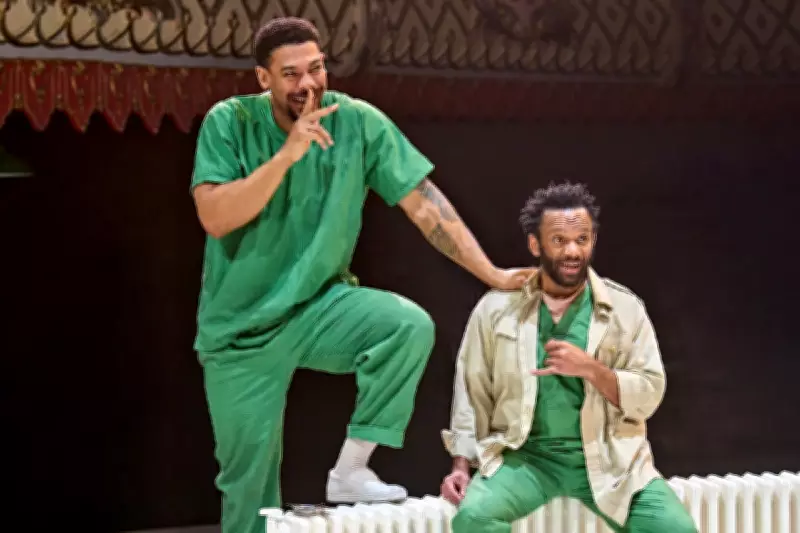
The casting of the hulking Aaron Pierre as McMurphy is nothing short of inspired. Pierre delivers a performance that is more inherently likeable than Jack Nicholson's iconic film portrayal and perhaps more overtly suggestive of mental illness. He brings a punchy, confrontational energy to the asylum environment, yet his struggle to function within its rigid confines is palpable—visible in every tensed muscle and rapid eye blink as he tries to endure the system's frequent psychological blows.
The acting excellence extends brilliantly throughout the entire ensemble. Kedar Williams-Stirling is exceptional in his portrayal of the fragile, stuttering Billy Bibbit, masterfully conveying profound longing and vulnerability. Jason Pennycooke is utterly believable as Martini, embodying the character with a chaotic energy and physical ticks that feel entirely authentic. A slight suspension of disbelief is required for Arthur Boan's portrayal of Chief Bromden; while standing at 6'4", he is not quite the physical match for Pierre, who appears capable of lifting the set's electrical power bank (a modern replacement for the film's water fountain) in a single bicep curl.
Then there is Olivia Williams' chilling performance as the dreaded Nurse Ratched. She masterfully drip-feeds her character's transformation from a strict, controlling matriarch into a full-blown figurehead for institutional malice and spite. The performances collectively create a dynamic, almost manic energy on stage, playing off each other with such intensity that moments of true stillness become rare and charged.
The Perils and Triumphs of Adapting Beloved Texts
Adapting such a beloved and well-known text is always a fraught endeavor. When executed successfully—as seen in Sean Foley's brilliant stage version of Dr. Strangelove—the potent combination of nostalgia and creative reinvention can be exhilarating. However, missteps—such as certain recent high-profile theatrical failures—are judged not only on their own lack of merit but also against the immense weight of historical and cultural legacy. Clint Dyer's revival of One Flew Over the Cuckoo's Nest at the Old Vic falls firmly and triumphantly into the first category. It is a blistering, relevant, and masterfully performed production that recontextualizes a classic story for a contemporary audience, forcing a searing examination of race, power, and institutional failure.