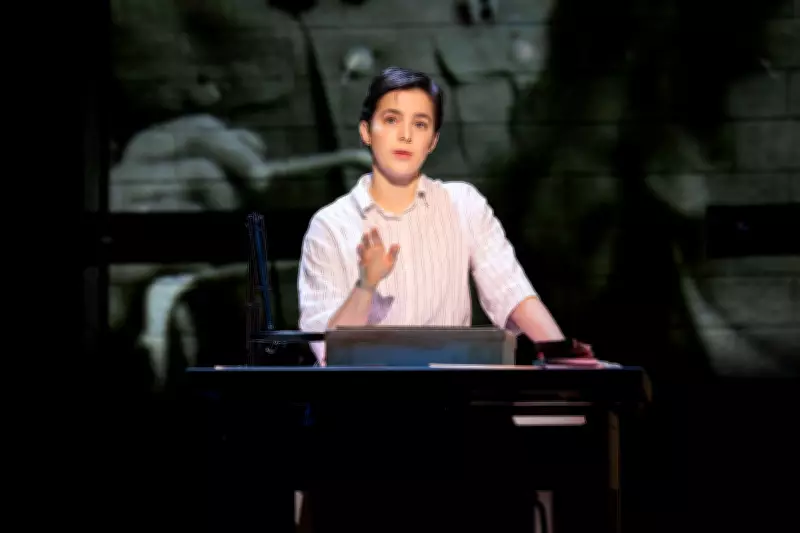
Holocaust Drama at Stratford East Faces Criticism for Sterile Presentation
The acclaimed US Holocaust drama, currently showing at Stratford East in London, centers on a profound search for truth but has been critiqued for resembling a sterile academic lecture rather than a compelling theatrical experience. Written by Moisés Kaufman and Amanda Gronich, this Pulitzer-nominated play delves into the work of archivists at the US Holocaust Memorial Museum as they meticulously study a mysterious photo album donated in 2007.
Unsettling Revelations in Nazi Photographs
The album contains images that depict Nazis at Auschwitz not as overt monsters, but in moments of leisure—laughing, relaxing, and picnicking. This unsettling portrayal suggests that, in private, they were disturbingly similar to ordinary people. The play follows a forensic unpicking of history, as the archivists attempt to identify faces in the photos, grapple with the moral implications of exhibiting such material in a memorial museum, and reassess how society confronts the legacy of the Nazis.
However, the narrative, based on real-life events and presented in a documentary style, unfolds like a slow puzzle assembly. In this new UK production, also directed by Kaufman, the facts are presented statically, leading to a loss of much-needed momentum. Projected photographs on the theatre's back wall serve as visual evidence, with figures circled and details enlarged, but the staging, set in a museum backroom under sterile lighting, moves at the deliberate pace of a genuine investigation.
Emotional Distance and Structural Issues
For much of the 90-minute runtime, the audience is essentially listening to a lecture delivered by Philippine Velge, who plays the young curator Rebecca Erbelding. Her tone remains informative but one-note and detached throughout. While the photographs, which made global headlines, are chilling, the drama struggles to extract further tension from two-dimensional images. A significant problem is the omission of victims' voices; when an Auschwitz survivor finally speaks, it provides a haunting and painful testimony that highlights the play's emotional shortcomings.
Even in moments of potential emotional depth, such as when the grandson of a Nazi in the photos meets the grandson of Rudolf Hoess, the focus remains secondary to the photographs themselves. The play explores worthy themes like generational trauma, the limitations of history, and engagement with past atrocities, but it feels sterile, cold, and emotionally airless. Historians may maintain professional detachment, but in theatre, such distance can hinder audience connection.
Practical Details and Performance Schedule
The play is staged at Stratford East, located at Gerry Raffles Square in Stratford, London E15 1BN, with easy access via Stratford International rail station and Stratford Tube/DLR. Ticket prices range from £10 to £39.50, and the runtime is 1 hour and 30 minutes. Performances are scheduled from Thursday, 12 February 2026, through Wednesday, 25 February 2026, with evening shows at 19:30 on most days, including weekends and weekdays.
Despite its important subject matter, this production leaves audiences questioning whether a play is the best medium to hash out such big ideas, as it prioritizes process over emotional engagement, resulting in a experience that feels more like an academic exercise than a moving theatrical piece.