Masterpiece Transformed: How Hokusai's Iconic Wave Became Opera
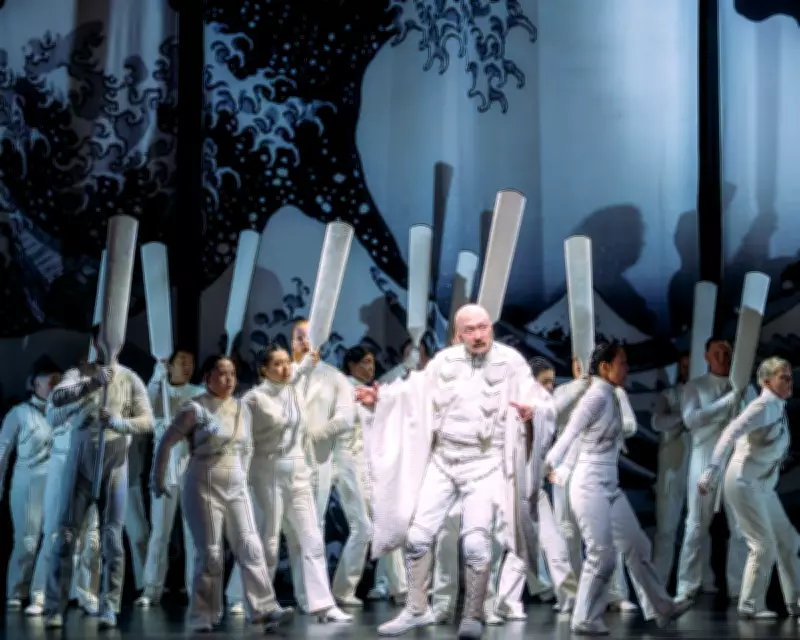
Katsushika Hokusai's legendary woodblock print, known worldwide as The Great Wave, has inspired countless reproductions from fridge magnets to phone cases. Now, this iconic image makes an unprecedented leap to the operatic stage in Scottish Opera's ambitious new production, The Great Wave, which premieres this February in Glasgow before travelling to Edinburgh.
An Artist's Remarkable Journey
Hokusai's life story reads like fiction. Born in 1760 in Edo (modern-day Tokyo), he survived numerous calamities including being struck by lightning, recovering from a stroke that forced him to relearn drawing, and escaping a devastating studio fire. Despite these challenges, or perhaps because of them, he produced an astonishing 30,000 works across his 88-year lifespan, constantly reinventing himself through at least thirty different artistic names.
His most famous creation, Under the Wave off Kanagawa, forms part of his celebrated Thirty-Six Views of Mount Fuji series created around 1831. The image's power lies in its dynamic tension between the terrifying wave and the serene mountain, regarded as sacred in Hokusai's time. Scottish Opera's production explores not just this artwork but the complex man behind it.
Breaking Operatic Conventions
Remarkably few operas have tackled visual artists as subjects, making The Great Wave particularly innovative. While operatic history includes notable artist-inspired works like Hindemith's Mathis der Maler and Berlioz's Benvenuto Cellini, Scottish Opera ventures into largely uncharted territory by centring an entire production around a single artwork and its creator.
The opera employs a non-linear narrative structure, beginning with Hokusai's funeral and moving through five acts that approach his life from unexpected angles. Librettist Harry Ross explains this deliberate choice: "We're teleological in the west – this is very much an eastern thing." The structure reflects Hokusai's own artistic approach to Mount Fuji, viewing his subject from multiple perspectives.
A Father-Daughter Creative Partnership
Central to the opera is Hokusai's relationship with his daughter Ōi, herself a significant artist who made unconventional choices for her time. After divorcing an artist husband she considered insufficiently talented, Ōi returned to work in her father's studio, forming a unique creative partnership that fascinates both Ross and composer Dai Fujikura.
"Ōi is an extraordinary character – we don't know much about her but we know enough," Ross notes. Fujikura adds, "The relationship between father and daughter was very special. We both have daughters, so it was very easy to tap into that." This emotional core gives the opera its human dimension beyond the historical biography.
Musical Innovation and Cultural Fusion
Composer Dai Fujikura, who grew up in Japan with western musical training, incorporates traditional Japanese instruments alongside western orchestration. The shakuhachi, a traditional Japanese flute, features prominently, with Fujikura encouraging improvisation around notated pitches to create what he describes as "another realm" of sound.
Fujikura particularly relished scoring a scene where German botanist Dr Philipp Franz von Siebold brings Prussian Blue pigment to Hokusai. "People are seeing an object they've never seen before, something very special," he explains, comparing it to a cinematic reveal. His musical representation of Hokusai's blue combines natural harmonic trills with artificial harmonics and shimmering vibraphone.
Cross-Cultural Collaboration
The production represents significant international cooperation, with Japanese government support and plans for the production to transfer to Tokyo and Kyoto in 2027. Director Satoshi Miyagi works with Japanese designers and choreographers from the Kajimoto company, though the production avoids literal historical recreation.
Scenographer Junpei Kiz faced particular challenges representing the iconic wave itself, developing an innovative solution: "It is such an iconic piece. There is going to be anticipation of how it will be presented." His approach introduces the image in monochrome before revealing its full colour spectrum.
Universal Resonance for Contemporary Artists
Both creators find Hokusai's story remarkably relevant for today's artists. Ross observes, "He's quite contemporary – we have this notion of the Romantic artist who's always struggling, but in the 21st century we're more like Hokusai – we must change to stay the same."
Fujikura agrees, admiring Hokusai's "nonstop creativity – that's something I absolutely love about this person." The opera ultimately celebrates artistic resilience and reinvention, qualities as valuable now as in Hokusai's time.
The Great Wave premieres at Theatre Royal Glasgow on 12th and 14th February before moving to Festival Theatre Edinburgh on 19th and 21st February, offering audiences a unique fusion of visual art, music, and theatrical innovation.