Death of a Salesman Revival Hypnotizes with Lane and Metcalf's Stark Performance
In a compelling new production at New York's Winter Garden Theatre, Nathan Lane and Laurie Metcalf breathe fresh life into Arthur Miller's timeless 1949 masterpiece, Death of a Salesman. Directed by Joe Mantello, this stripped-back revival offers a haunting exploration of the American Dream, set against a minimalist stage that evokes a sense of decay and purgatory.
A Minimalist Setting That Amplifies Tragedy
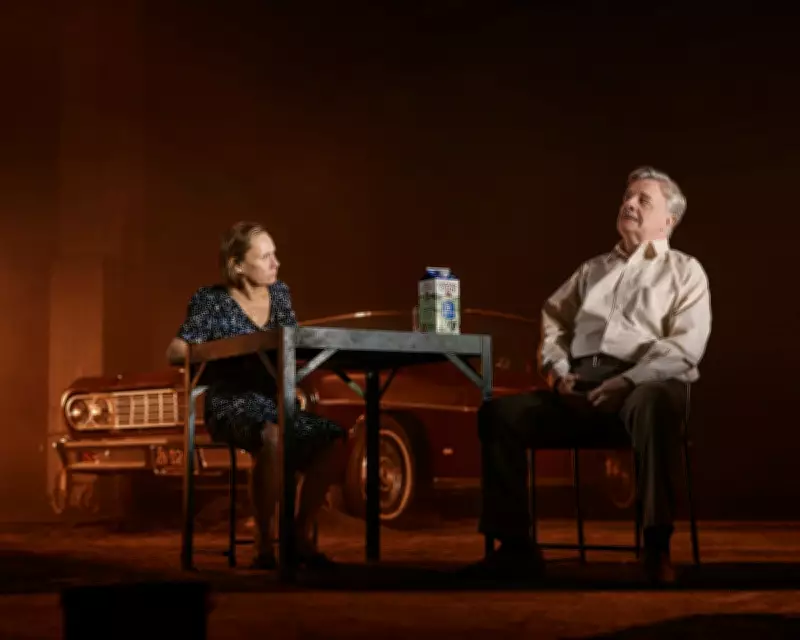
The stage design by Chloe Lamford transforms the Loman family home into a stark, ashy grayscale garage, complete with sheet metal doors and pockmarked pillars reminiscent of Brooklyn's industrial storefronts. This period-agnostic approach strips away nostalgia, focusing instead on the universal themes of failure and disillusionment. The family shuffles and rages amidst benches, a table, and a retro car, their feet stirring up literal dust—a powerful metaphor for the crumbling foundations of their aspirations.
This production eschews the traditional postwar boom aesthetic, instead creating a timeless environment that resonates with contemporary audiences. The sepia-hued flashbacks, while nostalgic, persist within this decay, emphasizing the inescapable nature of the family's struggles.
Nathan Lane's Hypnotic Portrayal of Willy Loman
Nathan Lane, in a career-long aspiration role, delivers a bravura performance as Willy Loman. His portrayal fidgets with grievance and bristles with the weight of a broken system. Lane's trademark brassiness lends Willy's long-winded rants an improbably winsome sheen, while his embarrassments evoke a piercing ache. There's a hypnotic rhythm to his madness; when Willy's time comes, he nearly takes the entire show with him.
Willy's unraveling—marked by perhaps intentional car crashes, ramblings, and intrusive flashbacks—is not just a tragedy of the American Dream but also a critique of ordinary white entitlement and masculinity in crisis. In one excruciating scene, the callous agency owner Howard unceremoniously lays off Willy, a painful reminder of the dream's failure.
Laurie Metcalf's Devastatingly Economical Linda
Laurie Metcalf imbues Linda Loman with crisp practicality, serving as the show's emotional heart. Dutiful, entirely un-naive, and blisteringly angry, Metcalf conveys the exhaustion of a woman used to holding everything together. Her performance is devastatingly economical, even in the most withering and emotionally prostrate moments, making Linda's plight resonate deeply with audiences.
An Evocative Mirror to Previous Revivals
This production acts as an evocative mirror to the last Broadway revival just four years ago, which reimagined the Lomans as a Black Brooklyn family. In that staging, elements like Willy's shame at accepting money from a white neighbor took on painful new resonance. Here, with the Lomans once again white and the generous neighbor Charley played by K Todd Freeman as Black, the show explores the opposite side of the coin, offering a discomfiting visage of privilege and crisis.
The supporting cast, including Christopher Abbott as prodigal son Biff and Ben Ahlers as overlooked Happy, adds depth to the family's dynamic. Tasha Lawrence's distracting vulgarity as Willy's floozy work associate and Joaquin Consuelos as young Biff further highlight the compromises made in pursuit of prosperity.
A Testament to Timeless Storytelling
Despite its nuances and boosted flavors, this revival remains a stark and gutting tragedy. The production teases out disdain and sympathy in equal measure, a testament to the powerful performances and Mantello's direction. Miller's masterwork, though a massive ask with its three-hour runtime, finds new urgency in this minimalist interpretation.
For all its updates, Death of a Salesman continues to challenge audiences with its long arc toward humiliation. Yet, in the hands of Lane and Metcalf, it's a show that, however reluctantly, one finds oneself buying into—a poignant eulogy for a man, a dream, and a curdled sense of privilege.