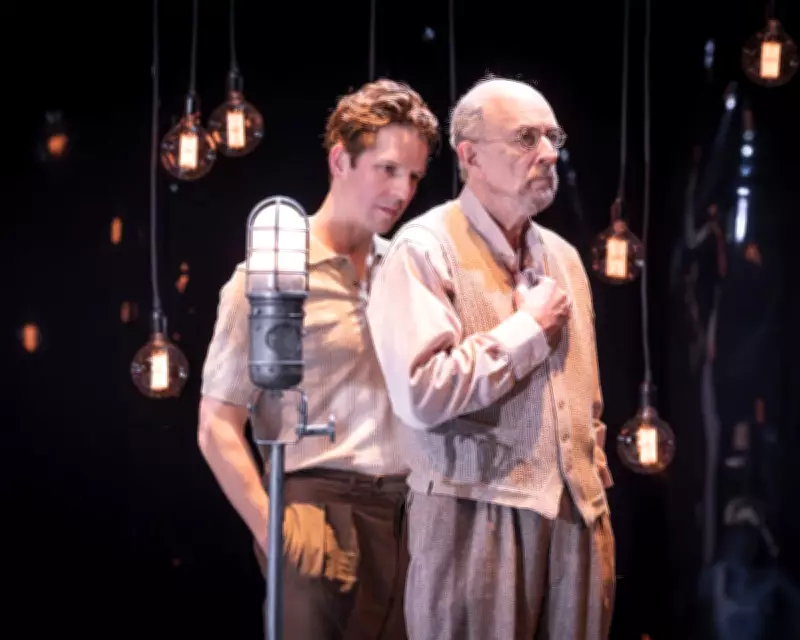
Copenhagen Revival Confronts Atomic Secrets and Moral Fog in Timely Hampstead Theatre Production
Michael Frayn's cerebral 1998 drama Copenhagen has returned to the stage at Hampstead Theatre in London with a terrifyingly timely revival that grapples with atomic secrets and moral ambiguity. The production, directed by Michael Longhurst, explores the pivotal 1941 meeting between Danish physicist Niels Bohr and German scientist Werner Heisenberg during the Second World War, a historical encounter shrouded in mystery and ethical complexity.
Historical Context and Contemporary Echoes
The play centers on the real-life meeting between Nobel Prize-winning quantum physicists Niels Bohr, portrayed by Richard Schiff, and Werner Heisenberg, played by Damien Molony. Bohr, who was half-Jewish, and Heisenberg, who worked on Germany's nuclear program, found themselves on opposite sides of a global conflict. The drama delves into the psychological uncertainty behind their encounter, mirroring Heisenberg's famous uncertainty principle which states that complete knowledge of subatomic particles is impossible.
What makes this revival particularly relevant is its chilling parallel to contemporary politics. While the play explicitly references Hitler's threat of genocide, audiences cannot help but hear echoes of modern political rhetoric, including recent statements from figures like Donald Trump regarding conflict with Iran. This production arrives at a moment when questions about scientific morality and political violence feel urgently pressing.
Production Strengths and Shortcomings
The staging benefits from Joanna Scotcher's striking set design—a non-realist circle surrounded by water that serves as both visual metaphor and historical reference. The water element cleverly alludes to the "heavy water" used in Nazi bomb-making attempts while also referencing a tragic boating accident in the Bohr family history. The dense scientific dialogue of the second act is rendered surprisingly accessible, avoiding the impenetrability of similar cerebral dramas like Tom Stoppard's Arcadia.
However, the production struggles to fully realize the emotional depth beneath the intellectual surface. The chemistry between Schiff's Bohr and Molony's Heisenberg feels underdeveloped, with the age gap appearing exaggerated beyond the actual sixteen-year difference between the historical figures. Schiff occasionally stumbles over lines, while Molony's Heisenberg comes across as more puppyish student than mature scientific rival. This dynamic undermines the tension that should crackle between former mentor and protege turned ideological opponents.
Supporting Performance and Narrative Gaps
Alex Kingston delivers a formidable performance as Margrethe Bohr, the physicist's wife and editor who provides much of the production's humanity. Her character serves as both emotional anchor and moral compass, though she bears disproportionate responsibility for the play's emotional heavy-lifting.
The drama occasionally feels sleepy despite its compelling central mystery, and it contains a significant historical omission that dates the material. While focusing intensely on the fear of Hitler obtaining nuclear weapons, the play largely overlooks the actual use of atomic bombs on Nagasaki and Hiroshima by the United States. This absence feels particularly glaring given contemporary concerns about American military imperialism, and the production does little to address this ironic gap in perspective.
Thematic Resonance and Lasting Questions
At its core, Copenhagen explores whether friendship can survive ideological divides and whether scientists bear responsibility as moral arbiters. Frayn presents multiple hypotheses about what transpired between Bohr and Heisenberg, weaving contested memories and retrospective conversations that mirror the uncertainty principle itself.
The play raises profound questions about scientific ethics during wartime that resonate powerfully today, even as this particular production struggles to balance intellectual rigor with emotional authenticity. It remains a work of significant cultural importance that continues to speak to our present moment, particularly regarding the intersection of science, politics, and morality.
Copenhagen continues at Hampstead Theatre in London through May 2nd, offering audiences a chance to engage with these enduring questions about knowledge, responsibility, and the human cost of scientific advancement.