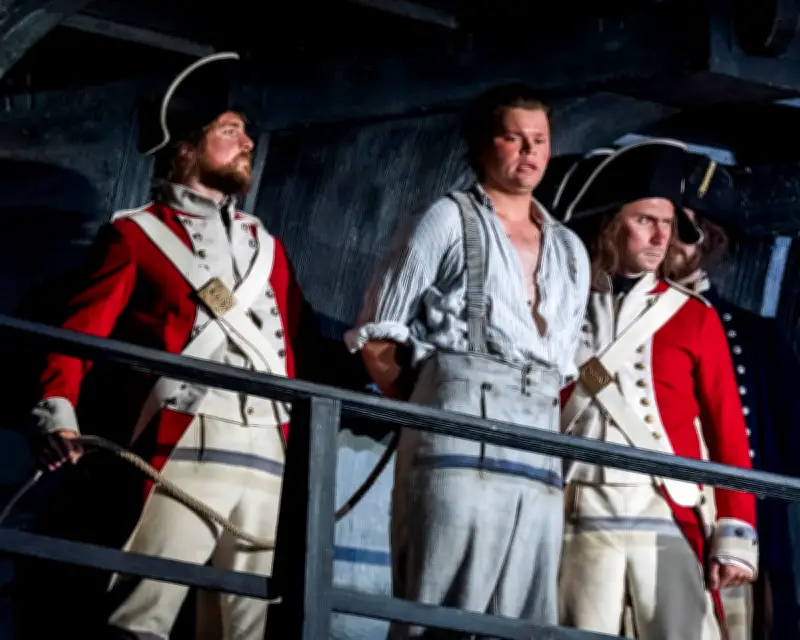
Allan Clayton's portrayal of Captain Vere in Benjamin Britten's Billy Budd at Glyndebourne has been hailed as the devastating heart of the revival, with critics praising his luminous tenor and intimate final scene.
Brutalist Set Creates Claustrophobic Atmosphere
Michael Grandage's production, revived by Ian Rutherford, features a brutalist grey set of HMS Indomitable that looms over the stage. The half-skeleton, half-cage design creates a relentlessly claustrophobic environment, softened only by coils of rope, hammocks, and Paule Constable's painterly lighting. The curved deck of Christopher Oram's set makes characters appear as if through a fish-eye lens, emphasizing the scrutiny faced by all aboard.
Polar Roles of Billy and Claggart
Baritone Thomas Mole as Billy Budd and bass-baritone Sam Carl as John Claggart deliver persuasive performances. Mole's voice is burnished, while Carl's lower register tends to muddiness but offers ferocious power up top. According to the review, Mole's double-speed wittering in his scene with the Captain captures the painful snapshot of overkeen youth, while Carl's flashes of lush baritonal beauty heighten the plot's tensions.
The chorus provides a rich blend and occasionally overwhelming heft, contrasting with the men's pitiful physical state. Other notable performances include Clive Bayley's warmly sympathetic Dansker and Laurence Kilsby's skin-crawling Novice. William Thomas, Dingle Yandell, and Daniel Okulitch compete as stiff, stentorian types. Conducted by Nicholas Carter, the London Philharmonic Orchestra rolls and surges beneath the action, seductive or brutal as required.
Allan Clayton's Standout Vere
The opera's effectiveness ultimately rests on Captain Vere, and Allan Clayton, known for chaotic, unhinged characters, proves an exceptional exponent. He stands taller and stiller than ever, exuding bewigged bonhomie, his luminous tenor carving across the opera's darkness as the voice of reason and then of conscience. His final scene, alone on stage with wig discarded, is described as quietly devastating—an intimate portrait of human vulnerability.
The production runs until 30 July at Glyndebourne, Sussex.