Maga-Funded Murals of Slain Ukrainian Refugee Ignite Debate Over Memory Weaponisation
Across several American cities, a series of striking murals depicting Iryna Zarutska, a twenty-three-year-old Ukrainian refugee tragically killed last year, have emerged, funded by prominent right-wing figures including Elon Musk. The project, which has raised over one million dollars, aims to memorialise Zarutska but has sparked intense controversy regarding the potential weaponisation of her memory for political purposes.
The Tragic Incident and Its Aftermath
Iryna Zarutska was fatally stabbed while riding the light rail in Charlotte, North Carolina, returning home from her job at a local pizzeria. The suspected assailant, Decarlos Brown Jr, had a history of serious mental health issues and multiple prior arrests. Surveillance footage of the attack went viral, prompting outrage. Conservative circles swiftly adopted Zarutska's murder as a symbol of what they perceive as rampant urban violence, with leading Maga figures employing dehumanising rhetoric.
Donald Trump called for the death penalty for Brown, labelling him an "ANIMAL" on Truth Social. Elon Musk alleged mainstream media downplayed coverage due to Zarutska's race, while JD Vance criticised "soft-on-crime" policies. The campaign gained further momentum when Eoghan McCabe, CEO of Intercom, pledged five hundred thousand dollars to fund murals, with Musk committing an additional one million.

The Murals: A Nationwide Project
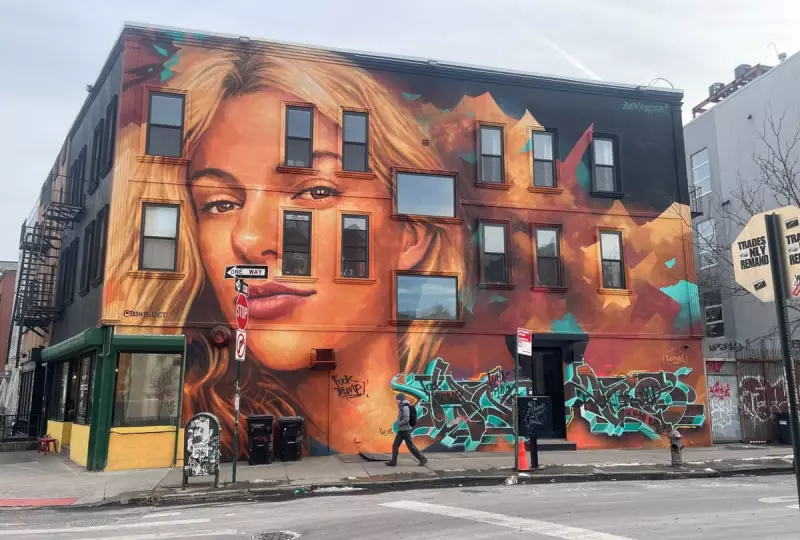
Funded primarily by Musk, McCabe, and smaller donors via platforms like GiveSendGo, the murals have appeared in locations from Bushwick, New York, to Washington DC, Miami, and Los Angeles. In Bushwick, the mural towers over Evergreen Street on the side of Formosa, a Taiwanese dumpling restaurant. The artwork, painted by Connecticut-based artist Ben Keller in collaboration with a local artist, depicts Zarutska's face across two storeys.
However, the murals have not been universally welcomed. In Bushwick, graffiti reading "Fuck Trump" was added shortly after its completion, with local residents questioning the connection between Zarutska and their community. Critics argue the project feels imposed, lacking the organic, grassroots spirit traditionally associated with memorial street art.
Artistic and Ethical Criticisms
Stefano Bloch, an associate professor at the University of Arizona specialising in public art, describes the murals as a "hijacking of the moral aesthetic." He contrasts them with longstanding, community-driven memorials, such as the tribute to Aaron "SK8" Anderson in Los Angeles, which has endured for decades. Bloch notes the Zarutska murals represent a "top-down process" that subverts the traditional purpose of street art to amplify marginalised voices.
He further criticises the imagery as a "glamour shot" and "paint by numbers" approach, lacking the raw authenticity of grassroots memorials. "It feels cheap," Bloch stated, suggesting the works resemble advertisements more than genuine tributes. Cultural critic RJ Rushmore compares the Bushwick mural to "marking territory," weaponising Zarutska's memory for political statement rather than heartfelt remembrance.
Contrasting Perspectives and Absent Humanity
Despite the controversy, some artists have created independent tributes. Rod Man, a sixty-six-year-old artist from Pensacola, Florida, painted a mural for Zarutska without external funding, driven purely by compassion. He sees no political connection to her death, asking, "Who could have beef with this victim?"
Critics acknowledge Zarutska's death as a profound tragedy, highlighting her personal story: she cherished family recipes, loved animals, aspired to become a veterinary technician, and was learning to drive with her boyfriend. Yet, these humanising details are largely absent from the political narrative and the funded murals, which present a homogenised image detached from her lived experience.
The project has drawn comparisons to George Floyd memorials, though most of those were artist-led and community-funded. The debate continues as these murals proliferate, raising poignant questions about memory, politics, and the ethics of public art in contemporary America.