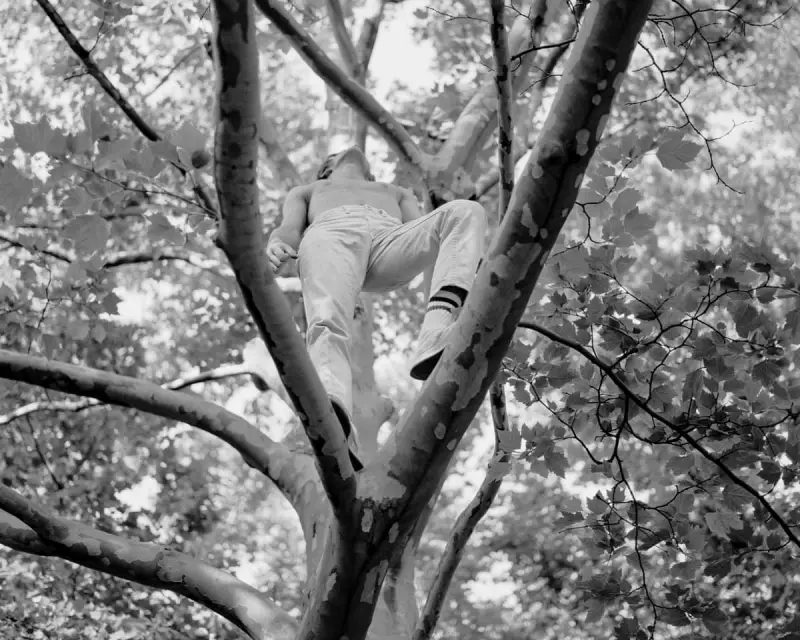
In 1969, photographer Arthur Tress began a clandestine project in an overgrown, secluded corner of New York's Central Park. The area, known as the Ramble, was the city's most famous outdoor meeting place for queer men, a hidden world within the metropolis. Tress's series, created over a little more than a year, is now recognised as the earliest known photographic record of outdoor cruising in a natural setting.
A Hidden World in the Heart of the City
Designed in 1857 by Frederick Law Olmsted as a picturesque woodland, the Ramble had, by the late 1960s, grown wild and half-forgotten. Tress, who lived just a ten-minute walk away on Riverside Drive, was drawn to its decay and secrecy. He described it as "a decaying pier in the city," a place of chance encounters and secretive performance. Olmsted had intended its winding paths and bridges to create a "degree of obscurity... sufficient to affect the imagination with a sense of mystery," an atmosphere that perfectly served its purpose as a cruising ground.
Tress returned repeatedly, capturing what he called the "everyday choreography of cruising." His images show a diverse cross-section of pre-Stonewall gay life. "In the Ramble there was always a mixture of gay subcultures," Tress recalled, "leather men, Ivy League types in suits, hippies and flamboyant queens, all parading by in a constant circling display." For the shy artist, the camera provided an excuse to approach men, though he noted that most refused to be photographed.

Documentation as Queer Still Life
Tress did not see his work as mere documentation. He framed it as a kind of queer still life, part allegory and part dream. The images, often gently staged, convey the complex emotions of the era: longing, anxiety, and a search for connection under the threat of exposure. Of one subject lying on a park bench, Tress wrote: "A sensitive young man posed for me... with his arms crossed as if to protect himself from perhaps much of the harsh brutality and rejection he had experienced living so far as a gay person."
The project was deeply informed by Tress's own 15 years of experience with the cruising scene, which he described as a mix of thrill and emotional emptiness. "The layers of guilt and fear of exposure led to a certain kind of behaviour," he said. This personal understanding allowed him to capture the psychological tension, as seen in an image of a man on the "Meat Rack" railings, whose body language Tress interpreted as expressing "a certain paranoid anxiety" mirroring his own stressed feelings.
A Historic Archive, Finally Seen
Created just months before the Stonewall riots of June 1969, the series captures a pivotal, transitional moment. Tress understood he was archiving history, even if he knew the photos would not be published for decades. "I did realise I was capturing and archiving a historic and transitional moment in queer culture," he reflected, "when the old fearful regimented norms of behaviour were changing to a more open, freer sense of male-to-male connection. They were my own personal way of coming out."
The danger of the time was ever-present. The Ramble's evening seclusion came at a cost: risks of arrest by plainclothes police or violent attacks by gangs, often unreported by victims fearing public exposure. Now, after decades as a private project, 'The Ramble' is celebrated as a vital piece of New York's queer history – a unique blend of ethnography and surrealist fantasy. It has been published as a book by Stanley Barker, and an exhibition at CLAMP in New York runs until 28 February 2026.
More than fifty years on, Tress's pioneering work stands alongside a new generation of queer landscape photography. It remains a powerful testament to how bodies, desire, and hidden urban spaces indelibly shape one another, preserving the fragile, fleeting moments of a community on the cusp of profound change.