WNO's The Flying Dutchman: A Haunting, Unconventional Wagner Revival
Welsh National Opera's new staging of Richard Wagner's The Flying Dutchman at the Wales Millennium Centre in Cardiff presents a compelling interpretation of the composer's first mature opera, blending delusion, torment, and menace with detailed musicality and fine vocal performances. Directed by Jack Furness, this unconventional production eschews traditional nautical elements in favor of psychological depth and visual metaphor, creating a powerful theatrical experience.
Origins and Conceptual Framework
The opera's genesis traces back to 1839 when the 26-year-old Wagner nearly drowned during a treacherous Baltic Sea crossing from Riga. This harrowing experience inspired his adaptation of the legendary tale about a man condemned to sail the oceans eternally, seeking redemption through the love of a faithful woman. Wagner conceived his libretto as a poetic exploration of epic themes including birth, life, love, and death, which Furness's staging amplifies through innovative theatrical choices.
Furness's production opens with a woman in childbirth, her contractions synchronized with the stormy surges of Wagner's overture. This establishes Senta's traumatic origin story: born amidst turmoil, she witnesses her mother's death as a child, setting her on a path toward obsession and derangement. The Dutchman's narrative of seeking salvation every seven years intertwines with Senta's psychological journey, creating parallel cycles of hope and despair.
Visual Design and Staging Innovations
Elin Steele's design and Lizzie Powell's lighting conjure turbulent seas and skies through muted color palettes and enveloping mists, emphasizing menace without literal ships. The production replaces traditional spinning scenes with garment-control sequences where female characters prepare dresses for a party, focusing attention on emotional dynamics rather than extraneous detail. Occasional showers of sentimental gold-dust provide visual punctuation, but the overall aesthetic remains stark and psychologically charged.
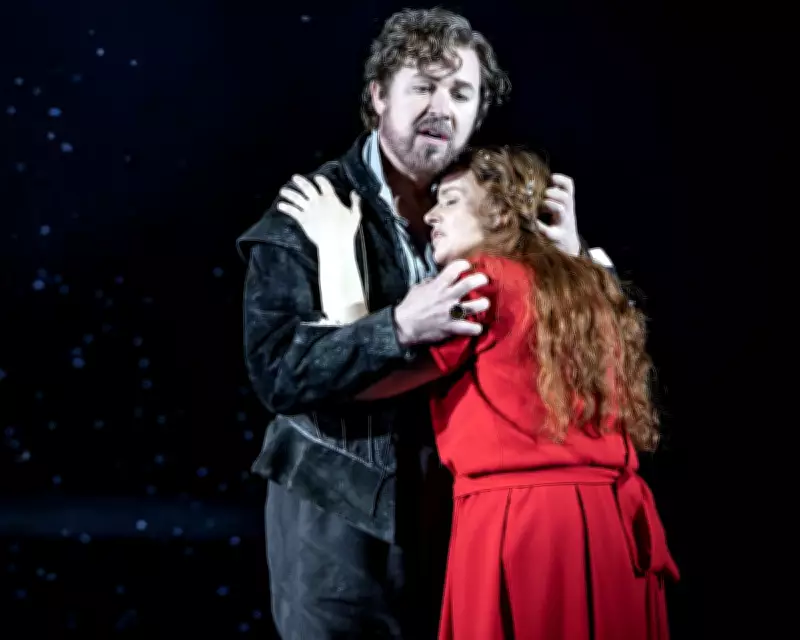
Central to the visual metaphor are the sweeping circles run by Senta—first as a young girl, then as a woman—mirroring the Dutchman's septennial cycles. The characters' blood-red dresses symbolically reference the ghost ship's sails, creating recurring motifs that reinforce the opera's themes of fate and redemption. This absence of conventional nautical elements allows for sharper focus on Wagner's text and the characters' emotional landscapes.
Vocal and Musical Excellence
The cast delivers musically rewarding performances with exceptional clarity of German diction. James Creswell's Daland stands out with nuanced vocal characterization, while Simon Bailey's Dutchman—costumed in a centuries-worn doublet with slashed sleeves—portrays a tormented yet sympathetic figure, reaching peak intensity in the final act. Rachel Nicholls's Senta proves particularly impressive, rendering her character's deluded love for the Dutchman with vocal precision, true pitch, and beautiful bel canto phrasing that makes her obsession psychologically plausible.
Supporting roles strengthen the production: tenor Trystan Llŷr Griffiths makes his mark as the hapless Steersman, and Leonardo Caimi brings depth to Erik, though both characters suffer from Wagner's tendency toward extended monologues. The choruses, while full-bloodedly sung, similarly face compositional challenges of length, yet contribute to the opera's dramatic heft.
Orchestral Leadership and Company Context
Under the authoritative baton of outgoing music director Tomáš Hanus, the WNO orchestra plays up a proper storm, capturing the elemental force of Wagner's score. This musical vigor arrives at a critical moment for the company, which faces a thin 2026/27 season and seeks to demonstrate its artistic vitality. Catching these limited performances becomes imperative for opera enthusiasts, though audiences should not expect conventional resolutions—Furness's staging concludes with unexpected dramatic choices that challenge traditional interpretations.
The production will tour to Theatre Royal Plymouth on April 24, Birmingham Hippodrome on May 7, and Milton Keynes Theatre on May 15, offering multiple opportunities to experience this haunting revival. Welsh National Opera's The Flying Dutchman ultimately succeeds as a psychologically nuanced, musically robust interpretation that reaffirms the company's creative resilience while honoring Wagner's enduring exploration of human obsession and redemption.