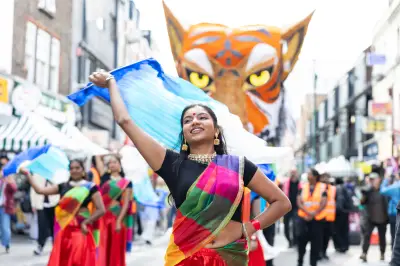
Pride in London takes place this Saturday, July 4, 2026, with the celebrated march starting at 12pm from Hyde Park Corner. The parade will wind through central London to Whitehall, culminating in a mass celebration at Trafalgar Square headlined by Lewisham's own LGBTQ icon MNEK, supported by Beth Ditto and Meek.
For many in the LGBTQ community, partying at dedicated venues is as much a protest as the march itself. Here is a non-exhaustive list of 12 of the most iconic LGBTQ venues to visit this Pride weekend.
Royal Vauxhall Tavern
No venue on London's gay scene has a heritage quite like the Royal Vauxhall Tavern. Dating from the 1860s, it became a haven for the gay community after the Second World War and was the stomping ground of Lily Savage in the 1980s. It has featured in films such as All Of Us Strangers (2023), Absolutely Fabulous: The Movie (2016) and Pride (2014). Today, it offers a kaleidoscopic programme of drag, comedy and music, with Sunday Socials evoking its past as performers like Myra Dubois, Charlie Hides and The Dame Edna Experience tread the same boards.

The Two Brewers
South London's premier LGBTQ bar on Clapham High Street became a major player under former manager Jimmy Smith, who led the venue for decades and won numerous awards. It regularly hosts London's biggest drag queens and queer entertainers, with camp décor, LED lights and glitter wallpaper creating an electric atmosphere. The venue is laid out over two rooms: an expansive front bar with seating and a dance floor, plus a spacious backroom for ticketed and club events, packed on weekends.
The Black Cap
Camden's The Black Cap has served the community since the 1950s and was dubbed the "Palladium of drag" with performers such as Mrs Shufflewick, Regina Fong, Lily Savage and Phil Starr. After closing in 2015, a decade-long campaign and a £2 million refurbishment led to its reopening on March 21, 2026. Now a modern, fully equipped LGBT venue, it has welcomed visitors including Doctor Who's Ncuti Gatwa and drag queens Baga Chipz, Victoria Scone and Tiana Biscuit.
Compton's of Soho
Compton's on Old Compton Street has been at the epicentre of Soho's gay scene since 1986. The bar is a beautifully furnished dead ringer for a Texas saloon, with polished mahogany, dangling chandeliers and baroque wallpaper. Alongside nearby The Duke of Wellington, it attracts mostly gay men and tourists, offering warm hospitality and a social atmosphere rather than a club scene.
The Admiral Duncan
A 200-year-old pub that became a gay bar in the 1980s, The Admiral Duncan on Old Compton Street carries a poignant history. In April 1999, neo-Nazi David Copeland detonated a nail bomb that killed three patrons, including a pregnant woman, and injured dozens. Copeland received six life sentences, and the community rallied with solidarity marches. Today, it is a luminous, camp mainstay with drag performances, an inscribed memorial chandelier and a permanent plaque honouring the victims.
She Bar
London's premier lesbian bar, She Bar opened on Old Compton Street in January 2014, replacing the previous Candy Bar. Run by the Ku Bar group, it remains one of the few venues catering exclusively to LGBTQ women, with bouncers strictly controlling admission. The underground bar features drag shows, cabaret, karaoke, quiz nights, DJs and club nights, open until 1am five days a week. It has been credited with preserving London's lesbian scene.
Central Station
Tucked off Caledonia Road near King's Cross, Central Station is often the first LGBTQ club for many visitors. It has a reputation as a loveable dive, with pink flamingo wallpaper (until recently) and regular classic drag and karaoke. The bar spans two floors, with a kitchen and outdoor terrace on the second floor, while beneath is the Underground Club with risqué events. It is quirky, off-beat and sociable.

Dalston Superstore
Founded in May 2009 by DJs Dan Beaumont and Matt Tucker on Kingsland High Street, Dalston Superstore is a beacon of the East End's LGBTQ+ scene. It doubles as a café and community space during the day, opening at 12pm. In the evening, it becomes a haven for drag queens, go-go dancers and performance artists, with rotating art exhibitions and shows into the early hours. It was closely associated with the nearby Glory until its closure in January 2024.
The Divine
After Haggerston's The Glory closed in January 2024 due to redevelopment, founders Jonny Woo, John Sizzle and Colin Rothbart banded together to open The Divine in Dalston. It continues The Glory's legacy as a sultry, avant-garde performance venue loved across the LGBTQ+ spectrum. It boasts high-energy weekend discos, alternative cabaret, fringe theatre and appearances by drag contestants like Bimini and LIPSYNC1000.
Ku Bar
Founded by Gary Henshaw in 1996, Ku Bar started as a pop-up in Charing Cross Station before finding a permanent spot on Lisle Street next to Chinatown. It epitomises glamour and chic sophistication, with a bright, 1980s-themed bar on street level, an upstairs cocktail lounge and a late-night basement. A multiple-award winner, it has adopted the tagline "from Ibiza with love."
Village
A multi-faceted, four-storey bar on Wardour Street, Village was recently named by TripAdvisor as the best LGBTQ bar in London. It has been a mainstay since 1991, with a laid-back café bar and a high-energy basement pumping club music. Its opening helped shift the focus of London's gay scene from Earl's Court to Soho.
The Yard
Based on Rupert Street since 1992, The Yard is one of Soho's most popular LGBTQ venues. Revellers enter through a terrace from the street into a street-level bar, then walk up to a larger bar upstairs. It is more a socialising spot than a club. In 2016, it successfully fought off a landlord's attempt to convert the premises into luxury housing; Westminster Council and the Planning Inspectorate rejected the plans, securing a decisive victory for the 'Save The Yard' campaign.