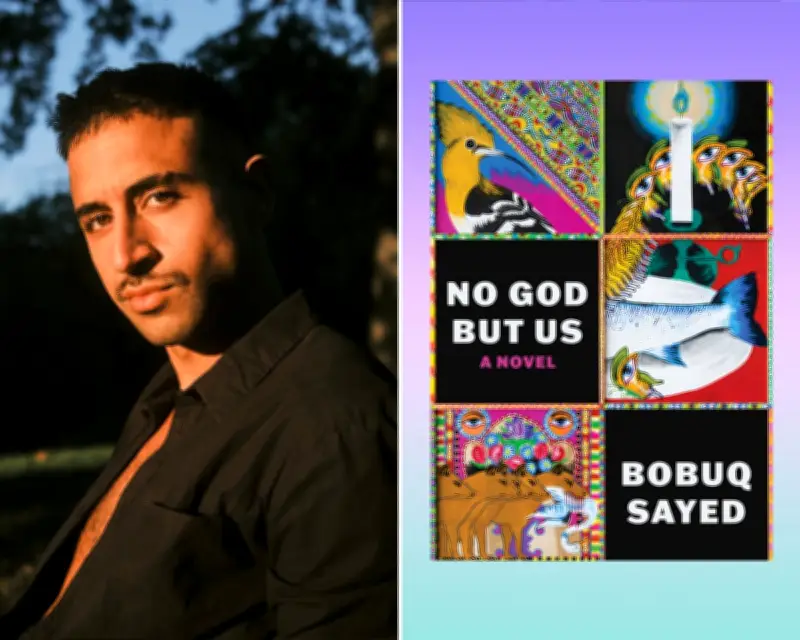
In Bobuq Sayed's anticipated debut novel No God But Us, everyone is performing. Families perform respectability; lovers perform fidelity; NGOs perform goodness; autocrats perform power. The drag queens are the most honest performers, the only ones who admit they are in costume.
A killer opening act
The novel opens with Delbar, the "door bitch" at a drag club in Washington DC. Fresh out of college and not yet out to his family, he has no idea who he is. He knows who he is expected to be: the well-buttoned son of Afghan immigrants. He also knows who he might become under the spotlight; his drag persona, Sharia Raw, is waiting in the wings.
We meet Delbar on the night of a lavish family party in Northern Virginia's "Little Kabul", a suburban hub for Afghans in the US. Arriving late from work and full of pith and vinegar, Delbar sneers at the discount nose jobs, fake Prada and showroom decor around him, calling it "typical nouveau riche immigrant bullshit". It is a world of moral theatrics and hypocrisy: "all kinds of perversity happened behind closed doors".

The night ends badly. A compromising photograph makes its way into Delbar's mother's hands, she downs a performative handful of sedatives, and he escapes to Istanbul to spend the summer with his aunt Yosra, an academic and activist in Erdoğan's Turkey.
Hype versus delivery
After being picked up by a trio of publishers in Australia, the UK and the US, No God But Us arrives with more hype than is helpful. But as opening acts go, this is killer: burlesque and heretical. The snark of Torrey Peters meets the early combustibility of Christos Tsiolkas. It feels like the beginning of something glorious, sequin-bright and savage, a farce of diaspora manners.
Take Delbar's mother, Qandal. A minor cable-TV pundit, she has built a following with "firebrand polemics and snake oil paeans": geopolitics one minute, husband-training the next. She is a magnificent character, and seems set to co-star here, alongside her dissenting sister. Instead, Qandal disappears. We will only see her once more, reduced to the familiar role of stern and fretful mother. Something vanishes with her.
A conventional love story emerges
Once Delbar leaves "the incivility of the suburbs" and decamps to Turkey, the plot settles into a well-worn, wide-eyed groove: political awakening by way of a doomed romance. Another young American abroad. Delbar might think he has left the US behind, but he is carrying one of the country's oldest fantasies: self-invention as destiny. The conviction that history can be outrun by sheer force of will.
For him, Istanbul is a choice: a place to lick his wounds and dodge Qandal's calls. For others, it is bureaucratic purgatory. Queer asylum seekers languish while their claims inch through the ponderous machinery of the UNHCR. Mansur is one of them. He has been exiled twice: first from Afghanistan as a refugee, and then from Iran when his sexuality was exposed.
When Delbar and Mansur collide, their attraction is elemental, but laced with astonishment: neither man has met an openly gay Afghan before. For Delbar, the encounter has the force of fate, like being reunited with "a lover from a former life". But Mansur has crossed too many borders to believe in destiny. Sayed alternates between their viewpoints: the young romantic and the bruised pragmatist. One man running from his family; the other torn from it.
Istanbul as a divided stage
Istanbul is the perfect setting for this tale of divided lovers: a city that is cleaved in both senses of the word. Divided by a continent; united by bridges. There has always been more than one Istanbul, but Sayed is interested in the one your passport allows you to see. As Erdoğan tightens his autocratic grip, we watch as Delbar and Mansur move through the same neighbourhoods, march in the same protests, love the same friends, and sleep in the same borrowed bed, but under vastly different conditions of possibility. They share a diaspora, but never quite the same world.
A novel haunted by time
Sayed's novel is haunted by another kind of distance, from the recent past. No God But Us opens in May 2015. It is springtime in Washington; Obama is president. The Supreme Court is a month away from legalising same-sex marriage. Delbar has no idea what is coming, but we do.

It is easy to mistake that time for a global threshold: the great before. Before Trump and Brexit and Trump again. Before the pandemic. Yet "before" is a luxury that belongs to those who think you can draw a line through history the way you draw one across a map. No God But Us is dedicated to those who know otherwise: "the transgressors of borders".
A conventional heart
But at heart, this is quite a conventional novel: twin tales of punctured idealism, rhinestone dreams burnished by political realities. For all its celebration of transgression, and its wild opening performance, this buzzy novel never quite crosses its own narrative borders. No God But Us by Bobuq Sayed is out in Australia through Ultimo Press, in the UK through Hajar Press, and in the US through HarperCollins.