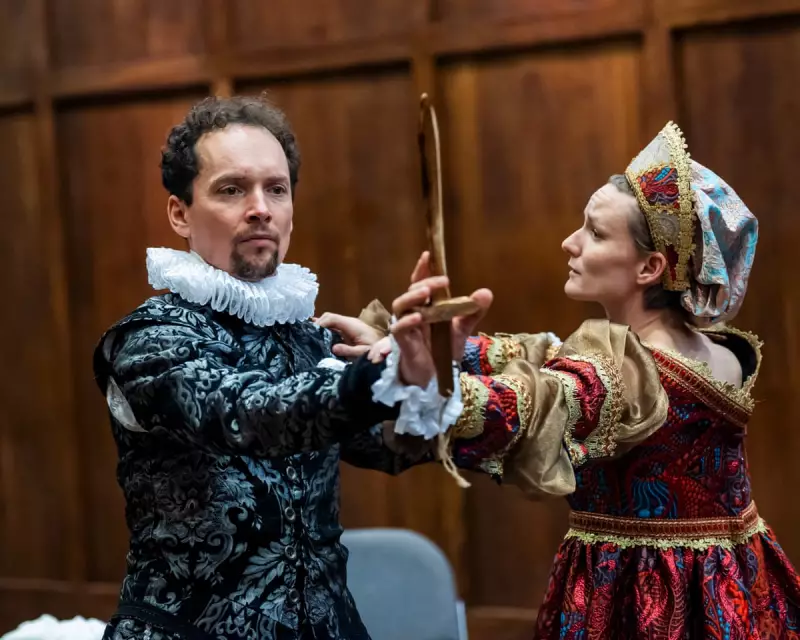
A new stage production opening in London confronts the dark and violent legacy of one of the Renaissance's most infamous composers, whose sublime music is forever shadowed by a gruesome crime.
The Atrocity and the Art of Carlo Gesualdo
Carlo Gesualdo, Prince of Venosa, is a figure of stark contradiction. He composed some of the most profoundly expressive and harmonically daring sacred music and madrigals of the late 16th century. Yet, in 1590, he also savagely murdered his wife, Maria d'Avalos, and her lover, the Duke of Andria, after discovering their affair.
The premeditated killings were exceptionally brutal, with the mutilated bodies reportedly displayed on the steps of his palazzo for days. This act of violent retribution, though legally permissible as an 'honour killing' for a nobleman of his time, has come to define his biography.

His later life was one of increasing isolation and torment. He retreated to his estate, where, according to accounts, he indulged in ritualistic flagellation and lived in a state of gothic paranoia, convinced he was being hunted by the families of his victims. He died in 1613, a broken man.
Confronting a Dark Legacy on Stage
This complex history forms the subject of 'Death of Gesualdo', a new piece of music theatre premiering at St Martin-in-the-Fields in London on 16-17 January. The work, created by writer-director Bill Barclay, marks the 300th anniversary of the central London church and features the acclaimed vocal ensemble The Gesualdo Six.
The production directly tackles the uneasy relationship between Gesualdo's artistic genius and his moral depravity. It maps his tortured, chromatic harmonies onto the painful episodes of his life, exploring how his musical innovations might reflect a descent into psychosis.
'The art will always be secondary to the atrocity,' Barclay notes, acknowledging the challenge. The composer's works, like the mournful 'Tenebrae Responsoria' of 1611, are not sunny pastorals but deeply sombre pieces that seem to echo a personal hell.
The Eternal Debate: Can We Separate the Art from the Artist?
The staging forces a modern audience to confront a perennial ethical question, one amplified in today's era of intense public scrutiny. Is it possible, or even right, to valorise the work of a murderer?
Barclay argues that erasing art as punishment for an artist's odiousness is the wrong lesson. He draws parallels with other contentious figures: we do not find antisemitism in the notes of Wagner's operas, and removing Picasso's 'Guernica' due to his misogyny would be a disproportionate act.
'High art at best is a Rorschach test,' he suggests. 'It isn't meant to reveal the artist, it is meant to reveal us.' In this view, a performance of Gesualdo's music or a play about his life becomes a mirror for contemporary concerns about morality, guilt, and the limits of forgiveness.
Gesualdo presents a unique case study. He lived centuries before modern celebrity culture, yet his noble status made his life one of unavoidable transparency. The gossip about his crimes, his sexuality, and his strange behaviour was rampant, fuelling his paranoia even as it perhaps drove him deeper into the solitude of composition.
'Death of Gesualdo' will also be performed at the National Centre for Early Music in York on 18-19 January, and at St John the Divine in New York on 13 February. It promises not to provide easy answers but to immerse audiences in the dissonant space where breathtaking beauty and profound wickedness uncomfortably coexist.