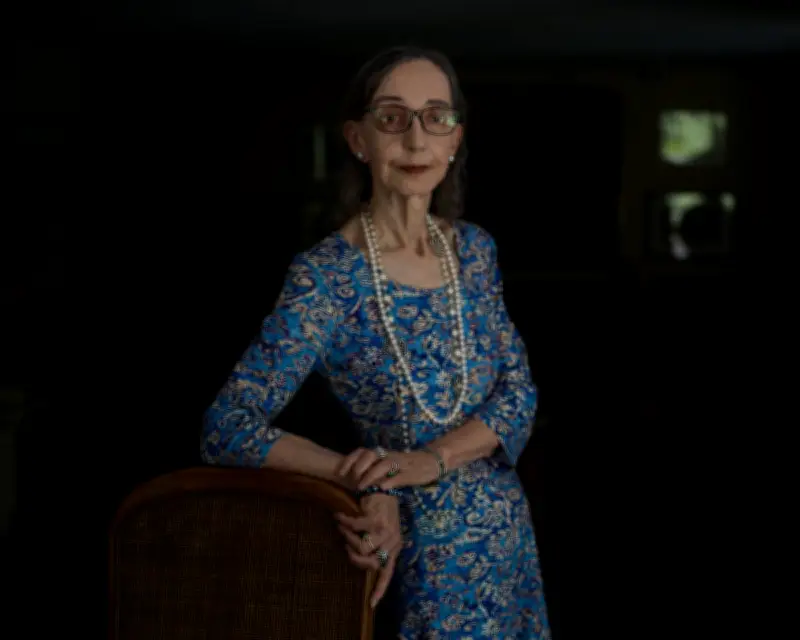
Joyce Carol Oates, the prolific author of more than 60 novels, turned 88 this month but remains as sharp and productive as ever. In a recent interview, she discussed her new short story collection The Frenzy, her views on grief, and the viral online exchange with Elon Musk that made headlines last November.
Oates on Musk: A clash of values
In November, Oates sparked a fierce online feud with Elon Musk, posting on X: 'So curious that such a wealthy man never posts anything that indicates that he enjoys or is even aware of what virtually everyone appreciates – scenes from nature, pet dog or cat, praise for a movie, music, a book … In fact he seems totally uneducated, uncultured. The poorest persons on Twitter may have access to more beauty & meaning in life than the most wealthy person in the world.' The post drew widespread attention and was described by Forbes as a 'fierce online feud'. Oates told the Guardian that Musk's reaction showed he couldn't handle something so indisputable, adding, 'Maybe what he minded was the idea that anyone else could be richer than him, even spiritually.'
The Frenzy: A collection about isolation and connection
Oates's new book, The Frenzy, is divided into three parts. 'It begins with people who are isolated from one another – girls becoming young adults, making their way. The second section is adults having their difficulties. Then it ends with two women really discovering the emotional impact of friendship. Two widows,' Oates explained. She noted that many of her friends are widowed, and sharing the experience of loss knits them together. The collection explores grief through various lenses, from bitter agony to hallucinatory sorrow, and includes a story about a character grieving a life not lived.

Personal loss and memory
Oates was married to Raymond J Smith for 48 years until his sudden death from pneumonia in 2008. Her memoir A Widow's Story (2011) details the devastation she felt. She later married Charles Gross, a psychology professor, in 2009; he died a decade later. The practical details of that loss appear in the story 'The Return' in The Frenzy. Oates lives in the same house she shared with Smith, surrounded by memories, but she acknowledges it's not healthy to live in the past.
On violence and the artist's perspective
Oates has long addressed violence in her work, notably in her 1966 story 'Where Are You Going, Where Have You Been?' based on serial killer Charles Schmid. In a 1981 essay 'Why is Your Writing So Violent?' she argued the question is sexist, as it assumes happiness is the default state for women. In The Frenzy, male control and violence are recurring themes, though Oates resists generalisation. She said, 'I'm perfectly capable of having a male protagonist. I'm not out to be critical of men.'
Political observations and the modern condition
Oates sees parallels between today's political divisions and those of the Vietnam era. She called Trump worse than Nixon, as he 'doesn't seem to be afraid of the law' and has profited more from office. On AI, she expressed concern for young people: 'They can't get jobs, they send as many as 1,000 letters of inquiry, they get AI rejections, sometimes they're interviewed by AI. This is killing these young people.' She also criticised the influence of extreme wealth in politics.
Early influences and the writer's life
Oates began her career at Syracuse University in 1956, before the women's movement. A professor told her there was no point in majoring in philosophy because it was 'literally all men'. Despite this, she became a writer, drawing inspiration from Lewis Carroll and others. She identifies with adolescent girls and the artist's outsider perspective, citing Nietzsche and Van Gogh as examples of those who don't fit in.
The Bicycle Accident and personal history
The story 'The Bicycle Accident' in The Frenzy recalls an accident Oates had at age 12. 'I didn't fall quite as hard as [the character] does,' she said, 'but I do remember the physical trauma and how I limped home. And I was bleeding and my clothes were torn, my skin was torn.' She turned it into a story by imagining the girl was fleeing from a disappointment of adults.
The Frenzy by Joyce Carol Oates is published by Random House USA (£27).