90s Rock Icon Bob Mould Reunites Sugar: 'When Cobain Died, I Pulled the Plug'
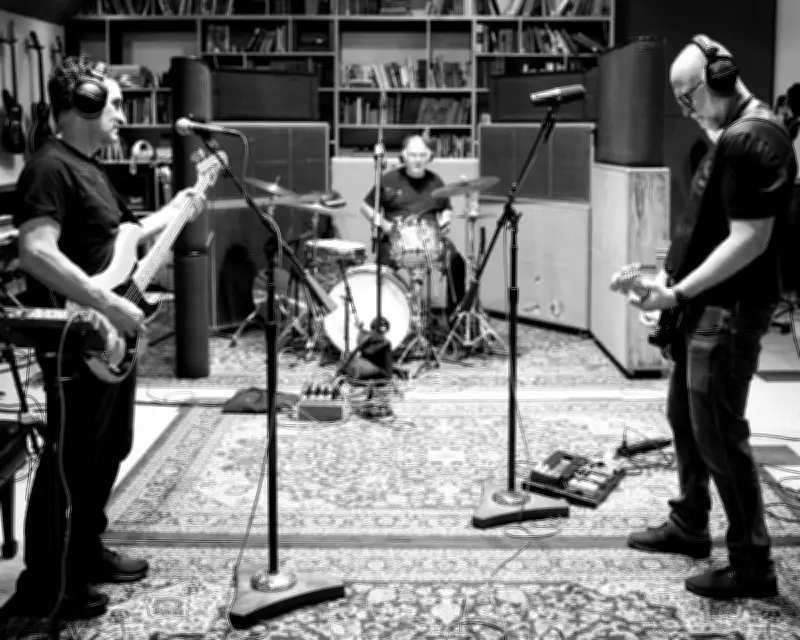
The beating heart of Sugar was always the sound of Bob Mould's guitar: a colossal, metallic, thunderous force, like a sonic boom you could whistle. "It was incredible, being engulfed by that wall of sound," remembers bassist David Barbe from his office at the University of Georgia, weeks before the group plays their first shows in over thirty years. "Bob was so loud, there were times on stage when I could see Malcolm drumming, but I couldn't actually hear him."
"I didn't wear earplugs when I started playing with Bob," adds drummer Malcolm Travis from his home in Cape Cod, Massachusetts. "But soon afterwards, I did. It was just deafening." While everyone involved is three decades older, age has not withered them; anyone who's caught Mould playing solo recently will attest that his guitar remains fearsomely loud.
The Rise of Sugar and Copper Blue
Sugar didn't merely deal in volume, however. Their 1992 debut, Copper Blue, channeled that noise into sculpted, melody-etched pop songs, securing critical plaudits and commercial success that had been unimaginable for an underground artist like Mould. But when Sugar dissolved three years later, he was left wrung-out by the intensity of this life-changing rollercoaster. As he says now from San Francisco, "There hadn't been much time for reflection during the Sugar years."

Mould wrote Copper Blue's songs in 1991, the same year Nirvana's paradigm-shifting breakthrough pulled alternative rock into the mainstream. While his previous band Hüsker Dü influenced Nirvana, crossover success seemed distant; he'd followed Hüsker Dü's 1988 implosion with modest-selling solo albums. "I could feel this cultural groundswell coming, this great energy happening," he recalls, "but I was on the edge of everything, not at the centre."
Adrift, he retained faith in his songwriting, touring incessantly across Europe and the US with just his guitar, testing new tunes. From Creation Records in London, Mould secured a deal from Alan McGee and a pre-release cassette of My Bloody Valentine's Loveless. "I was mesmerized, just taking it in," he says of the album's blissful noise-rock, which profoundly influenced his own work.
Formation and Critical Acclaim
To accompany him on what he envisioned as his next solo album, Mould reached out to friends Travis and Barbe. "Bob and I listened to his demos, drinking coffee and chain-smoking cigarettes," remembers Travis. "The songs were incredible." Barbe agrees: "They crystallized the best aspects of everything he'd done: the melodicism of late-Hüsker Dü, the power of punk rock, the maturity of his solo albums ... They sounded like a greatest hits."
Mould soon realized these weren't accompanists but bandmates, christening the group while gazing at a sugar sachet in a Waffle House in Athens, Georgia. Sugar relocated to suburban Massachusetts to record, with tracks ranging from lullabies to love songs, to darker pieces like The Slim, a corrosive waltz Mould wrote "in the voice of someone widowed by Aids." This balance of sweetness and substance yielded an anthemic masterpiece that inspired critical rapture upon release in September 1992. "We hit the ground running," Mould says. "I didn't really get to take my shoes off until September 1993."
Constant touring and glowing reviews brought Mould his first UK Top 10 success, and when Copper Blue won NME's 1992 album of the year award—which Barbe calls "like winning an Oscar"—MTV and US radio stations playlisted the group. While success was sweet vindication, Mould didn't rest, delivering Beaster, a 32-minute EP with religious themes released at Easter 1993. "Beaster was an emotional fever dream, all kinds of insanity at once," Mould says of the cycle that reached No. 3 in the UK, addressing issues like the moral majority and HIV/Aids.

Challenges and Dissolution
Mould's homosexuality had been an open secret in punk circles, but as Sugar's star rose, Barbe sensed journalists fishing to out him. In 1994, Spin magazine sent Dennis Cooper to interview Mould, with the understanding, Mould said in 2008, "if I didn't come out, they were going to out me." The experience was traumatic, but today he shrugs: "Why didn't I do it much sooner? I could have been of much greater use to my community. The only backlash was some radio stations in the deep south took Sugar off their playlists."
But the episode was a wake-up call that post-Nirvana reality meant playing a celebrity game—"the innocence of 1992 was gone." In March 1994, Sugar decamped to Triclops Studio in Georgia for their second album, but vibes were off. Then, on April 8, MTV news reported Kurt Cobain's suicide. Mould was distraught. "It was a good time to walk away for a bit. I pulled the plug, erased the tapes completely. There was nothing worth saving."
Months later, Sugar tried again with File Under: Easy Listening. While strong, it wasn't Copper Blue II; Mould wrote it in three months under pressure. They toured, but when Barbe wanted more time with his children in early 1995, a burnt-out Mould called time on Sugar.
Reunion After Three Decades
For the next thirty years, Mould pursued a solo career, Barbe produced albums and taught, and Travis became a drummer for hire. Bad timing scuppered reunions until Travis, after a birthday video from Mould, realized "the window was rapidly closing on a reunion. If we want to do this, we better do it now."
The reunited Sugar are touring Europe and the US from May to October, having recorded two new tracks. Mould won't be drawn on further Sugar music; his focus is elsewhere. "My only thought in the 90s was to ensure this thing could keep going," he says. "This time, I'm just trying to enjoy it all, in a way I wasn't able to the first time around."
What's for sure is, it's bound to be loud—punishingly, electrifyingly so. Be sure to bring earplugs.