The Rijksmuseum in Amsterdam is hosting a major exhibition, 'Ed van der Elsken Up Close', running until 13 September 2026, dedicated to the influential Dutch photographer Ed van der Elsken (1925–1990). The exhibition features approximately 8,000 prints, the largest group of photographs by a single person ever added to the museum's collection, highlighting his quality, historical significance, and social relevance.
Unvarnished Vision and Boundless Curiosity
Van der Elsken's career spanned over 40 years, during which he became one of the most prominent postwar photographers from the Netherlands. His work, known for its bluntness and cheerful audacity, reached a wide audience through photo books and photojournalism. His images are described as unvarnished, attesting to his boundless curiosity about the world, his fellow humans, and his own life and family.
In his early years, van der Elsken stayed in Paris in the early 1950s, photographing street culture. A 1954 publication described him as 'young, blond and French, with a somewhat timid, shy way of behaving. A man, still practically a boy, who had difficulty forming relationships, evidently because he had been too quick to trust life and people and, in his idealism, had been wounded too deeply.'
Organised Chaos: The Archives of a Life
Van der Elsken's archives are best described as organised chaos, reflecting the character of their creator. Prints, contact sheets, dummies, letters, notes, and financial records were kept loose in boxes, with stamps and scribbles on both sides. He retained diaries, notebooks, letters, and even Post-it notes from the 1950s until his death, forming a messy, multifarious, and humorous biography.
A 1955 article in the newspaper Het Parool featured a photograph of a sullen van der Elsken and his partner Ata Kandó reflected in a mirror, with the headline: 'We will wait until this door opens,' referring to his professional impasse. This image also served as the working title for an autobiographical photo novel he was developing.
Mastering Colour: A Sign of True Skill
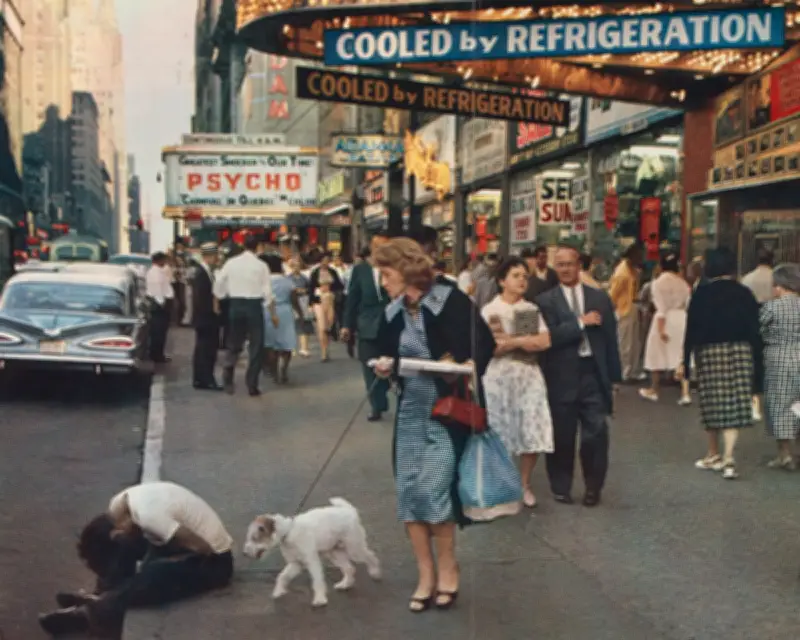
Van der Elsken believed that mastering colour photography was the mark of a truly skilled artist. He stated, 'I often say that in colour photography you have to expose yourself, to show you can make good, significant photographs without trickery. I know this because I did the same thing myself 20 years ago, making gloomy, dark-skied, high-contrast prints, and because those techniques are used willy-nilly for cheap effect, I take a devilish pleasure in puncturing those balloons.'
He considered colour photography difficult and skilled, with little margin for error due to the impossibility of manipulating prints in the darkroom. This process demanded a different way of looking and framing, and its unfiltered depiction of reality became a beloved means of expression for him. He argued, 'I think serious photographers will have to start working in colour too. It’s there. Colour is in the world. But for a really good colour photograph, one that holds its own, you have to give everything you have to offer.'
Empathic Engagement and Personal Captions
Van der Elsken showed himself to be an empathic and engaged photographer. His captions were elaborate, personal, and informed about the specific socio-economic circumstances in which he took his pictures. He shared his musings about places and people in a chatty, frank, sometimes blunt colloquial language.
A period of marital strife, divorce, depression, and soul-searching in the early 1970s drove him to move away from the city to a plot of land near Edam, where he turned inward and photographed his surroundings down to a microscopic level. This introspection eventually gave way to a renewed drive to engage with city life in the 1980s.
Legacy at the Rijksmuseum
The acquisition of approximately 8,000 prints by the Rijksmuseum is exceptional, as most photographers in the collection are represented by just one or a few photographs. The decision was justified by the work's quality, historical significance, and social relevance. The exhibition offers a comprehensive look at van der Elsken's pioneering style, often described as 'organised chaos', and his contributions to colour photography.