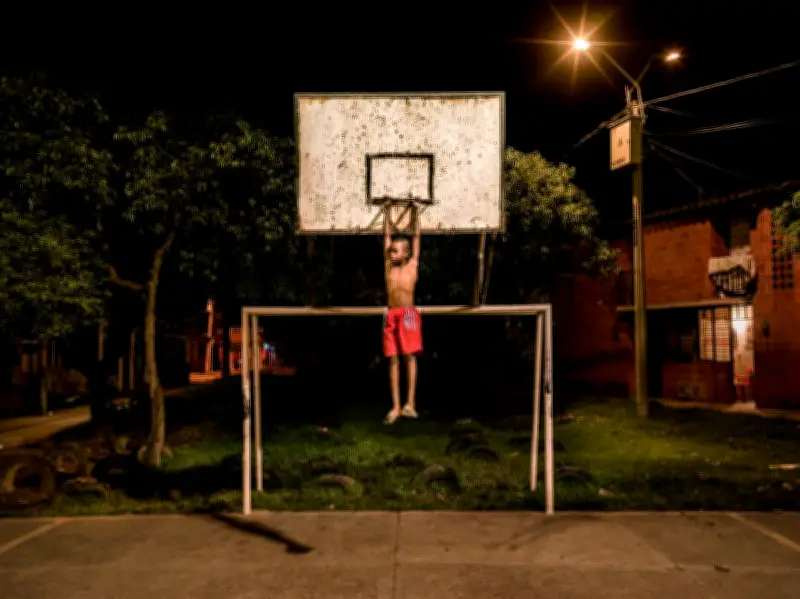
Danish photographer Mads Nissen captured a striking image in 2017 of nine-year-old Didiller Angulo clowning around on a basketball court in Potrero Grande, a suburb of Cali, Colombia, which serves as a crucial corridor for cocaine trafficking. The photograph, featured in Nissen's book Sangre Blanca: The Lost War on Cocaine, highlights the intersection of everyday life and the pervasive influence of the drug trade in the region.
A Photographer's Journey into Colombia's Cocaine Economy
Nissen, who fell in love with photography at age 19 while studying Spanish and volunteering in Venezuela, has long been drawn to Colombia's complex social and political landscape. He first traveled there for a project on the Amazon rainforest, and in 2016, the Nobel Peace Center commissioned him to cover the final stages of the peace process. He also documented millions of people displaced by the conflict, but felt he could not address turmoil and inequality without examining Colombia's cocaine production.
“I didn’t want to produce more work blaming or stigmatising the country, which I think has been the narrative of the past – and still is today,” Nissen said. He aimed to document the entire cocaine supply chain, from coca farmers and harvesters to lab operators, police, soldiers, gangsters, and cartel members.
The Story Behind the Photograph
Potrero Grande is one of Colombia's most complicated neighborhoods, a key transit point where major roads and the Cauca River converge. Nissen was speaking with a young woman selling small amounts of cocaine in a square when he noticed Didiller playing nearby. “As you can see, it was late in the evening, and I couldn’t help thinking he should be at home getting ready for school the next day,” Nissen recalled.
In such areas, many households lack fathers or positive male role models, leaving young boys to look up to gang leaders. “When I speak to these kids, their only plan to create a route for themselves out of poverty is to become a professional football player, which concerns me,” Nissen said. “What are the chances of someone like Didiller achieving that? If it doesn’t happen, what is he going to do? Obviously the gangs offer a different dream – enough money to give to your family and live the life you see on your phone.”
A Tragic Update
A few years after taking the photo, Nissen returned to Potrero Grande and asked about Didiller. He could not find him. “Someone told me he had been killed, though I cannot confirm it,” Nissen said. Despite the neighborhood's dangers—including houses where gangs tortured and killed victims—Nissen emphasized that everyday life continued. “That’s the sense I wanted to give here,” he added.
For many people involved in the cocaine trade, Nissen noted, it is simply a means of survival. Some spoke to him at personal risk. In contrast, he observed that in Europe, the main consumer of cocaine, people are less willing to be photographed discussing their role. “People will happily talk about how common cocaine use is, not only at parties but in daily life. Then, when it comes to taking a picture, the conversation completely closes down,” he said.
Sangre Blanca: The Lost War on Cocaine by Mads Nissen is published by Gost.