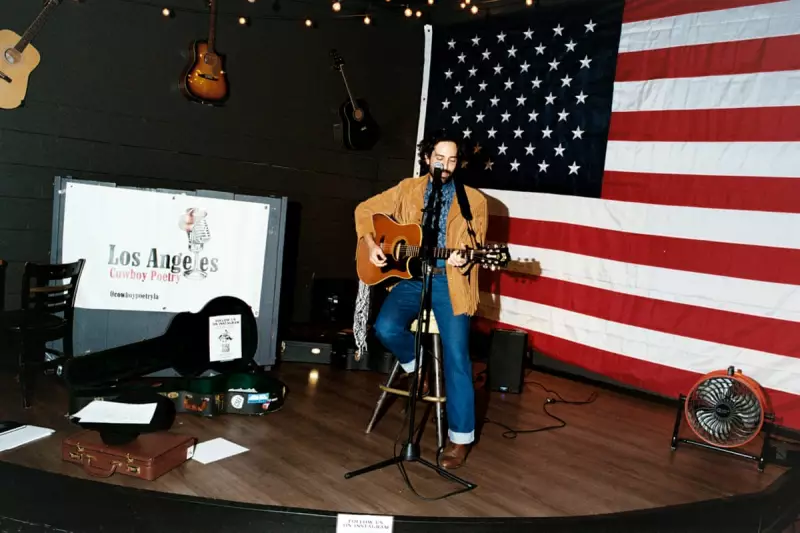
Amid the neon lights and K-pop beats of Los Angeles's Koreatown, an unexpected cultural revival is taking root. Inside the Eastwood bar, a western-themed saloon, the clatter of vintage typewriters has replaced the usual country music. Here, a young, diverse crowd is gathering to practise the centuries-old art of cowboy poetry, proving this folk tradition is far from a relic of the past.
The Urban Corral: Cowboy Poetry Finds a City Home
On a warm August evening, the co-founder of Cowboy Poetry Los Angeles, Amir Beardsley, 31, takes the stage at Eastwood. He recites his poem, Black Friday, a visceral account of the bull that nearly ended his professional rodeo career. His performance is a crisp demonstration of the form: memorised, rhythmic, and rich with imagery. The audience, many sporting Stetsons, listens intently, some jotting down notes for their own verses.
This scene is a far cry from the art form's origins in the 1870s, when cowboys on long cattle drives from Texas would share stories and songs to pass the time. While many assume the tradition is fading, a significant revival is underway, with new gatherings sprouting from California to Utah. Cowboy Poetry LA is notable for being one of the few scenes emerging in a major metropolis, attracting city dwellers to the authentic storytelling of the American West.

Kristin Windbigler, CEO of the Western Folklife Center which organises the National Cowboy Poetry Gathering in Elko, Nevada, applauds the LA group. "It allows cowboy poetry to reach an audience that it might not necessarily reach," she said.
More Than a Caricature: Redefining the Cowboy Narrative
Beardsley, who grew up among cowboys in rural Red Bluff, California, moved to Los Angeles three years ago. He teamed up with his cousin, Zane York, 33, a consultant at a skateboarding non-profit. While Beardsley is the "real deal" with a rodeo past, York is a self-described "California kid" from suburban Claremont. Together, they bridge two worlds.
Since their first performance at a Venice basement concert in April 2024, they have participated in over 30 events. They cleverly tap into the current "cowboy-core" trend—fueled by shows like Yellowstone and Beyoncé's Cowboy Carter—to attract newcomers, offering live music and prizes for best western wear. However, their mission is deeper than fashion.
The cousins actively challenge Hollywood's stereotypical, hyper-masculine cowboy image. They emphasise the West's true diversity, noting its roots in Mexican vaquero culture and the historical fact that one in four cowboys was Black. As Arab Americans of Jordanian descent, this is personal. Beardsley, who believes he may have been the first Middle Eastern pro rodeo competitor, once wore chaps in the colours of Jordan's flag. "I say I'm half Jordanian, half cowboy," he states.
An Intergenerational Tradition Secures Its Future
The revival is not confined to LA. Windbigler reports that ticket sales for the National Cowboy Poetry Gathering have grown by 53% in the past decade, with roughly 8,000 attendees in 2025. She has worked to include more poets under 40, who will make up at least a third of the lineup at the next Elko gathering in January 2025, where Cowboy Poetry LA will be special guests.
This intergenerational exchange is vital. Elders pass on lyricism and lore, while younger poets preserve these legacies by learning and reciting their mentors' works. "Our whole deal is passing on these creative traditions to the next generation," Windbigler explains. "You can't do that if the older generation isn't there or the younger generation isn't there."
Back at the Eastwood bar, the workshop's inclusive spirit resonates. Participants like Katie Meza, who has "never touched a horse," feel welcomed. First-time performer Jarod Ramirez, 25, wearing his grandfather's bolo tie, reconnects with his New Mexican roots through a poem about Hatch chillies. Another attendee, Charles McGarrigle, 30, initially felt like a "poser" but was encouraged by the founders' message: it's less about the hat and more about the story.

For Amir Beardsley, the essence is universal. "I like to tell folks being a cowboy, it's not what you do, but who you are and how you respect yourself, others and the land," he reflects. In a bustling city far from the open range, a new generation is learning just that, one poem at a time.