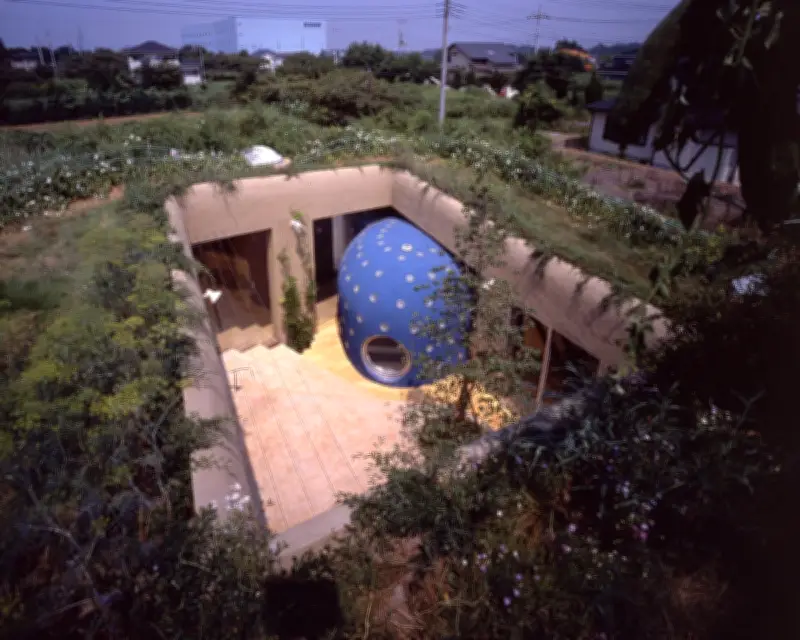
The exhibition 'Ushida Findlay: Unbroken Spaces' at V&A Dundee showcases the work of architect Kathryn Findlay and her partner Eisaku Ushida, whose surreal and sensual designs challenged architectural conventions. The show, part of the Royal Scottish Academy's bicentenary programme, runs until 28 August.
Soft and Hairy House: A Surrealist Vision
Completed in 1994, the Soft and Hairy House in Tokyo was inspired by Salvador Dalí's prophecy that 'the future of architecture will be soft and hairy.' The house features a classic courtyard plan reimagined with plump rounded contours and a shaggy fringe of greenery on the roof. A bright blue bathroom pod with porthole windows intrudes into the courtyard 'like a giant fungal entity,' according to the exhibition notes. Inside, soft draperies and seductive lighting create a glamorous dream space.
Melding Cultures and Theories
Findlay, from rural Angus, Scotland, and Ushida, from Japan, merged Celtic coiling and Japanese 'rawness' with interests in natural forms, fractal geometries, and chaos theory. Their best-known work, the Truss Wall House, appears as living sculpture with reinforced concrete echoing mutated shells or whale jawbones. Findlay described their design approach as 'a worm eating an apple,' carving spaces from a solid mass rather than building a frame. 'The shape is an outcome of the spaces and movement inside,' she explained.
Exhibition Highlights Archive Treasures
The exhibition presents a chronological trove of archive material, including photographs, drawings, models, and sketchbooks from the Ushida Findlay partnership, one of the largest donations in RSA history. Hand drawings from the pre-computer era are described by Findlay as 'slimy drawings,' evoking fluidity of conception with pointillist delicacy. A vertical lightbox displays 35mm slides like stained glass fragments, with magnifying glasses for visitors to examine details of buildings and studio life.
Findlay's Later Career and Legacy
After returning to Scotland, Findlay continued to produce unconventional work. A thatched pool house in the Chilterns, dubbed 'digi-thatch' by architect Peter Cook, subverted traditional materials. A starfish-shaped beach palace in Qatar resembled a colossal propeller in the desert. She also served as delivery architect for the ArcelorMittal Orbit, the monumental sculpture by Anish Kapoor and Cecil Balmond, which handled 700 visitors per hour during the 2012 Olympic Games. Findlay called it 'Meccano on crack' but praised its artistic ambition.
Findlay died of a brain tumour in 2014 aged 60. The exhibition, though in a modest gallery, offers a fitting tribute to a talent gone too soon, showing how her trajectory from west to east was distinctly unconventional. As she admitted, she was never interested in 'the bread and butter stuff.'