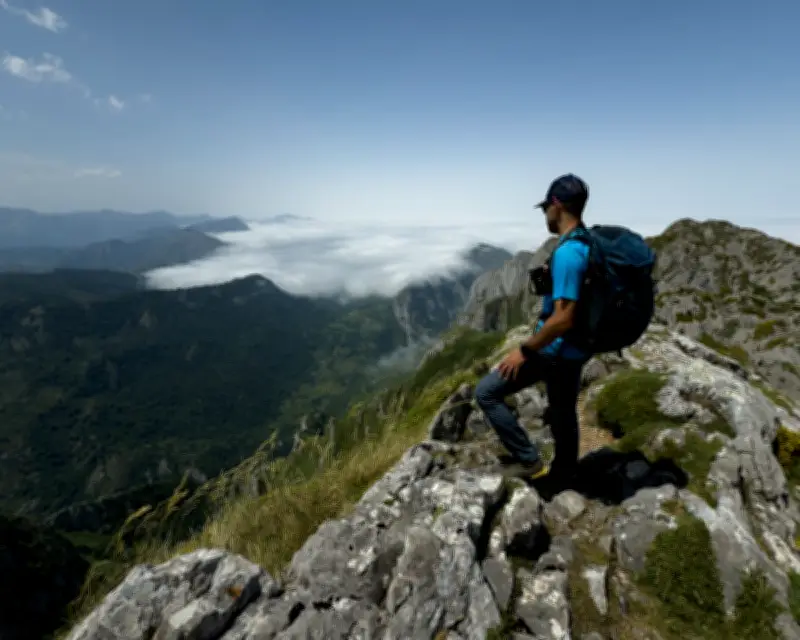
Halfway across the first glacial depression, a hiker leaves the footpath to stand on a snow patch, disturbing a spider that runs off across the frozen crystals. A few yards farther along, the mountainside is awash with colour: tiny Alpine flowers alive with bees and crickets in a world surrounded by jagged peaks. A pair of chamois watch from a crag, then clatter off up an almost vertical face. Having stopped walking, the hiker cools down fast and puts on a jacket. This is Spain, during a European heatwave.
When the hiker tears away from the wildlife, the hiking group are distant dots on a path snaking up a wall of rock. This is the Picos de Europa mountain range in northern Spain, a cluster of peaks rising to more than 2,500m and famed for the steepness of its slopes. The hiker sets off in pursuit, catching up with the group as they scramble over a ridge to find an unexpected view: a gun turret from a Second World War aircraft carrier that is now a mountain refuge hut. Cabin Verónica was cut from the USS Pulau in 1961 at a Bilbao breakers’ yard and dragged up here by mule.
A Mountain Refuge with a Unique History
The custodian, Jorge, took on the hut as a project eight years ago and has since made it his summer home, adding solar power and water tanks to the gleaming aluminium dome. “I love it,” he says, grinning while he makes coffee in the tiny kitchen. “Why would I need cities and crowds when I have this?” The panoramas are spectacular. Far below, down the valley, a bearded vulture is soaring, one of a small number successfully reintroduced in 2005. The hut sleeps a maximum of six, too small for the group, but it’s popular with climbers and solo walkers.
This trip seems determined to throw up contradictions and improbabilities. For a start, on the Portsmouth to Bilbao ferry, a passenger was alone on deck at 5am, surrounded by a cold fog so dense that the waves below the rail were invisible. The ferry was motionless, it seemed, in the outer reaches of the cosmos. As the passenger stared down, the intergalactic mist lifted a fraction and three dolphins burst from the swell, reminding that this was planet Earth and not a spaceship. This ferry route, and its sister route to Santander, crosses an oceanic canyon 4,000m deep and cetacean sightings are common. The on-board expert, André, reports seeing orcas and several whale species, including the rare Cuvier’s beaked whale.
The Unexpected in the Picos
The Picos mountains that stand to the west of Bilbao have always had a reputation for the unexpected. In Spanish history, they were a centre for resistance to Roman rule and later the Moors. They have flowers and butterflies not found elsewhere; the chamois is a unique subspecies, and there are bears and wolves too. Beneath the soaring peaks lies another surprise: an underworld network of rivers and giant caverns almost a mile deep.
The hike across the range started to the north, walking first up to the mountain hut Vegarredonda at 1,410m. There’s a sprinkling of these huts across the Picos, most off-grid and supplied by mule. Expect good conversation, generous food portions and a plastic-covered mattress in what some might call “a snoremitory”. One hiker is saved by the generosity of Arten, a group member, who hands out silica gel earplugs. They work well, and in the morning the hiker wakes to find everybody already gone to breakfast.
Food and Tradition in the Mountains
Food is a major element of the Picos experience. That morning the group hikes to a few stone cabins by a lake, Ercina, and comes across a handwritten sign advertising homemade cheese. Bruno and Cristina, the guides, get very excited. In a little stone-walled workshop, an old lady is sitting on a rustic milking stool, dressed in a nylon housecoat, waiting for customers.
“My grandfather built this cabin in 1944 when I was three years old,” says Maria. “Everyone would come up here for summer, bringing their animals with them. Now there’s only me.” Hung on the walls are her ancestors’ drinking horns and wooden platters; on the shelves are wheels of cheese. The Picos technique is to blend milk from sheep, cows and goats. The results are delicious. “I feared this tradition might die,” Maria says. “But my son is interested, so there is hope it will continue.”
Leaving Maria, and still eating the cheese, the group turns up a side valley and ascends steadily, passing boulders that harbour tiny gardens of saxifrage and stonecrop in their hollows. A wallcreeper flits away, one of the rarer birds that live here. Chamois pose on distant ridges, never far from the snow patches. Their world is shrinking, however, as Spain’s heatwaves encroach higher and higher. The hiker was glad to have travelled by ferry; as a foot passenger, the carbon footprint was less than 10% as much CO2 as flying, according to the Direct Ferries carbon calculator.
Caving and Climbing in the Peaks
The night is spent in the Refugio Vega de Ario, a hut with the best cooking, and also hosting the Oxford University caving team. After more than 60 years of exploration and several generations of speleologists mapping some of the most extensive cave systems in the world, they report being on the brink of connecting two huge cave networks. The hiker promises to come back and see it – when the stairs are installed.
The next day, the group crosses one of the few places where a car can be seen in the Picos, the village of Poncebos, which is on a fine gorge walk alongside the Rio Cares. From there, they ascend again through flower-strewn meadows and abandoned farmhouses into the clouds. Then, with perfect dramatic timing, the mists part to reveal the climactic wonder of these mountains: the Picu Urriellu, a soaring 2,529m pinnacle of rock under which is one of Europe’s most spectacular mountain huts, the Vega de Urriellu.
This is one of the most popular huts and sleeps 96, with many more camped nearby, but the place remains friendly and sociable. The group stands outside with Bruno and Cristina as they point out their favourite climbing routes. Around them are small huddles of climbing groups discussing their plans. The south face is popular with guided groups; the west is a 750m monster.
Reflections on the Journey
The glacial depressions, with their spiders and flowers, lie ahead, but this is where the hiker would choose to linger. Not down a cave, but tempted by what Bruno describes as excellent climbing routes. As the sun goes down, the rock turns orange, giving Urriellu its Spanish name, Naranjo de Bulnes – the Bulnes orange.
Dusk falls, and the hiker strolls up a mountain track for more panoramas, but finds the world below the hut all smothered in cloud. Perching on a boulder, after some time, the hiker becomes aware of being watched. A chamois is standing poised on a ledge above, its delicate curving horns silhouetted against the twilight like twin question marks. The hiker watches the last orange glow fade on Urriellu’s summit, then glances back to that ledge, but the chamois has gone.
The trip was provided by KE Adventure Travel; the eight-day traverse of the Picos starts at £1,295, including all meals, accommodation and guides. Brittany Ferries sails up to twice weekly from Portsmouth to Bilbao and Santander, and from Plymouth to Santander, from £128 for foot passengers in August.