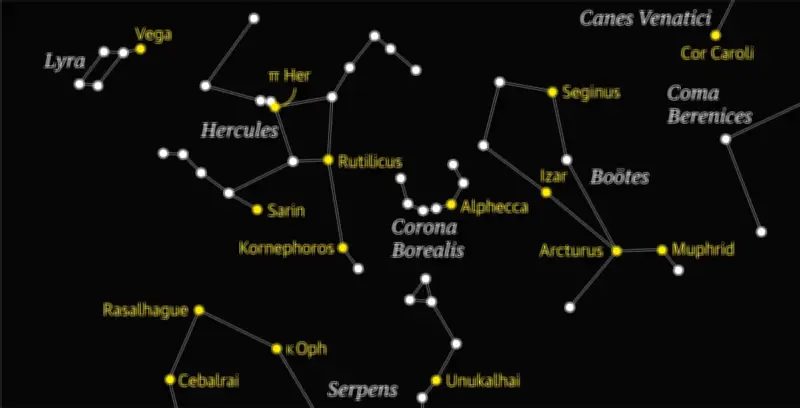
Hercules, the hero, is one of the most distinctive constellations of the northern summer skies. Although it lacks a single standout star, its pattern is easily recognized once you know where to look.
Finding Hercules in the Night Sky
To locate Hercules, first find the bright star Vega in the constellation Lyra. From Vega, look to the east for a trapezoid of four stars known as the "Keystone" – this forms the torso of Hercules. The Keystone is the key to identifying the entire constellation.
The Great Globular Cluster M13
Within Hercules lies one of the finest deep-sky objects: the Great Globular Cluster, M13. This dense ball of hundreds of thousands of stars is visible to the naked eye under dark skies, appearing as a faint, fuzzy patch. Through binoculars or a small telescope, it resolves into a spectacular swarm of stars.
M13 is located along the western side of the Keystone, about one-third of the way from the top to the bottom. According to astronomy guides, it is one of the most prominent globular clusters in the northern hemisphere.
Observing Tips for Summer Stargazing
Hercules is best viewed during summer evenings, when it is high overhead. For optimal viewing, find a location away from city lights and allow your eyes to adapt to the darkness. A pair of binoculars will reveal M13 easily, while a telescope will show its individual stars.
The constellation also contains other interesting objects, such as the globular cluster M92 and several double stars. With a little patience, anyone can enjoy the hero of the summer skies.