Saint Francis of Assisi's Skeleton on Public Display for First Time
In an unprecedented event, the skeleton of Saint Francis of Assisi is being placed on full public display for the first time, starting from Sunday. This historic exhibition is anticipated to attract hundreds of thousands of visitors over its month-long duration, marking the 800th anniversary of the saint's death in 1226.
Historic Display in the Basilica
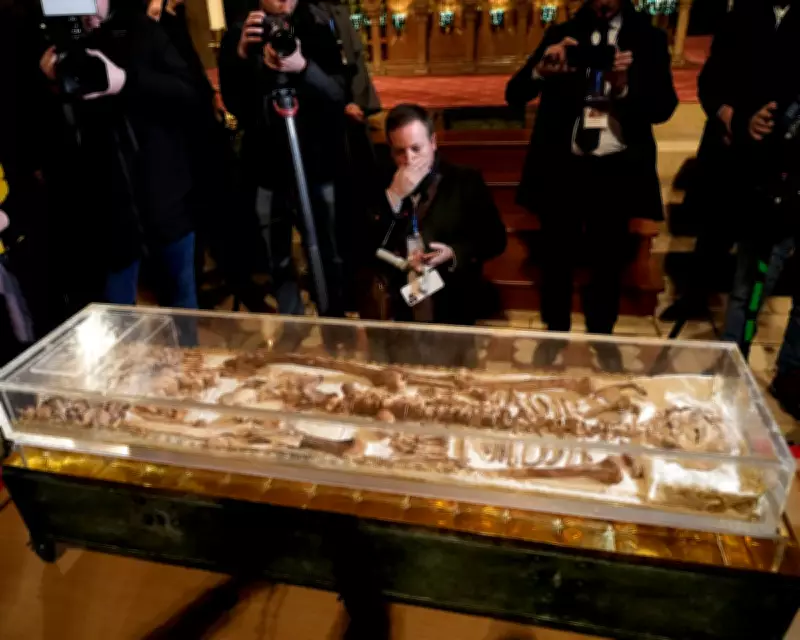
The remains are showcased inside a nitrogen-filled plexiglass case in the Basilica of Saint Francis of Assisi, located in the Italian hillside town of Assisi. The case bears the Latin inscription "Corpus Sancti Francisci", meaning "the body of Saint Francis". Saint Francis, who passed away on October 3, 1226, is renowned for founding the Franciscan order after renouncing his wealth to dedicate his life to serving the poor.
Giulio Cesareo, the director of communications for the Franciscan convent in Assisi and a Franciscan friar himself, expressed hope that the display would offer "a meaningful experience" for both believers and non-believers. He noted that the "damaged" and "consumed" condition of the bones reflects how Saint Francis "gave himself completely" to his life's mission.
Rare Public Viewing and Security Measures
The remains will be on display until March 22, having been transferred to the basilica built in the saint's honor in 1230. Their tomb was rediscovered in 1818 after secret excavations. Prior to this exhibition, the bones were only displayed once before, in 1978, to a very limited audience for just one day, apart from exhumations for inspection and scientific purposes.
Typically hidden from view, the transparent case containing the relics since 1978 was removed from its metal coffer inside the stone tomb in the basilica's crypt on Saturday. It is now housed within another bullet-proof and anti-burglary glass case. To ensure added protection, surveillance cameras will operate continuously, 24 hours a day.
Surge in Visitor Numbers and Global Interest
Reservations to view the saint's remains have already reached almost 400,000 people, with visitors coming from all over the world, though predominantly from Italy. Marco Moroni, the guardian of the Franciscan convent, highlighted that "we also have Brazilians, North Americans, Africans" among the attendees.
During this typically quieter time of year, the basilica usually welcomes 1,000 visitors on weekdays and 4,000 on weekends. However, for the month-long display, expectations are set at 15,000 visitors on weekdays and up to 19,000 on Saturdays and Sundays.
Preservation and Cultural Significance
Cesareo explained that the extended display should not impact the preservation of the remains, as the sealed case prevents contact with outside air, maintaining the same conditions as when in the tomb. The lighting in the church will remain subdued to avoid any adverse effects, with Cesareo emphasizing, "The basilica will not be lit up like a stadium. This is not a movie set."
He also reflected on the cultural and religious significance, noting that since the time of the catacombs, Christians have venerated the bones of martyrs without perceiving it as macabre. Saint Francis is Italy's patron saint, and a public holiday is being reinstated on October 4 to commemorate the 800th anniversary of his death, further underscoring the event's importance.