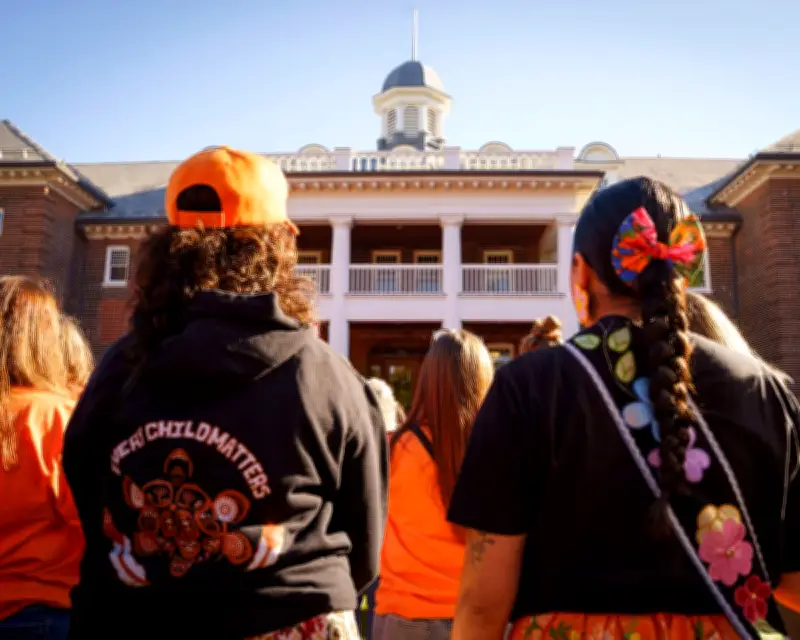
The former Mohawk Institute residential school in Brantford, Ontario, has been transformed into a museum, offering a space for survivors to reclaim their history and educate the public about the brutal legacy of Canada's residential school system. The site, which operated from 1828 to 1970, was part of a network of institutions designed to eliminate First Nations as distinct cultural groups.
Survivors' voices guide the museum's mission
In the foyer, a plaque requests visitors to help identify unnamed survivors in photographs. Similar requests appear throughout the museum, near images of First Nations children who attended the school. Some photos show children labouring in identical colourless clothing; others depict them with family. The museum is still working to identify individuals, but many will likely remain unknown.
Heather George, executive director of the Woodland Cultural Centre, which owns the site, said the decision to keep the building was made by survivors in 2013. "I am really grateful that the decision was made to keep the building," she said. George noted that everything the centre does—from Indigenous art and languages to social dancing and the museum—is a form of protest against the goals of the residential school system.
Brutal conditions and lasting trauma
Conditions at the Mohawk Institute were brutal. Children were punished for speaking Indigenous languages, sometimes beaten with a strap. Meals consisted of watery oatmeal; one survivor recalled being beaten for picking an apple. Those who tried to escape were kept in solitary confinement for days. Sexual abuse by staff was rampant.
Doug George-Kanentiio, a survivor in his early 70s, was kidnapped from his home in 1967 by federal employees and confined at the school for over a year. He now works as an educator at the museum, sharing his experience. He described playing with asbestos around heating ducts, drinking water from lead pipes, and suffering malnutrition from the oatmeal diet. Behind the boiler room and in the headmaster's office, children were sexually assaulted.
Broader context of reconciliation and denialism
The transformation of the Mohawk Institute comes amid what academics and activists describe as a "backsliding" in reconciliation. Residential school deniers downplay abuses, arguing the institutions benefited Indigenous children. At the same time, First Nations sovereignty faces threats from new infrastructure legislation that Indigenous groups say lacks proper consultation.
Sean Carleton, an Indigenous studies professor at the University of Manitoba, said commemoration can be a tool for public education. "If we look at other contexts of genocide, commemoration has played a really important role in facilitating that public awareness to combat things like denialism," he said.
Other sites and the question of excavation
Canada has nearly 140 former residential school sites; the last closed in 1997. Some, like the Shingwauk centre in Ontario, have become education centres. Others, such as the Lower Post school on the Yukon-BC border, were voted by survivors to be torn down.
In 2021, ground-penetrating radar at former school sites in British Columbia and Saskatchewan identified over 1,000 "anomalies" that some experts suspect could indicate unmarked graves. Church and government records, along with survivor testimony, have long shown children died at these sites and their remains were left behind. Communities are debating whether to excavate.
Museum as a means to preserve truth
George-Kanentiio said displaying what happened inside the museum makes these stories harder to erase. "I can still hear the echoing of the children as they go up the stairwell. And I can still hear the remnants of the predators who used that same stairwell," he said. He argues that understanding the residential school system requires immersion in "the horrors of what human beings do to each other."
"Why do I keep coming back? The basic reason is, inside the confines of that building, there are still remnants. There’s still children that are held, their spirits imprisoned," he said.