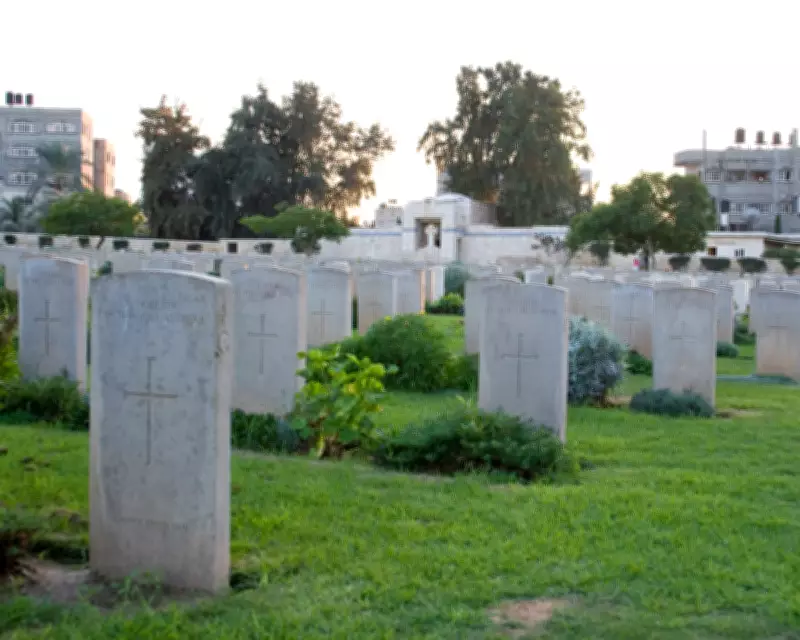
Satellite Imagery Exposes Systematic Destruction of Historic Gaza War Cemetery
Compelling satellite evidence and eyewitness accounts have revealed that Israeli military forces bulldozed substantial sections of the historic Gaza war cemetery, which contains the graves of dozens of British, Australian and other allied soldiers killed during both world wars. The destruction appears systematic rather than incidental to combat operations in the area.
Documented Earthworks and Systematic Removal
Satellite imagery of the Gaza war cemetery in al-Tuffah, a district of Gaza City, shows extensive earthworks concentrated in the southernmost corner of the graveyard. While bomb craters are visible around the cemetery perimeter, the damage within this specific area demonstrates a more methodical approach to destruction. Rows of gravestones have been completely removed, topsoil has been churned up, and a substantial earth berm now runs across the middle of the affected section, suggesting the deployment of heavy military equipment.
The earthworks were not present in March of last year but became clearly visible in satellite photographs taken on 8 August. By 13 December, the disturbed area had become even more apparent. While vegetation has regrown among gravestones throughout most of the cemetery, the southwestern corner remains bare, with the newly created earth berm casting long shadows over the sandy soil.
Eyewitness Testimony Corroborates Findings
Essam Jaradah, the cemetery's former caretaker whose home is nearby, provided detailed testimony about the destruction. "Two bulldozing operations took place at the cemetery," Jaradah explained. "The first bulldozing occurred outside the cemetery walls, extending approximately 12 metres around all sides of the cemetery. These areas were entirely planted with olive trees."
He continued: "Later on, an area of slightly less than 1 dunum [1,000 square metres] was bulldozed inside the cemetery walls, specifically in the corner containing graves of Australian soldiers. The bulldozing covered the area from the bench where foreign visitors used to sit up to the memorial monument. Bulldozers also created sand mounds that were used as earth barriers. I witnessed this bulldozing after the Israeli army withdrew from the area, around late April or early May."
Israeli Military Response and Justification
When presented with the satellite evidence, the Israel Defense Forces acknowledged operations in the area but framed them as defensive necessities. An army spokesperson stated: "At the relevant time, the area in question was an active combat zone. During IDF operations in the area, terrorists attempted to attack IDF troops and took cover in structures close to the cemetery. In response, to ensure the safety of IDF troops operating on the ground, operational measures were taken in the area to neutralise identified threats."
The spokesperson added: "We emphasise that underground terrorist infrastructure was identified within the cemetery and in its surrounding area, which the IDF located and dismantled. IDF activity in sensitive areas is approved by senior ranks in the army and handled with the required sensitivity needed."
International Reaction and Historical Significance
A spokesperson for the Royal British Legion expressed profound concern: "We are saddened to hear that graves of British and allied personnel who bravely served in the first and second world wars have been damaged. War graves honour the memory of every member of the armed forces who has made the ultimate sacrifice and deserve to be treated with the utmost respect."
The Commonwealth War Graves Commission (CWGC), responsible for maintaining the Gaza cemetery and similar sites worldwide, last commented on the graveyard's condition on 11 December. They reported: "As a result of the conflict the cemetery has suffered extensive damage to headstones, memorials, boundary walls, staff facilities and storage areas." Specific damage was noted to the memorial for the 54th (East Anglian) Infantry Division of the British army, along with the Indian UN memorial and Hindu, Muslim and Turkish sections.
Extent of Destruction Beyond Initial Reports
The satellite photographs reveal even greater destruction than previously documented. A plot just outside the main cemetery reserved for Canadian UN peacekeepers shows no visible trace remaining. Within the main graveyard, two entire sections containing more than 100 allied soldiers killed during the Second World War have been completely razed. The majority were Australian servicemen, with some British and Polish personnel among them. Most had been stationed in Palestine (as it was then known), with some serving in field hospitals in Gaza.
Additionally, four sections containing First World War dead have been flattened. CWGC records indicate the affected graves are almost exclusively British, with soldiers drawn from regiments across the United Kingdom. These men were killed as British divisions fought to gain control of Palestine from Ottoman Turkish troops, suffering particularly high casualties in Gaza itself.
Historical and Emotional Significance
Professor Peter Stanley, a military historian at the University of NSW Canberra, emphasised the cemetery's significance: "The Gaza cemetery is as valued and as cared for as any cemetery in the world: an enormous amount of sentiment and emotion has been invested in maintaining these cemeteries as sacred places."
He added: "The first need is to stop people in Gaza dying and to provide succour to those who have been starving and suffering for years now: this needs to be kept in proportion. But for Australians, a serious consequence of this conflict is the desecration of the graves of Australian soldiers. That might not be major in the global scheme of things, but it is definitely something Australians should be concerned about."
Personal Connection and Loss
Jaradah, who tended the graves for 45 years—first as an assistant to his father Ibrahim, then for a decade in charge before passing responsibility to his son—expressed profound personal grief. "The cemetery was considered one of the most beautiful archaeological sites in Gaza," he recalled. "It contained diverse and beautiful trees and served as a living public space for the people of the Gaza Strip."
His emotional response captured the depth of loss: "I feel a sorrow like that of a child who has lost his mother. Pain and bitterness grip my heart over the cemetery, just as deeply as the pain of losing my home entirely."
Broader Context of Ongoing Conflict
Since a ceasefire agreement in October, Gaza has been divided by a "yellow line" marking the boundary between Israeli and Hamas-controlled territories. This line originally ran through the cemetery but has since been pushed westward by Israeli forces. Despite the official ceasefire declaration, Israeli troops have continued firing on Palestinian civilians, particularly those approaching the demarcation line. More than 500 Palestinians have reportedly been killed since the ceasefire, approximately a quarter of whom were children.
The destruction of the war cemetery represents not only physical damage to a historic site but also a symbolic blow to international efforts to honour military sacrifice and maintain respect for the dead across conflict lines.