In the tense atmosphere of 1944 London, as Europe awaited the D-Day invasion, three intelligence officers gathered at the Café Royal on Regent Street. Outside, the city prepared for the monumental Allied operation. Inside, Graham Greene stunned his colleagues by announcing his resignation from MI6, Britain's secret intelligence service. Across the table, Kim Philby, his superior in Section V, MI6's counterespionage division, reacted with a blink. This moment, captured in Robert Verkaik's compelling book "The Writer and the Traitor," symbolizes the intricate web of loyalty and deception that defined their extraordinary relationship.
The Unlikely Friendship at the Heart of British Intelligence
Kim Philby, educated at Westminster School and radicalized at Cambridge University, had already established himself as Moscow's most valuable asset within the British establishment by 1944. He played a crucial role in Operation Overlord, the D-Day deception that misled Hitler into expecting an Allied landing at Calais rather than Normandy. Greene, the celebrated novelist, had contributed to maintaining this illusion. Yet his sudden departure raised immediate questions: Had Greene detected Philby's treachery? Verkaik's elegant and forensic double portrait examines this mystery while tracing the parallel lives of these two complex figures against the backdrop of the emerging Cold War.
Graham Greene: The Sociologist of Sin and Risk
Greene entered MI6 already shaped by conflicting loyalties. During his school years at Berkhamsted in Hertfordshire, he felt torn between his headteacher father's authority and his peers' contempt. This sense of standing on the wrong side of boundaries persisted throughout his life. He dabbled with communism, showed interest in Labour politics, rarely voted, and cultivated a romantic attraction to various causes. However, risk became his true creed.
During the London Blitz, Greene frequented Soho's seedier establishments, visiting clip joints and compiling private records of sex workers. When a Luftwaffe bomb destroyed his Clapham home, the Reform Club became his sanctuary. This exclusive venue served as a gathering place where British intelligence elites and Soviet agents exchanged gossip over fine wine. From this comfortable limbo, Greene's recruitment into MI6 under Philby's supervision occurred swiftly.
Kim Philby: The Kremlin's Golden Boy
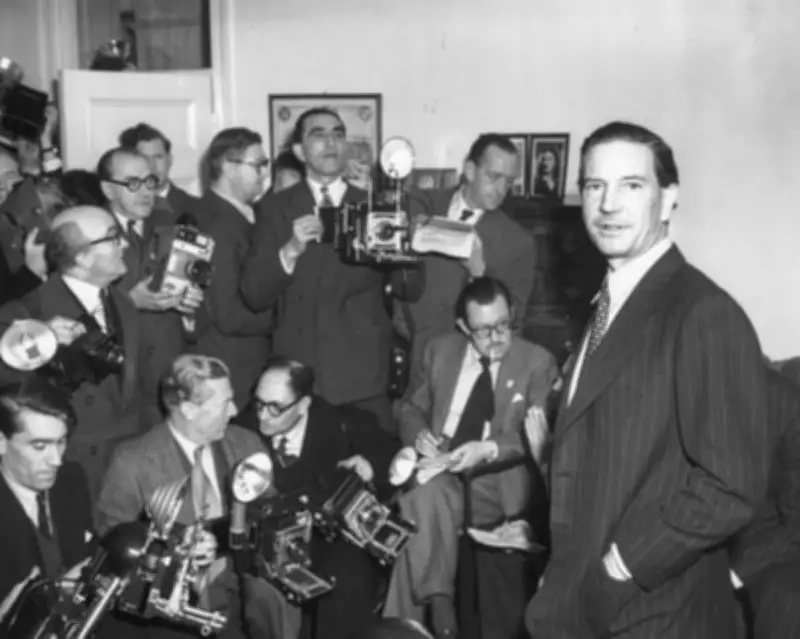
Philby's duplicity operated on a cooler, more calculated level. Born in India and nicknamed after Kipling's hero because his first words were in Punjabi, he was the son of St John Philby, an Englishman who converted to Islam and advised the Saudi king. Verkaik portrays him as a scion of "the British ruling class," though this characterization slightly exaggerates his status. Philby brushed against upper echelons without fully belonging to them, and class resentment during his school and university years likely sharpened his revolutionary tendencies.
Through the clubbable incompetence of intelligence vetting processes, Philby became a trusted insider at MI6. His father's assurances that his communist phase was merely youthful folly helped smooth his path. Once established, Philby began secretly funneling operational details, analytical reports, and critically sensitive D-Day planning materials to Moscow. His gamble assumed Stalin would not betray his Western allies, but had the Kremlin acted differently, the Normandy beaches could have become a slaughterhouse.
Parallel Lives of Deception and Desire
Verkaik benefits from both subjects providing terrific material for narrative. Greene, constantly dramatizing his delinquency, wrote to his long-suffering wife that he was "profoundly antagonistic to ordinary domestic life." He described his infidelities as symptoms of a "disease" that also served as his creative material, suggesting that curing this malady would destroy the novelist. Philby, less confessional but equally carnivorous, maintained four marriages and numerous affairs, conducting treason and matrimony with comparable sangfroid.
Part of the book's pleasure comes from vicariously observing their parallel rakish progresses. Yet beneath the surface glamour lay something profoundly darker. The central question persists: Did Greene suspect his boss's double game as early as 1944? Did his abrupt resignation reflect not office politics but having caught Philby in the act? Verkaik raises these questions without presuming definitive answers.
The Aftermath of Betrayal
It would take MI5 nearly two more decades to uncover Philby's treachery. He finally defected to the Soviet Union in 1963. However lofty his ideological justifications, reality proved more mundane. In Moscow, he reduced to pestering his handlers for English marmalade and the latest cricket scores from home. The great betrayer became a nostalgic exile, longing for the very culture he had undermined.
Robert Verkaik's "The Writer and the Traitor: Graham Greene, Kim Philby and the Great Betrayal" published by Headline, offers a fascinating exploration of these intertwined lives. The book reveals how personal vulnerabilities, class tensions, and ideological conflicts shaped one of the most damaging espionage relationships in British history, reminding us that betrayal often wears a familiar face.