German Leader Confronts Painful History in Guernica
Eighty-eight years after one of the most notorious atrocities of the Spanish Civil War, Germany's President Frank-Walter Steinmeier has made a historic visit to the Basque town of Guernica to honour the victims of the Nazi bombing that devastated the community.
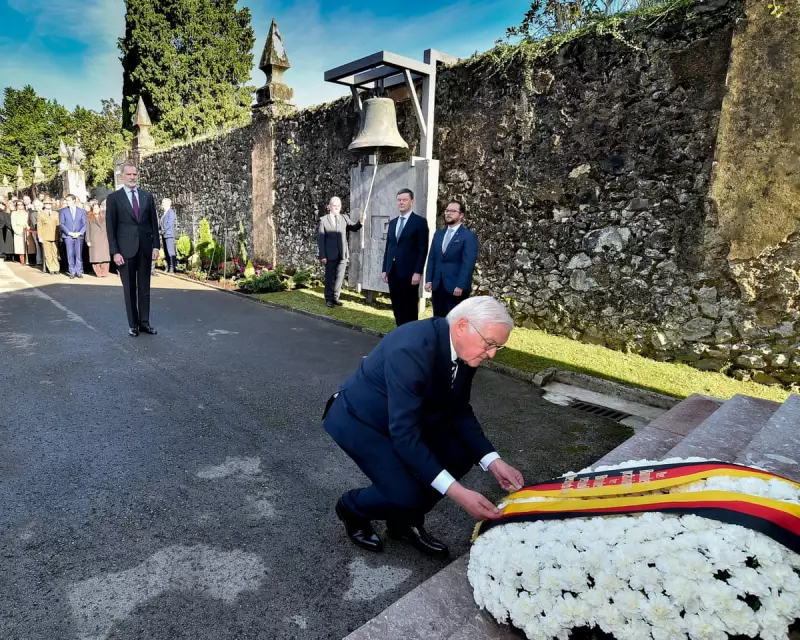
The German head of state became the first in his nation's history to travel to Guernica, where he joined Spain's King Felipe VI for a solemn remembrance ceremony at Zallo cemetery on Friday.
The Horrors of April 26, 1937
On market day, April 26, 1937, planes from the German Condor Legion, operating alongside aircraft from fascist Italy, spent hours bombing the defenceless town. The attack resulted in hundreds of civilians killed and hundreds more injured in what would become a template for the aerial bombardment of civilian populations.
Adolf Hitler had loaned the Luftwaffe unit to General Francisco Franco's nationalist forces both to assist their coup against the republican government and to allow Nazi Germany's pilots to practise the blitzkrieg tactics they would later deploy during the Second World War.
The destruction was immortalised by Pablo Picasso in his enormous monochrome masterpiece that bears the town's name, serving as an enduring anti-war symbol worldwide.
A Historic Act of Remembrance
During the emotional ceremony, President Steinmeier adjusted a ribbon featuring the colours of the German flag on a flower wreath before laying it in tribute to the victims. The German leader later visited Guernica's Museum of Peace, where he met two survivors of the attack, Crucita Etxabe and María del Carmen Aguirre.
Speaking earlier in the week during his state visit to Spain, Steinmeier had directly addressed Germany's responsibility for the atrocity. "Germans committed terrible crimes in Guernica," the president told guests at a banquet in Madrid on Wednesday.
He described how the feared Condor Legion bombed the city, razing it to the ground and causing hundreds of defenceless children, women and men to lose their lives in "appalling, agonising ways." Steinmeier acknowledged that "the terror, pain and grief is felt to this day by many Basque families."
Confronting the Past, Looking to the Future
The German president's visit comes three decades after Germany's then president Roman Herzog first acknowledged German pilots' "culpable involvement" in the bombing. Steinmeier emphasised the continuing relevance of Picasso's warning against indifference to conflict and suffering.
"It is very important to me, and I am consciously addressing this sentence to my compatriots in Germany, that we do not forget what happened back then," Steinmeier stated. "This crime was committed by Germans. Guernica serves as a warning - a call to stand up for peace, freedom and the preservation of human rights."
Meanwhile, Guernica's mayor José María Gorroño, who described the visit as "a day that will go down in the town's history," used the occasion to repeat calls for Picasso's Guernica painting to be moved from Madrid's Reina Sofía museum to the town that inspired it.
The Basque regional president Imanol Pradales also called for the Spanish state to follow Germany's example in confronting its role in the bombing, asking for "nothing more, and nothing less, from the Spanish state than what the German president is doing."