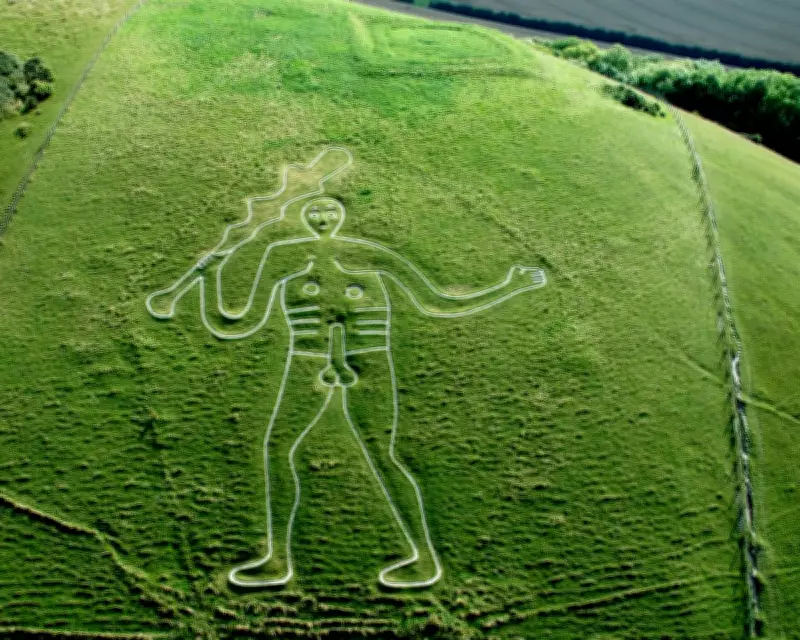
The famous Cerne Abbas Giant in Dorset stands as one of England's most iconic and enigmatic chalk figures, captivating visitors with its mysterious origins and striking presence on the hillside. These ancient hill carvings, including horses, crosses, and crowns, have long fascinated artists, writers, and travelers, drawing them into a world of folklore and history that spans centuries.
The Long Man of Wilmington: A Protective Spirit
In the churchyard adjacent to Wilmington Priory in East Sussex, an ancient yew tree, so old it has consumed part of a gravestone, sets a eerie scene. Nearby, the Long Man of Wilmington treks across the hillside, his form marked by concrete blocks on the steep scarp of the South Downs. This figure, possibly Anglo-Saxon in origin and resembling designs linked to the god Odin, has inspired many, including photographer Lee Miller and artist Roland Penrose, who saw him as a protective spirit. The Long Man has also influenced composer Avril Coleridge-Taylor and folk groups, with Benjamin Britten even picnicking at its feet.
Chalk Figures Across England
England is home to around 40 chalk figures, unique to the country and scattered across its hills. These carvings, often located near ancient trackways used by pilgrims and traders, have become integral to the landscape, sparking curiosity and conjecture among historians, archaeologists, and walkers alike. In my journey for the book The Tattooed Hills, I explored these shapes to uncover their hidden stories.
From Litlington to Cerne Abbas: Giants and Horses
A planned walk from the Long Man to the Litlington White Horse was interrupted by a thunderstorm, but the next day revealed this small, lonely horse peeking over the hill towards the English Channel. Cut secretly in 1924, it replaced an earlier lost figure. In Dorset, the huge figure of George III on his horse, Adonis, overlooks Weymouth, carved in 1808 as a tribute to the king, though now faded. Farther north, the priapic Cerne Giant dominates a secluded valley with his club held high. His origins are debated, with theories ranging from a Romano-British figure to a Saxon image of Hercules, making him a shapeshifter in local lore.
Wiltshire's White Horses and Musical Inspirations
Wiltshire's chalk hills are dotted with eight remaining white horses. A midsummer walk from the Alton Barnes White Horse along the Wansdyke offers views of ancient sites like Silbury Hill, leading to the Cherhill White Horse, carved near a hillfort. These figures have inspired music, appearing in videos for bands like Dodgy and the KLF, blending nostalgia with the countryside's rebellious spirit. The Uffington White Horse, dated to the late Bronze Age, is a remarkable survival that has inspired artists like Kate Bush and XTC, with its cover featuring on the album English Settlement.
Chiltern Hills and Beyond: Strange Figures and Folklore
The Ridgeway merges with the Icknield Way, passing through the Chiltern Hills, home to unusual chalk figures like the Whiteleaf Cross and the Watlington White Mark, an 18th-century trompe l'oeil. Eastward, the Whipsnade White Lion, cut to celebrate a zoo opening, is now maintained by wallabies. At Wandlebury in the Gog Magog Hills, folklore speaks of giants once ruling Britain, with archaeologist TC Lethbridge speculating about hidden figures. His words resonate: excitement and quests are found in prosaic old England, right at our back door.
The Tattooed Hills: Journeys to Chalk Figures by Jon Woolcott delves deeper into these stories, published by Aurum. These chalk figures continue to enchant, offering a glimpse into England's rich heritage and the enduring allure of its ancient landscapes.