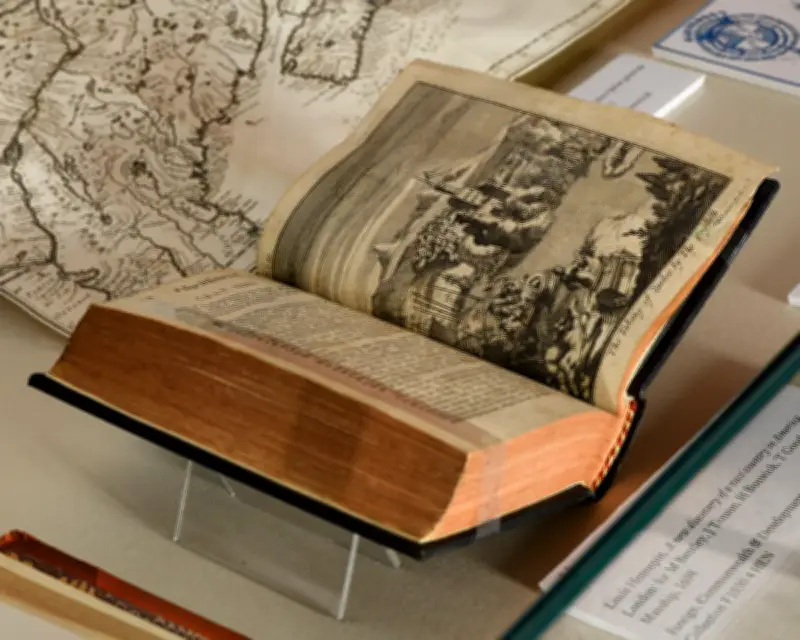
Canadian artist Terence Gower's Artangel commission Enemies and Rascals is a sound installation inside the neogothic Victorian Maughan Library at King's College, London. It revisits the first US proprietorial moves towards Canada during the American war of independence in 1775-76, drawing a line to current US-Canada tensions under Donald Trump, though Trump is not named.
Installation details and content
Visitors wander among empty metal bookshelves in a darkened space as actors voice 18th-century diplomatic dispatches, government pronouncements, and pamphlets. The quotes, from figures like George Washington (introduced as a “Virginia plantation owner”) and Benjamin Franklin (“printer”), portray US founders as rapacious thugs eager to seize Canadian land, especially from Indigenous peoples. Samuel Johnson is heard pointing out that American colonists shouting for liberty were slaveowners.
The installation suggests that US freedom was born bad—hypocritical, grasping, and mendacious—with manifest destiny leading to Trump. It contrasts British colonial practices, which left large lands in Indigenous possession, with US revolutionaries' despoliation. Gower adds nascent imperialism and precocious Trumpism to the infamous original sin of slavery at America's founding.
Critique of execution
While the concept has ironic relevance to current US-Canadian relations, the execution lacks drama. The recitation of sources without interpretation, discussion, or comment buries any bite. Unlike a history podcast that might offer debate, jokes, or analysis, this installation offers only a crushing accumulation of quotes. At intervals, voices fall silent for windswept northern plains sounds, then return to source declamation.
The work is described as “the world’s most boring history podcast.” It lacks characters for engagement, so it fails as drama; the soundscape is banal, so it's not music; and as history, it is thin and tendentious, resembling conspiracy theory rather than sophisticated analysis. The attempt to reduce US history to a single thread from the battle of Quebec to Trump versus Carney doesn't explain 250 years of complexity.
Broader historical implications
In vilifying the US, Gower comes close to praising the British empire, making the British sound more civilized than Washington and Franklin—a naive illusion. The American Revolution unleashed ideals of human rights that inspired the French Revolution and democracy movements in 19th-century Europe and the Americas. Dismissing its positive energy effectively suggests we'd be better off under absolute monarchies or emperors.
The US contains multitudes: racism, slavery, economic imperialism, wars, and Trump, but also rock'n'roll, the civil rights movement, Gloria Steinem, and Jackson Pollock. It's been a wilder and sometimes more hopeful quarter millennium than these dead shelves reveal.
The installation runs from 3 July to 18 October at the Maughan Library.