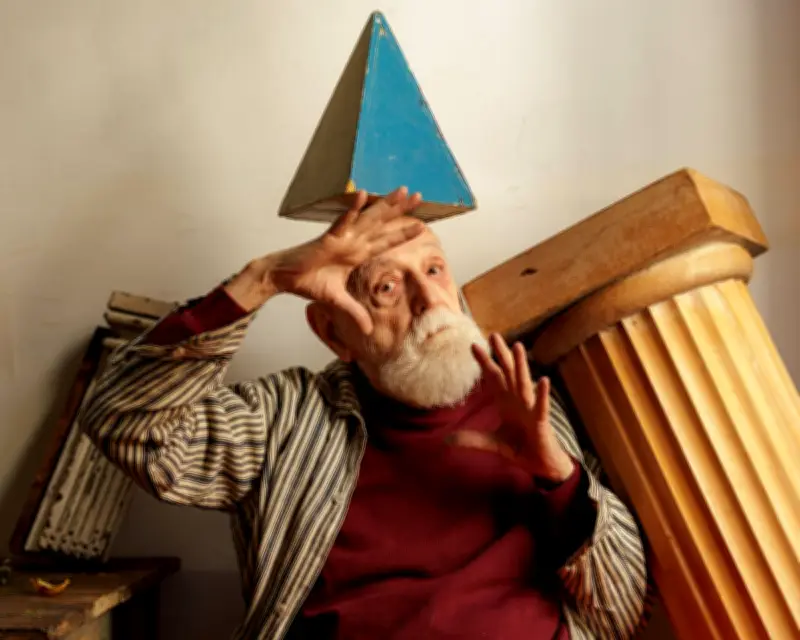
Duane Michals, the pioneering photographer who staged surreal tableaux and used double exposures to explore life, death, and memory, has died aged 94. His work, inspired by his Catholic upbringing and surrealism, challenged documentary conventions. As he often said: 'I think that if you're a very serious person, it's very important to be very silly.'
Pioneer of the 'Directorial Mode'
Michals was a pioneer of what he called the 'directorial mode' of photography, staging his subjects in roles ranging from angels to everymen. His sequences blended the profound, the profane, and the puckish. In Paradise Regained (1968), a man and woman are gradually divested of clothes and possessions as their room fills with pot plants, offering a 'photo-cartoon' philosophical inquiry. Death Comes to the Old Lady (1969) shows the grim reaper in a suit whisking her away, while Take One and See Mt Fujiyama (1976) ends with a man confusing a snow-capped summit with a lump in his underwear.
Early Life and Influences
Born in McKeesport, Pennsylvania, a steel town near Pittsburgh, to a family of Czech origin, Michals had a troubled childhood. His father, John, worked in the steel mill, and his mother, Margaret (nee Matik), was a housekeeper. 'They pretended to be a family, like actors pantomiming two different plays on one stage at the same time,' Michals said. He revisited this frequently in his work, exploring his relationship with his remote father and returning to his abandoned family home later in life.
Raised a devout Roman Catholic, he later rejected religion. At 14, he took a weekly watercolour class at the Carnegie Institute in Pittsburgh, later earning a BA in art from the University of Denver and studying graphic design at the Parsons School in New York.
Career Breakthrough and Surrealist Influence
In 1958, on a three-week trip to Russia with a borrowed camera, he took portraits and cityscapes. After they were included in a group exhibition alongside work by Garry Winogrand, Michals dropped graphic design for photography. He worked on publicity stills for a Broadway musical and later shot for Vogue and other high-profile commissions, including the cover of the Police's 1983 album Synchronicity.
His series Empty New York (1964-65) featured deserted lobbies and vacant bars, echoing Eugene Atget's Paris. In 1965, he visited surrealist René Magritte in Brussels, making portraits using double exposures. Magritte showed home movies and they watched Bonanza dubbed in French. The surrealist influence led Michals to disavow documentary photography, declaring 'to photograph reality is to photograph nothing.'
Narrative Sequences and Hand-Written Text
He began making sets of staged photographs forming narratives, using double exposures and rudimentary printing techniques. He would write in ink alongside or on the pictures, grateful that his lack of formal training freed him: 'I didn't know that you weren't supposed to write on a photograph.'
In A Letter from My Father (1975), he paired a portrait of his younger brother with his parents and wrote of his despair over their relationship. A Failed Attempt to Photograph Reality (1975) features only a few lines on blank photographic paper, asserting photography's inability to capture more than appearances. 'Photographers are always describing the package very well, but they never talk about the content,' he said. 'They show me the what of things but they don't show me the why or how of things.'
Later Work and Legacy
At age 70, after his parents had died, Michals returned to McKeesport to photograph the remains of his childhood home. The House I Once Called Home pairs old prints with images of the overgrown, derelict house, using double exposures to superimpose his parents' portraits on the ruins. The work is less playful than usual, with memory overpowering imagination.
Michals maintained a polemical attitude toward the photographic establishment. Later, he incorporated painting, even painting over prints by photographers such as Henri Cartier-Bresson. 'People believe in the reality of photographs, but not in the reality of paintings,' he said. 'That gives photographers an enormous advantage. Unfortunately photographers also believe in the reality of photographs.'
His long-term partner, Frederick Gorree, an architect, whom he married in 2011, died in 2017.