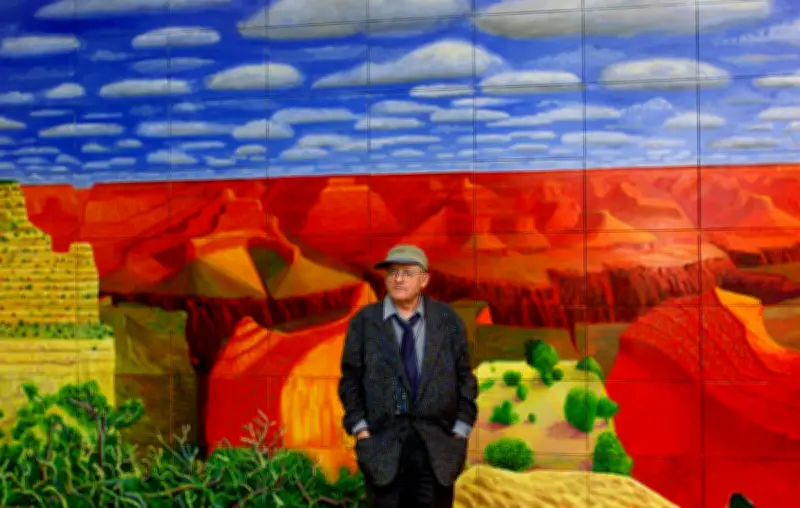
David Hockney, the revolutionary British artist who changed the world just by looking at it, has died aged 88. His art was a feast of unabashed visual pleasure, one long orgy of the gaze, the delighted lifelong epiphany of someone who cherished flowers in a vase and freeways in the sun and thought endlessly about new ways of making pictures of such passing treasures.
It didn't seem to occur to him that the way he saw was revolutionary – all he cared about was truth. But no one had ever captured the look and feel of the contemporary world with such acceptance before. He has the same simple perfection as the Beatles – just as they caught the sound of the modern world, he caught its look.
Hockney's California: A Vision of Paradise
The most revealing fact about Hockney is that he loved LA. Where some might see a moronic inferno, he saw freedom and possibility under an unjudging blue sky. Low-lying houses with patio doors glinting vacantly, tall thin palm trees with tiny heads, the white spume of a diver's splash – Hockney's California is a vision of paradise. He is the Matisse of pop art, A Bigger Splash the 1960s answer to Matisse's 1904 manifesto for hedonism, Luxe, Calme et Volupté.
Subversive and Bold: Hockney's Gay Art
Pop art had a miserable streak a Chevrolet wide. Most of its great exponents – Richard Hamilton, Andy Warhol, Gerhard Richter – were not fans but cold critics of the new western consumer society. Then along came Hockney. A childhood in the smoke-blackened industrial landscape of Bradford produced a young artist as free from nostalgia as he was from snobbery. His early pictures accept modern life not ironically but because it was his life: from desk lamps to dancing to taking a shower.
Being gay was just part of the truth he lived and painted. It wasn't a big deal, and he'd be upset if we remembered him as 'Britain's first openly gay artist.' It's exactly his relaxed and untroubled depiction of a sexuality that was illegal in early 1960s Britain that makes his art so insouciantly subversive. From his splashy 1960-1 painting Doll Boy that confesses to his passion for Cliff Richard to a composed 1968 portrait of Christopher Isherwood and Don Bachardy, the development of Hockney's art is about finding the right style to show gay life as it is.
The Observer: Hockney's Masterpieces
By the end of the 1960s, an eerie stillness dominated his paintings as he became more openly the observer. The loneliness of looking is the theme of what may be his greatest painting, Portrait of an Artist (Pool with Two Figures). It's certainly his most expensive, selling in 2018 for $90.3m. In this huge 1972 canvas, a young man in a pink jacket stands by an open air swimming pool watching a swimmer whose pale flesh flickers under translucent turquoise water.
Yet if looking can be solitary, it is also a delight. Some of his most memorable works are simple still lifes: Mount Fuji and Flowers (1972) or Breakfast at Malibu, Sunday 1989, where fragile still life scenes are juxtaposed with immense images of nature.
Art Historical Games and Experiments
Hockney was deeply curious about art's changing styles. One of his biggest heroes was Picasso. He portrayed an imaginary meeting between them in a brilliant assimilation of Picasso's own graphic style and applied shifting perspectives of cubism to photography. His layered arrays of photographs that capture the many glances and fractured glimpses in which we really see the world are among his most instantly recognisable works.
A Modest and Courteous Libertarian
Hockney's house in Bridlington was beautifully but unpretentiously decorated. He didn't use his wealth to live luxuriously but to work and research. There was a modesty and directness about him that was hugely affecting. He became famous for his last stand refusal to give up smoking, but he used a hi-tech ashtray that kept his smoke to himself. He was a courteous libertarian.
That character came through in public and made Hockney a celebrity. He attained a kind of popularity that has eluded younger British artists and has more in common with that of David Attenborough or the queen. David Hockney was the real thing – a great artist and a great human.