A Daughter's Antarctic Pilgrimage to Her Father's Past
Amanda Barry's life took an unexpected turn during a routine visit to her mother's loft. While searching through old belongings, she discovered her father's trunk, filled with photographs, letters, and journals that would ultimately guide her on an extraordinary journey to Antarctica.
Discovering a Father's Legacy
Barry's father, George, passed away suddenly from a heart attack when she was just nine years old. Her mother had preserved his memory carefully, keeping his personal items exactly as he left them. Among Barry's cherished possessions was a photograph of her father taken at Port Lockroy in Antarctica, where he served as base leader in 1948.
"He always wanted to go back," Barry recalls. "I remember thinking, 'Well, Dad, I'm going to go. For you and for me.'"
Building Toward the Impossible Journey
Barry, now 63, grew up in Essex and built a successful career in public relations, specializing in environmental issues after working with Lynne Franks PR. Despite professional fulfillment, she felt something was missing.
In her 30s, while exploring her mother's loft and writing a business book, Barry made a pivotal decision to step away from her company. "I thought: 'I'm going to close my business ... I'm going to get off this hamster wheel and take time out.'"
After marrying and freelancing, Barry contacted the British Antarctic Survey about visiting Port Lockroy. She learned she would need a science degree to work there, prompting her to enroll with the Open University in her 50s, where she graduated in environmental science.
The Path to Antarctica
Barry strategically prepared for her Antarctic dream:
- Volunteered as a walking tour leader in Ullapool, Scotland
- Assisted at the local museum to build relevant experience
- Trained as a coach, often working with women navigating life transitions
- Applied to the UK Antarctic Heritage Trust, which manages Port Lockroy
Her preparation paid off when she was offered a two-month position as museum manager at Port Lockroy, requiring no science degree through this organization.
Arriving at Her Father's Antarctic Home
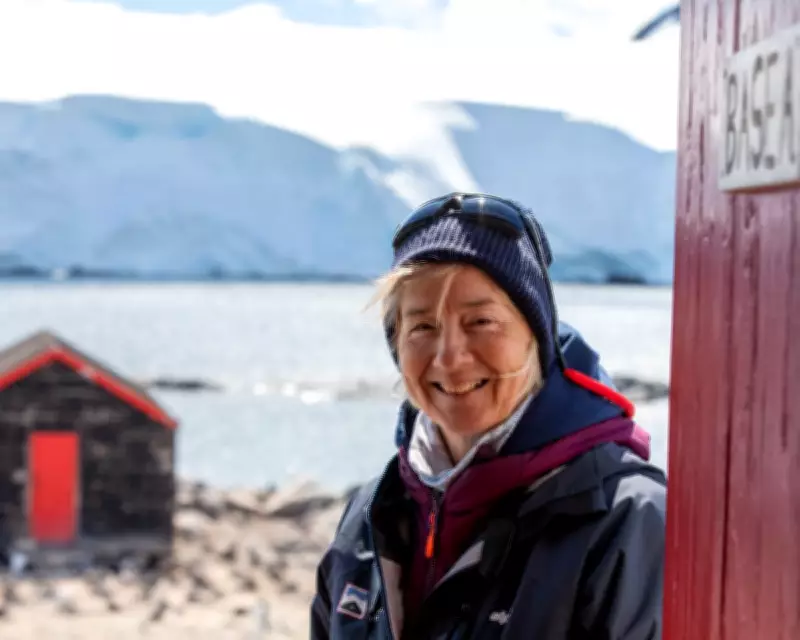
Last November, Barry traveled to Ushuaia, Patagonia, then boarded a cruise ship to Antarctica. A rib boat transported her to Goudier Island, home to Port Lockroy. "The island is tiny. The size of a football pitch. It was snowy. There were lots of gentoo penguins. No slipway. We sort of clambered ashore."
Barry shared a Nissen hut with five coworkers but immediately sought out Bransfield House, the original hut where her father lived, now converted to a museum. "The first time I walked in, I saw his picture on the wall," she says. "I cried, of course. It was such a magical thing."
Finding Connection Across Decades
Barry carried a treasured photograph of her father bearded and wrapped in a coat after a swim, with mountains in the background. During her stay, she searched for the exact location where the photo was taken.
One day, while holding the picture, she realized she had found the spot. "I stood on that spot where he had stood. And, oh, it was amazing," she recalls with emotion.
Transformation and Resilience
Barry returned to Scotland in January, still processing her Antarctic experience. "It has given me more confidence, and the knowledge that I'm resilient," she reflects. Living conditions were challenging with no running water, a camping toilet, and shared bunk rooms with strangers.
After years of professional expectations about appearance, Barry found liberation in irregular showers (arranged through passing cruise ships) and giving presentations in woolly hats.
Closing the Circle
When asked if she felt her father's presence, Barry responds without hesitation: "I did. I really did."
"When you've lost a parent when you're young, you're always hankering, always searching for that connection. I think I'm always wanting to fill that gap. And I never can. But going there was the closest I'll ever get to it."
Barry's journey demonstrates that profound personal fulfillment and connection can emerge at any stage of life, even when following paths laid decades earlier by loved ones. Her Antarctic adventure not only honored her father's unfulfilled dream but created her own transformative experience, bridging generations through shared geography and purpose.