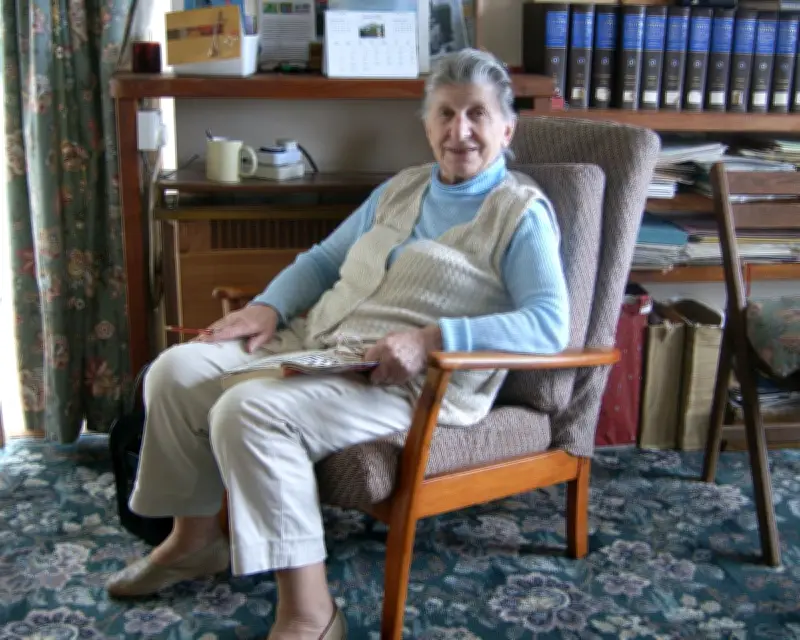
Daphne Medley, an applied mathematician who conducted nuclear physics research at the Cavendish laboratory at Cambridge in the 1940s and later lectured at Durham and Leeds universities, has died aged 105.
Early life and education
Born in Bath, Somerset, Daphne was the daughter of Priscilla (née Le Croissette), a typist, and Wilfrid Padfield, an engineering draftsman. Her parents were progressive: her father was an active Esperantist and her mother a suffragist. She attended the City of Bath girls' school and then the University College of the South West of England (now Exeter University), where she studied mathematics. After teaching and laboratory work during the second world war, she went to Girton College, Cambridge, for her PhD.
Research at Cambridge
At Cambridge, under the supervision of Russian-born nuclear physicist Nicholas Kemmer, she used the university's differential analyser—one of the last major mechanical analogue computers—to calculate the magnitudes of forces in the nucleus of a deuterium atom. She was one of the few women researching nuclear physics at the Cavendish laboratory in the mid-1940s, mixing with the greats of the field.
Career and family
After her doctorate in 1948, she became a maths lecturer at Durham University. After four years, she moved in 1952 to the Wool Industries Research Association (WIRA) in Leeds to apply her maths skills to problem-solving. There she met fellow physicist John Medley, whom she married in 1960. She left WIRA shortly after to bring up their young family, while working as a part-time lecturer at Leeds until retiring in the early 1980s. She also wrote an undergraduate textbook, An Introduction to Mechanics and Modelling (1982).
Personal interests and legacy
In her spare time, Daphne pursued hiking, camping, politics, and playing music. She was a member of amateur recorder and renaissance-instrument groups. During retirement, she wrote an as-yet unpublished book applying maths theory to analysis of music's impact on feelings. John died in 2011. She is survived by their three children, Jill, Brian, and the author, and four grandchildren.