The Medieval Horror That Killed Half of Europe
In his comprehensive new work, historian Thomas Asbridge presents a chilling global history of the Black Death that reveals startling parallels with modern pandemic responses while underscoring the unprecedented scale of medieval suffering. Between 1346 and 1353, this devastating plague claimed approximately 100 million lives, representing what Asbridge describes as "the most lethal natural disaster in human history."
Eerie Pandemic Parallels Across Centuries
Asbridge's research uncovers remarkable similarities between 14th-century plague responses and 21st-century COVID-19 measures. Venetian authorities attempted to enforce social distancing by closing all bars and prohibiting wine sales from merchant boats navigating the canals. In Gloucester, officials tried to implement a lockdown by banning travel to and from Bristol, located 40 miles south. London witnessed a dramatic surge in personal protective equipment sales, specifically gloves, mirroring modern PPE shortages.
These medieval containment efforts frequently failed, with fights erupting among thirsty Italians and Gloucester's quarantine being breached, though historical records don't specify whether these violations involved people claiming to travel for eyesight checks.
A Truly Global Catastrophe
Asbridge fundamentally recontextualizes the Black Death as "not solely, or even primarily, a European phenomenon, but rather a catastrophe that touched almost all of the medieval world." His vivid narrative transports readers from Sicily to Egypt, where observers documented "bodies scattered under palm trees and in front of shops," to Marseille where victims were "coughing up blood," through Syria, Spain, Sweden, and ultimately to Russia.
Evidence of sudden population collapses in Ghana, Nigeria, and Burkina Faso suggests the plague penetrated deep into the African continent. The devastation certainly reached Tunis, where scholar Ibn Khaldun survived and later argued that "lethal plagues played an essential role in the rise and fall of civilizations" centuries before Jared Diamond's similar theories.
Micro-Histories of Human Suffering
Asbridge powerfully evokes terror and pity through what he terms "micro-histories" of individuals across social strata. Princess Joan of England, daughter of Edward III, contracted the Black Death in Bordeaux and died at just 14 years old. In Bologna, artisan family member Ysabeta Ugolini "seemingly lost her husband, along with her father, mother, brother and brother-in-law in barely one month."
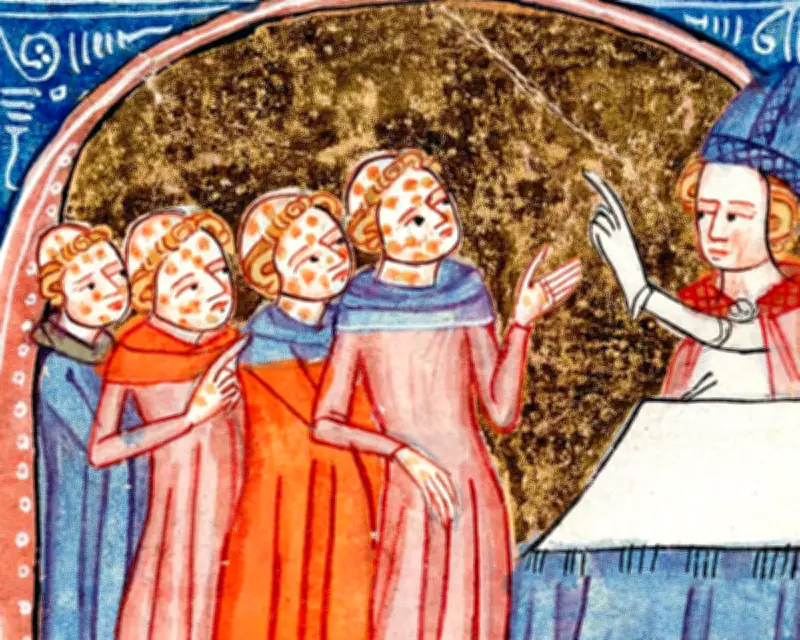
The author's extensive use of contemporary chronicles highlights both horror and bafflement among medieval populations. Without germ theory, some believed infection could occur simply by looking at a victim.
Reassessing Mortality Through Bureaucratic Records
Mining bureaucratic archives, Asbridge argues some areas suffered far worse than previously understood. Florence appeared relatively spared, but the historian discovered a sudden increase in will preparations, "suggesting a steep increase in patient numbers and, potentially, rates of mortality." Bologna recorded five times more wills in 1348 compared to previous years' averages.
Despite the extreme danger, most notaries continued working, and essential public functions persisted even as society grappled with overwhelming death. When churchyards overflowed and funeral services became impossible, people were still carefully placed in mass graves like London's Smithfield site.
The Bleak Social Contagion of Antisemitism
One particularly dark social consequence involved blaming Jews for the plague, leading to massacres of hundreds of innocent Jewish men, women, and children across Toulon, Strasbourg, Provence, Basel, and the Iberian peninsula. Murderers often destroyed victims' financial records to erase their debts. Hundreds more Jews were convicted through "due legal process" of poisoning wells and burned to death. Asbridge estimates "tens of thousands" were killed during the Black Death, prompting subsequent Jewish migration to Eastern Europe.
Endemic Legacy and Lasting Consequences
The Black Death didn't disappear after 1353 but became endemic, erupting again in London in 1665 and persisting into the 19th century. The pandemic's long-term consequences were profound: 14th-century labor shortages contributed to serfdom's end, recurrent outbreaks likely weakened Constantinople enough to hasten the Byzantine Empire's fall, and Asbridge suggests the plague might have even inspired the Protestant Reformation by focusing believers' minds on "the imminency of death and the urgent need for effective spiritual redemption."
Nor is the threat permanently quiescent: Madagascar experienced outbreaks in 2014 and 2017 that killed nearly 300 people. As for COVID-19's long-term social consequences, Asbridge notes it's too early to tell while we await the next pandemic. His work serves as both historical record and sobering warning about humanity's perpetual vulnerability to microscopic threats.