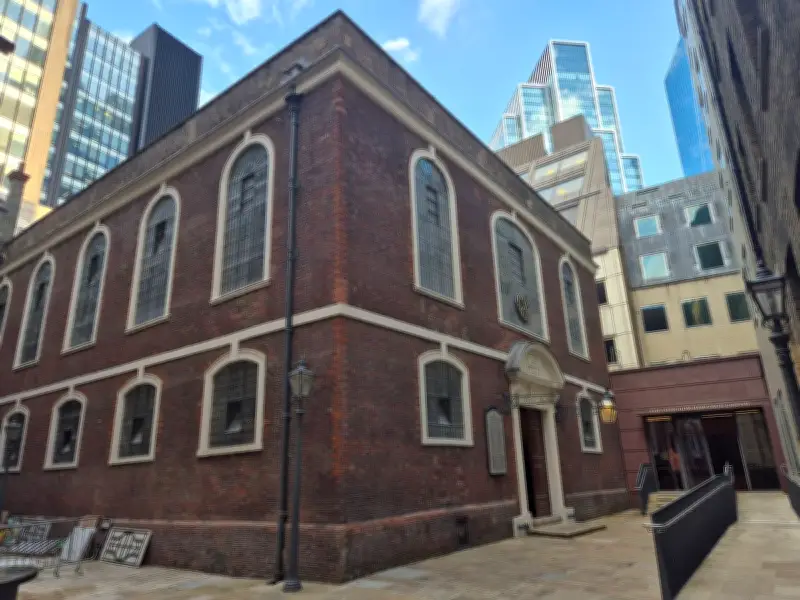
Bevis Marks Synagogue, the oldest synagogue in the UK and the oldest in Europe in continuous use, is launching a set of proposed guiding principles for developers and the City of London Corporation to protect its future from tall building proposals. The Grade I-listed site in the east of the Square Mile dates back to 1701, predating Sir Christopher Wren's rebuilding of St Paul's Cathedral, and has maintained regular worship for over three centuries.
Threat from skyscrapers
The synagogue, founded by Spanish and Portuguese Jews fleeing the Inquisitions, has faced several battles in recent years as tall building proposals threatened its functioning. In late 2024, a 43-storey tower proposed on Bury Street went before the City of London Corporation’s Planning Applications Sub-Committee. A key concern was the building’s impact on Kiddush Levana, a Jewish ritual requiring sight of the moon, performed outside at Bevis Marks since its founding and by the local community since the 1600s. The Bury Street scheme was refused, but the synagogue remains worried about future applications.
Draft planning framework
To preempt such proposals, Bevis Marks has created a draft planning framework, with a consultation launched on July 2. The document outlines the synagogue’s significance and offers guidance for the Corporation and developers. It includes three guiding principles: recognition of the synagogue’s unique importance, consultation through early engagement and mitigation of harms, and prevention of harm. The last principle asks proposals to form a “positive relationship” with the site, especially concerning the ability to see the moon and stars.
Rabbi Shalom Morris told the Local Democracy Reporting Service: “We felt it was really important for there to be a document that would help those who are landowners around us, and the City as a whole, to understand what the characteristics are of the synagogue that need to be protected, so that as development happens it can be done so in a sensitive way.” He noted a “lack of understanding and awareness” in recent planning proposals and hopes the document will create something “positive.”
Cultural and historical significance
Rabbi Morris emphasized the synagogue’s role as a living symbol of Jewish continuity: “As a place that is still alive it also represents the idea that the Jewish community is still here and isn’t going anywhere, and actually we need to celebrate that and recognise that. It is part of what makes England, England.” The proposed guiding principles are available online, with the consultation running for four weeks.