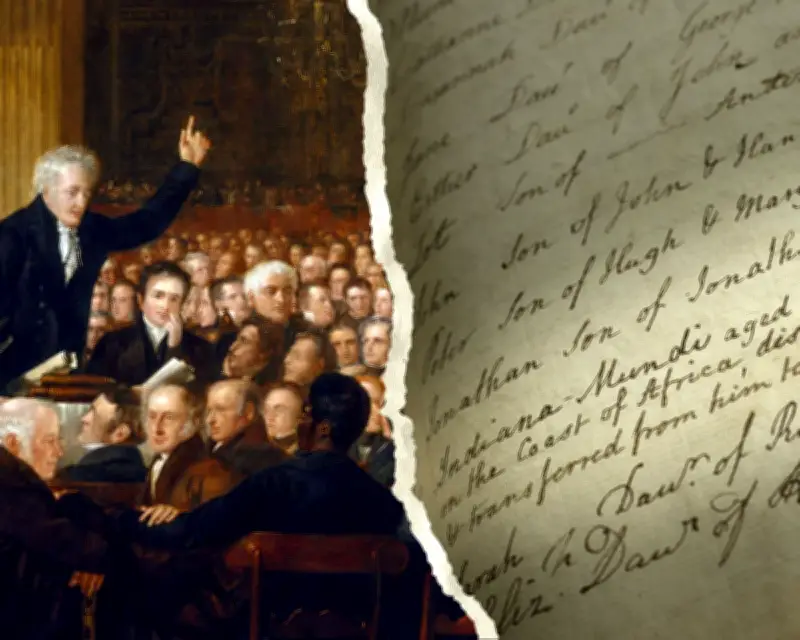
The baptism record of Indiana Mundi, a 14-year-old enslaved girl from Congo, has been rediscovered at Manchester Cathedral, offering a rare glimpse into the lives of Black Mancunians in Georgian England. The entry, dated 26 December 1798, states: "Indiana Mundi, aged 14. A negro girl from Congo on the coast of Africa, disposed of to Mr Paton at St Kitts & transferred from him to Arch.d Paton MD baptised this day."
Significance of the Discovery
The record was rediscovered by Cathy Hirst, research officer at Manchester Cathedral, while working through 18th-century ledgers. It is expected that Indiana and other enslaved individuals in Manchester will be honoured with a memorial at the cathedral, supported by Heritage Lottery funding, to be unveiled on Clarkson Day (28 October).
At the time, an estimated 20,000 Black people lived in England. Indiana was brought to Manchester by Dr Archibald Paton, a Liverpool doctor who had married Sarah Burton at the cathedral in 1797. She likely served as a household servant, as Black servants were then a status symbol. The name "Mundi," meaning "of the world" in Latin, was probably chosen by the Patons.
Political and Spiritual Significance of Baptism
Malik Al Nasir, a Cambridge University academic and author of Searching For My Slave Roots, explained that baptism during enslavement was both spiritual and political. Plantation owners discouraged baptism, fearing Christian teachings like Moses leading the Israelites out of bondage would encourage literacy and resistance. There was also a belief that baptism conferred legal freedom. Al Nasir noted: "The argument was that you can’t baptise a thing, you can only baptise a person – and because he’s a person, you cannot treat him as property."
This argument proved pivotal to the abolitionist cause. In 1771, the case of Somerset v Stewart in London ruled that no master had the right to forcibly detain an enslaved person for transport abroad. Judge Lord Mansfield declared slavery "so odious, that nothing can be suffered to support it, but positive law." Though narrow, the ruling exposed that no law permitted enslavement on English soil.
Impact on Abolitionism and American Independence
Benjamin Franklin attended the Somerset case and reported the legal direction to America, contributing to colonists' fears that Britain would compel emancipation—a driver of the American war of independence. In England, enslaved people ran away, declaring themselves free, while masters shipped them overseas to retain control.
Yet neither the crowd of Black Mancunians Thomas Clarkson saw in 1787 at the cathedral, nor Indiana Mundi, could be assumed free. The legal status of enslaved people in England remained contested, and the transatlantic slave trade continued until 1807.
Clarkson's Visit and Grassroots Abolitionism
Clarkson's 1787 Manchester visit was a seminal moment. He survived an assassination attempt in Liverpool before arriving in Manchester, where his sermon led to 10,500 Mancunians (one in five) signing a petition against the slave trade. Clarkson later wrote: "When I went into the church it was so full that I could scarcely get to my place … I was surprised also to find a great crowd of black people standing round the pulpit. There might be 40 or 50 of them."
Despite Manchester's role in the cotton trade built on enslaved labour, Clarkson's signature in the cathedral's "book of strange preachers" and Indiana's baptism record are among few visible links. Others include a memorial to Rev Richard Assheton, who inherited 244 enslaved workers, and a memorial to Dauntessy Hulme, who signed a petition opposing abolition in 1806.
Other Glimpses of Black Lives in Parish Records
Parish records offer further glimpses: on 20 May 1757, "Philip a Negro from Mr John Mosse" was buried at the cathedral; on 26 August 1831, Eliza Alburn, "a brown girl from Upper Germany," was buried. In Manchester city centre, "Immy and Fanny, two West Indian girls" were baptised at Cross Street Chapel in 1771, and "Frances Williams … a Black Woman" was baptised at St Mary Parsonage in 1767.
Hirst said: "As an institution we have to deal with this history – we can’t just keep celebrating the fact that we were important to the abolitionist movement."