Anna Ritchie, the archaeologist who led excavations at some of Orkney's most significant prehistoric sites, has died at the age of 82. Her work at Knap of Howar on Papa Westray uncovered the oldest standing domestic buildings in north-west Europe, dating back to the 4th millennium BC.
Early Career and Buckquoy Excavation
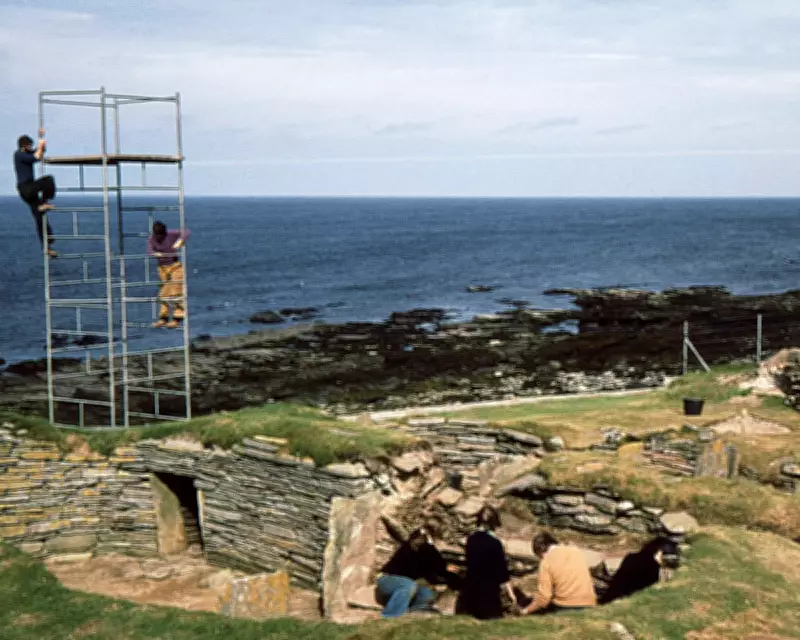
In 1970, erosion threatened a low mound at Point of Buckquoy on the far north-west corner of Mainland, Orkney, opposite the tidal island of Brough of Birsay. The potential significance of the site prompted a rescue excavation, and the young archaeologist called to direct the operation was Anna Ritchie. In her first project as director, she uncovered a sequence of stone buildings, primarily Pictish but with possible later Norse influence. The site raised questions about the transition between Pict and Viking, with Anna favoring a model of peaceful coexistence over aggressive takeover. Recent radiocarbon dating, more precise than methods available in the 1970s, suggests the settlement likely pre-dated Viking incursions entirely.
Excavation Techniques and Mentorship
At Buckquoy, Anna imparted her exacting excavation techniques to her team, mostly young diggers. The excavation was formative not only for her own career but also for many in her team, including the author and their future husband, the late Ian Shepherd. She devoted days off to transporting her crew around Orkney's archaeological sites, sharing her knowledge and enthusiasm.
Major Orkney Excavations
Buckquoy was followed by three important initiatives in Orkney. In 1972-73, with David Clarke, she co-directed excavations at the Neolithic settlement of Skara Brae, focusing on the site's economy and dating. In 1973, she began excavating at Knap of Howar on Papa Westray, a site previously partially excavated and assumed to be Iron Age. Anna recovered suitable dating material that reassigned the structures to the 4th millennium BC, making them the earliest standing domestic buildings in north-west Europe.
A decade later, after having two children, Anna returned to excavate a chambered cairn on the Holm of Papa, likely the burial place for the inhabitants of Knap of Howar. Her meticulous work recovered the remains of nine individuals and revealed evidence of varied and complex uses of the tomb over time.
Early Life and Education
Born in Putney, London, Anna was the daughter of Peggy and George Bachelier, who separated soon after her birth. She was raised in Surrey by her mother and stepfather, Charles Dunn, a professional photographer. Her interest in archaeology began at Woking Girls' Grammar School, where she curated a case of Roman and Egyptian artefacts. She earned a BA in archaeology at Cardiff and a PhD at Edinburgh in 1970.
At Edinburgh, she met fellow archaeologist Graham Ritchie, marrying him in 1968. She gained the regard of professor Stuart Piggott, who dedicated two of his poems to her. Anna remained a celebrated cook, known for preparing lobster for her crew on Papa Westray.
Freelance Career and Writing
Beyond excavations, Anna developed a wide-ranging freelance career, teaching extra-mural classes, university lecturing, and writing prolifically. From the 1970s to the 2010s, she produced two or more publications each year, including academic books and articles, general guidebooks, and popular works. Many were co-authored with Graham, notably Scotland: Archaeology and Early History (1981). She edited for the Society of Antiquaries of Scotland and wrote volumes for the series Exploring Scotland's Heritage. A memoir of her excavations was published by the Orkney Archaeological Society, and papers from a conference in her honour, Common Ground in Scottish Archaeology, were published in 2025.
Media and Public Engagement
Anna was a great communicator, providing an accessible face for archaeology in an era with fewer popular outlets. In 1971, she was a panellist on the television show Animal, Vegetable, Mineral?, discussing the Viking age. She wrote scripts and consulted for BBC's Chronicle and Blood of the Vikings, and for Channel 4's Time Team. A 1973 Chronicle time-lapse film of the Skara Brae excavations, compressing six weeks into four minutes, proved unintentionally comedic.
Leadership and Legacy
Anna served on governing bodies of archaeological and antiquarian organisations, including the Society of Antiquaries of London and the Society of Antiquaries of Scotland, where she became its first female president. She was a trustee of the National Museum of Scotland and the British Museum, and was appointed OBE in 1997. Latterly, she helped enhance the online Historic Environment Scotland database Canmore (now trove.scot).
She was described as graceful, modest, and self-deprecating, emerging spotless from even the muddiest trenches. She faced her illness with calm serenity, continuing to enjoy reading, jigsaws, and gardening until her final months. Her husband Graham died in 2005. She is survived by her daughter Elspeth, son Matthew, granddaughter Gabby, brother Leon, and sister Pat.