The Birth of the American Bank Heist: A Tale from 1831 Wall Street
It stands as the archetypal heist narrative: two cunning, hardened criminals; a simple yet daring plan; a determined law enforcement official; and the enduring mystery of $63,000 that vanished without a trace. The first bank robbery in America recorded in any substantial detail established the template for an entire genre of crime stories that continues to fascinate audiences nearly two centuries later.
The Etymology of "Heist" and Its Criminal Glamour
Have you ever pondered the origins of the word "heist"? This evocative term carries with it that dangerous, guilty glamour that art has consistently brought to crime narratives. A "heist movie" reliably quickens the pulse and triggers adrenaline surges. The finest films in this genre rank among cinema's greatest achievements: The Italian Job, The Thomas Crown Affair, Heat, Ocean's Eleven, and the meticulously crafted Rififi.
The term emerged during the 1920s, a decade that epitomized the allure of lawlessness. A "heister," meaning a thief, first appeared in 1927, documented in Dialect Notes Volume 5 of the American Dialect Society. "Heist" as a term for robbery appeared in Edward Dean Sullivan's Chicago Surrenders in 1930. The derivation proves surprisingly mundane, apparently a simple dialectical alteration of "hoist." The concept of "lifting" as a euphemism for stealing dates back at least to Shakespeare's era.
New York City in 1831: A Booming Metropolis
To discover what might be America's first recorded bank heist, we must travel back a full century earlier to New York City in 1831. The United States was just 55 years old, with military hero Andrew Jackson midway through his first presidential term. New York, experiencing explosive growth following the completion of the Erie Canal connecting the Great Lakes to the Atlantic, housed over 200,000 residents. This made it comfortably America's largest city—Baltimore and Philadelphia both had populations around 80,000—though modest by international standards. London, Beijing, and Paris all exceeded one million residents, while New York remained smaller than Edo, St. Petersburg, Constantinople, Vienna, and Naples. Yet the city grew rapidly, reaching half a million by mid-century and 3.5 million by 1900.
The City Bank of New York had been established in 1812 following the expiration of the Bank of the United States charter, Alexander Hamilton's initial attempt at creating a national banking institution. Operating from its handsome granite and limestone premises at 52 Wall Street, City Bank primarily handled foreign trade finance for New York. Inevitably, it also attracted attention from those who viewed appropriating others' wealth as the simplest path to prosperity.
The Heist: Methodical and Daring
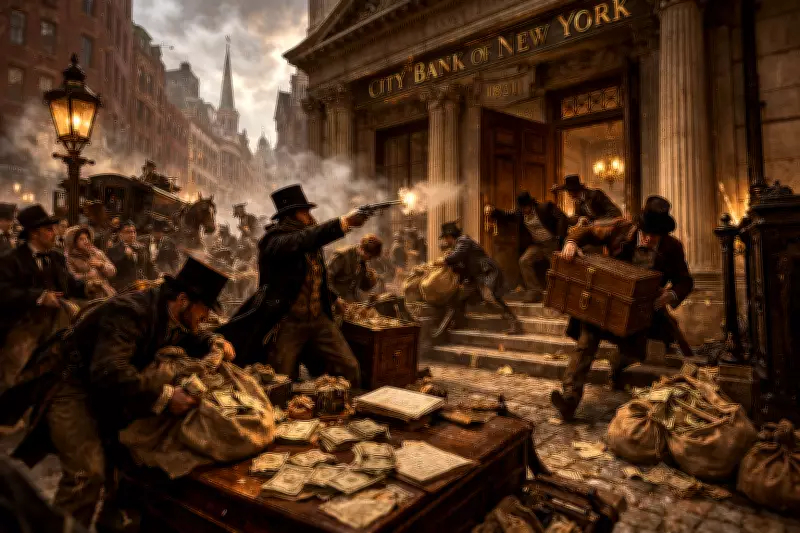
Exactly 195 years ago today, during the final hours of Saturday, March 19, 1831, two Englishmen entered City Bank using keys crafted from wax impressions of the doorlock, securing the doors behind them. Operating under numerous aliases, their identities appear to have been James Honeyman and William J. Murray—seasoned criminals who had served time at the penal colony of Sydney Cove in New South Wales. Honeyman's brother-in-law, a locksmith, had manufactured the keys for them.
Once inside the bank, the pair demonstrated remarkable patience. They emptied City Bank's vault and multiple safety deposit boxes, methodically filling several bags with coins—including 398 gold doubloons—and banknotes totaling $245,000. In today's currency, this amounts to over $50 million. After the nightwatchmen concluded their duties and dawn approached, Honeyman and Murray departed 52 Wall Street with bags concealed beneath their cloaks, heading to Murray's lodgings to divide their loot. Honeyman packed his share into three trunks and rented a room in a boarding house under the unoriginal alias "Jones." Murray, meanwhile, traveled 80 miles south to Philadelphia.
The Investigation and Capture
At City Bank, suspicion initially fell on employees, with the absence of forced entry suggesting an inside job. The following weekend's edition of The Saturday Evening Post published notice of the heist and offered a $5,000 reward for recovering the stolen funds. However, authorities were already closing in.
Honeyman's landlord grew suspicious of his tenant's behavior and the presence of three large trunks, eventually concluding they contained stolen property. On Saturday, March 26, Honeyman left the boarding house with one trunk, informing the landlord he would return for the remaining two. The landlord immediately summoned Jacob Hays, who had served as High Constable of New York since 1802. Approaching sixty, Hays possessed encyclopedic knowledge of the city's criminals and such relentless determination that parents warned misbehaving children, "Old Hays will get you."
Hays already had Honeyman in his sights. He knew the Englishman had been charged with robbing a Brooklyn bookstore, had attempted to steal money from a steamboat, and was rumored to remain a suspect in an English mail coach robbery. Hays and the landlord opened the two remaining trunks, discovering $185,785 in stolen money, then waited for Honeyman's return. When he reappeared three hours later, Hays placed him in handcuffs and brought him before a judge. Hays then traveled to Philadelphia, apprehended Murray, and returned him to New York.
Sentencing and Enduring Mystery
Honeyman and Murray each received five-year sentences in the newly opened Sing Sing prison, where absolute silence was enforced through whipping and prisoners were forced to quarry stone. $63,000 of the robbery proceeds, including the gold doubloons, was never recovered. For a period, Hays himself faced suspicion of having appropriated the missing funds.
This 1831 robbery established the quintessential heist blueprint: two shrewd, hardened criminals; a straightforward yet audacious plan; a tenacious law enforcement official; the morally satisfying conviction and sentencing of the perpetrators; and the tantalizing mystery of vanished wealth. America's first bank robbery documented in significant detail set the standard for an entire genre that continues to captivate imaginations nearly two centuries later.