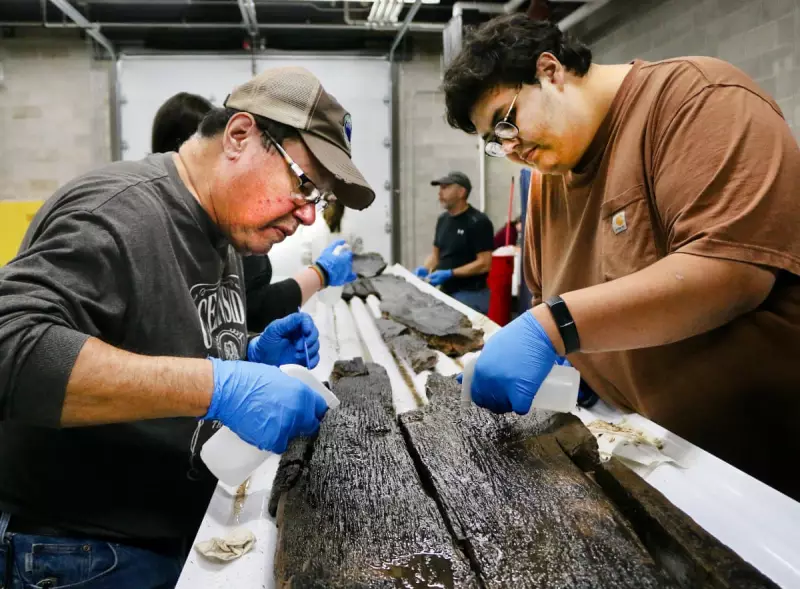
Archaeologists in Wisconsin have made an extraordinary discovery, uncovering what appears to be a prehistoric parking lot containing sixteen ancient canoes left behind by Indigenous peoples along the shores of Lake Mendota.
A Millennia-Old Watercraft Collection
The Wisconsin Historical Society announced the remarkable find, revealing that maritime archaeologists have mapped the location of sixteen submerged canoes resting in the lake bed of Madison's Lake Mendota. According to Tamara Thomsen, the state's maritime archaeologist, the site lies strategically near what were once Indigenous trails, suggesting ancient travellers left their watercraft there for communal use.
"It's a parking spot that's been used for millennia, over and over," Thomsen explained, comparing the ancient practice to modern-day bike sharing systems where community members could access transportation as needed for their journeys.
Uncovering Layers of History
The discoveries began in 2021 when archaeologists first uncovered the remains of a 1,200-year-old canoe submerged in 24 feet of water. The following year brought even more astonishing finds: a 3,000-year-old canoe, a 4,500-year-old canoe beneath it, and a 2,000-year-old canoe nearby, alerting researchers that they had stumbled upon something far more significant than initially anticipated.
Working in collaboration with Sissel Schroeder, a University of Wisconsin-Madison professor specialising in Native American cultures, and preservation officers from the Ho-Chunk Nation and Bad River Band of Lake Superior Chippewa, Thomsen has now identified the remains of twelve additional canoes at the site.
Ancient Origins and Environmental Context
Radiocarbon dating has revealed that the oldest of the sixteen canoes dates back an astonishing 5,200 years, making it the third oldest canoe ever discovered in eastern North America. Only two canoes found in Florida predate this discovery, with the oldest dating back 7,000 years.
Thomsen noted that Wisconsin experienced a significant drought beginning approximately 7,500 years ago that lasted until around 1000 BC. During this period, the area where the canoes were discovered would have been only about 4 feet deep, creating an ideal disembarkation point for foot travel.
Dr Amy Rosebrough, the state archaeologist, suggested travellers may have been headed toward Lake Wingra on Madison's south side, an area the Ho-Chunk Nation considers part of their ancestral homeland and views one of its springs as a portal to the spirit world.
Cultural Significance and Future Potential
Bill Quackenbush, the Ho-Chunk's tribal preservation officer, emphasised the deep cultural significance of the discovery, stating: "The canoes remind us how long our people have lived in this region and how deeply connected we remain to these waters and lands."
Thomsen, who typically spends her days uncovering Great Lakes shipwrecks and works on the canoe project just one day weekly, described this work as the most impactful of her archaeological career. "I think I've shed more tears over this," she admitted. "Talking with the Indigenous people, sometimes I sit here and just get goose bumps. Each one of these canoes gives us another clue to the story."
The archaeologist also speculated that if the drought began 7,500 years ago and they're finding canoes beneath other canoes, they may eventually discover a 7,000-year-old canoe in the lake, potentially revealing evidence of Indigenous peoples who predated many of Wisconsin's current tribes.