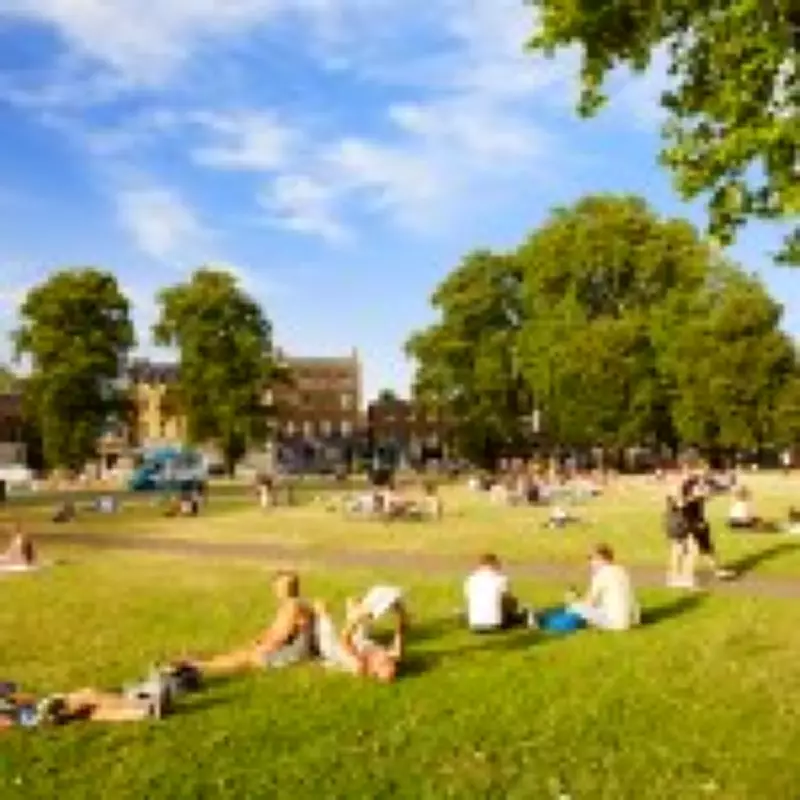
With urban homes often having limited outside space, many city-dwellers are forced to head to the park when it’s hot out. Every grassy knoll becomes prime real estate once temperatures hit 20°C — but while this influx of people makes for a lively summer atmosphere, it can also cause clashes. For some, a park is a sanctuary: somewhere to stretch out with a book, catch up with friends or let children toddle around safely. For others, however, green spaces are for kickabouts, frisbee matches and impromptu games of catch. The result, during crowded periods, is a seasonal battle between those seeking peace and those determined to play — a tension which often spills over online.
Users on social media have complained about what they see as inconsiderate behaviour from a group Metro has dubbed ‘ball-busters’, who obliviously encroach on packed public spaces with their games. It’s important to caveat that parks are for everyone, and not every park-goer who enjoys an impromptu five-a-side match with their mates is being disruptive. The offending party here is instead defined by a lack of awareness (or care) of those around them; sending objects flying into quiet picnics and sunbathers, busting apart others’ enjoyment and unwritten social rules alike.
‘My four-year-old daughter has had a ball kicked full force into the side of her face and her leg so we stay away now,’ Clare Court wrote on one UK park Facebook group. ‘I won’t take my little one there after nearly having a ball to her face, I just caught it myself,’ added another, Charlene Thompson. ‘After explaining to the kid it says no balls I had a mouthful of language back.’ Dad Andy Coley, from Hither Green, London, has experienced this first-hand, telling Metro: ‘I’ve been at the park and had footballs cruising through the middle of the picnic, almost knocking the food over. And sometimes people get more energetic and start swearing, which isn’t very nice.' The 50-year-old leadership trainer and author of Leadership is a Skill, continues: ‘It’s just situational awareness; checking on the people around you, and making sure it’s appropriate for where you are.’

Poll: What is your opinion on ball games in public parks?
- They should be allowed everywhere, parks are for everyone.
- They should be limited to designated areas to respect others.
- They should be banned altogether.
Some dismiss these complaints as over-sensitive grumbling though, including 45-year-old Jen Mellor from Mansfield, Nottinghamshire, who tells Metro: ‘[People playing games like football or frisbee] promotes physical activity for all ages, encourages a community spirit if others join in, and makes good use of these spaces. No one has any right above anyone else, so just position yourself away from anyone that’s doing anything you will interrupt or find will annoy you. Parks are for everyone young and old.’ Under a Facebook post where a woman complained about being hit by a stray ball, one user commented: ‘It’s a park and a ball. It’s not the end of the world.’ ‘Get a life, I’d rather kids play with balls on grass than watch them smash up a car because they are bored,’ added another, while a third, this time on Reddit, wrote: ‘You’re the same miserable people who moan that kids spend too much time indoors and need to get out more in the fresh air.’
But ‘ball-busting’ isn’t a new phenomenon, and many public parks have had rules in place for decades to combat the behaviour. In the Government’s model byelaws — which local authorities can adapt as required — councils have the option to ban ball games altogether, restrict them to designated areas, or require players outside these zones not to ‘exclude persons not playing ball games from use of that part’ or ‘cause danger or give reasonable grounds for annoyance to any other person’. Meanwhile, The Royal Parks website states: ‘Ball games are only permitted in certain areas of some of the parks. These ball games must also be informal, which we define as “jumpers for goalposts”.’

The psychology of ‘ball-busting’
So, why do some people become ‘ball-busters’ in the first place — and why do others struggle without calm and quiet, even in public spaces? According to Dr Bijal Chheda, consultant chartered psychologist and founder of Nos Curare, it’s all down to differences in how people experience stimulation, social environments and shared space. ‘Many people genuinely see public parks as spaces designed for movement and social interaction, so activities like ball games or frisbee feel completely appropriate to them,’ she tells Metro. ‘It’s not that they’re being inconsiderate, they’re often just experiencing the environment differently from those around them.’ Dr Chheda says some may not immediately recognise the impact their behaviour has on others due to differences in ‘spatial awareness, impulsivity or attention regulation’, which can be linked to neurodivergent conditions such as ADHD and autism. She also notes that we each naturally have a different tolerance for noise, movement and unpredictability in shared space, explaining: ‘In many cases, individuals underestimate the impact of their behaviour because they assume everyone shares the same expectations of public space that they do.’
On the opposite end of the scale, certain people may find it difficult to relax unless in a calmer, more predictable environment — particularly if they have anxiety, autism, OCD or sensory sensitivities. ‘Their brain may process surrounding stimulation more intensely, making busy public spaces harder to emotionally manage,’ Dr Chheda adds. Over time, she warns, this can lead some people to avoid public spaces altogether if they begin associating them with sensory overwhelm or distressing past experiences.
Upbringing may shape how people react to noisy park behaviour too, as preferences ‘often rooted in how our values were internalised over time’. The psychologist stresses that neither side is inherently wrong, but ‘when we understand where others are coming from, we’re better equipped to navigate these shared spaces with kindness and respect.’ ‘Be sure to notice how crowded the space is, how close others are sitting and whether children, elderly people or nervous dogs are nearby,’ she advises. ‘Small adjustments, such as moving to a more open area or lowering noise levels when spaces are busy, often help shared environments feel more respectful without stopping you from enjoying the fun.’
Do you have a story to share? Get in touch by emailing MetroLifestyleTeam@Metro.co.uk.