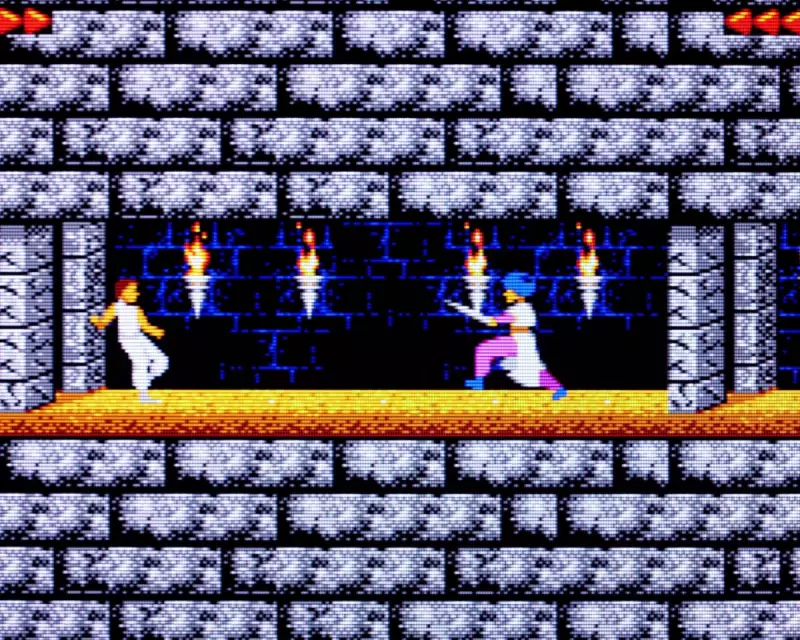
In the late 1980s, a groundbreaking video game emerged from a unique blend of Hollywood inspiration and painstaking technical ingenuity. Prince of Persia, created by Jordan Mechner and published by Broderbund, would go on to sell over two million copies and establish a template for action-adventure games for decades to come.
From Car Park to Computer: The Birth of Fluid Animation
The journey began in October 1985. With no dedicated animation software available, Mechner used a revolutionary technique to bring his character to life. He videotaped his brother, David, performing runs, jumps, and climbs in their old high school car park. The process was arduous: Mechner had to photograph still frames from the tape, develop the film, and then manually retouch the images into two-tone black and white for a digitiser to process. This quest for realistic movement, inspired by the rotoscoping in his earlier game Karateka, took months of meticulous work.
Mechner's creative vision was fuelled by cinematic thrills. He aimed to capture the relentless excitement of Raiders of the Lost Ark, where the hero faces death at any moment. The game's premise—saving a princess from an evil vizier within a strict one-hour time limit—came from a deep, personal place, later recognised by Mechner as an echo of his family's history as Jewish refugees.

Technical Ingenuity and a Last-Minute Nemesis
Moving to San Francisco to work at Broderbund's offices in 1986, Mechner found himself among programming legends like Will Wright. Despite the stimulating environment, completing the game took a total of four years. A major breakthrough came from a technical constraint. The game's fluid animation had maxed out the Apple II's 48K memory. At the suggestion of his then-girlfriend, programmer Tomi Pierce, Mechner knew the game needed combat, but had no memory left for new animations.
His ingenious solution was byte-shifting. This technique created a polarised "dark" version of the prince—the Shadowman—without using additional memory. This mirror-generated foe would steal the player's potions and block their path, providing the perfect antagonist. Freeing up memory allowed for sword-fighting animations, which Mechner rotoscoped from a six-second duel between Errol Flynn and Basil Rathbone in the 1938 film The Adventures of Robin Hood.
A Slow Burn That Rescued a Genre and Its Creator
When Prince of Persia was finally released in 1989, the Apple II platform was in decline. Its initial impact was muted. However, success in Europe and Japan led to a PC re-release in the US, where sales dramatically picked up. Publisher Doug Carlston noted that the game had an intangible, compulsive quality and that everyone at Broderbund knew they had a hit. It eventually went platinum, selling over 2 million copies.
The game's legacy is profound. It defined a new action-adventure template for platformers, directly influencing later 3D classics like Tomb Raider and Uncharted. It also foreshadowed the convergence of film and game technology. For Mechner, the franchise later provided a lifeline. After spending his savings on the commercial flop The Last Express, the success of the 2010 film adaptation of Prince of Persia: The Sands of Time, starring Jake Gyllenhaal, ultimately rescued him financially. The prince's arduous journey to save the princess, it turned out, had also saved his creator.