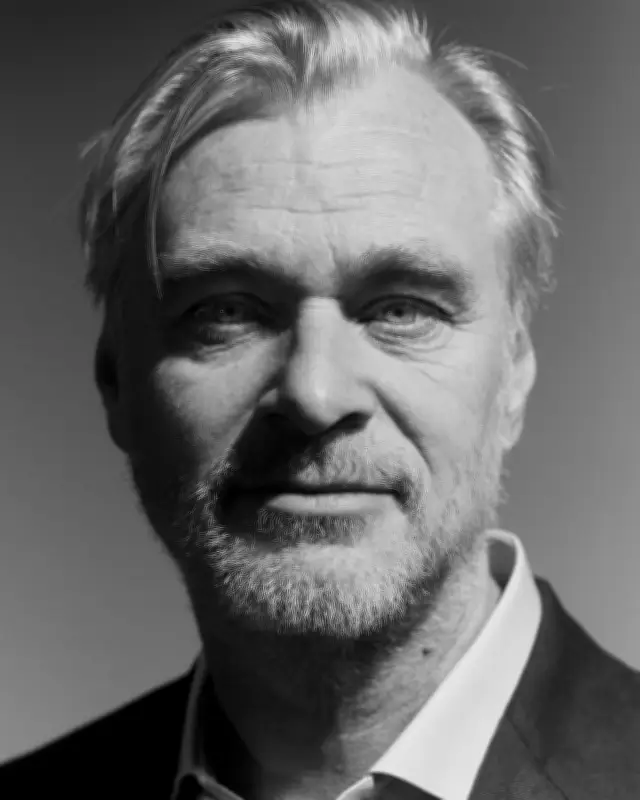
Christopher Nolan, sitting in a suite at the Corinthia hotel in London, appears relaxed despite the impending world premiere of his latest film, an adaptation of Homer's epic poem The Odyssey. The film, reportedly costing $250m (£185m), represents the biggest gamble of his career. Nolan acknowledges the pressure: 'It never gets any easier, because I make films for audiences and the audience tells me what it likes. They finish the film. I don’t have anything to hide behind. I can’t just be like: “Oh, people don’t get it.” Those aren’t the films I make.'
From Oppenheimer to Homer
Conceived in the wake of Oppenheimer's seven-Oscar triumph, the project was greenlit by Universal's Donna Langley. Nolan recalls receiving the directing Oscar from Steven Spielberg: 'I sort of collapsed in his arms like a runner crossing the finish line.' The film is, in every sense, a child of Oppenheimer. Nolan explains: 'I thought: OK, I’ve now got an opportunity to make a film that I wouldn’t be able to make otherwise.'
His wife and producing partner, Emma Thomas, adds: 'I don’t think there’s any world we could have gone to a studio and said: “We want to adapt a 2,700-year-old poem,” and that be an automatic huge movie. We were asking for a big budget to do it. That would not have happened without Oppenheimer.'

A long-held vision
Nolan first considered Homer in the early 2000s, after Memento's success, when he was briefly attached to David Benioff's script for Troy. The germ of his screenplay for The Odyssey came from an image of a beached monument sinking into sand: 'A true Hail Mary, as we say in America, just an act of absolute desperation that shouldn’t work. That was the first image I had. I carried that with me for 20 years. I always wanted to do it.'
The challenges of filming
The shoot, described as the hardest of many careers, crossed deserts, mountains, seas and Arctic landscapes. Cinematographer Hoyte Van Hoytema's team lugged 300lb (136kg) Imax cameras across terrain accessible only by helicopter or long hikes. Thomas recalls: 'At the end of each day the heads of department would have dinner and then we’d collapse into a screening room to watch dailies. Every time you would get through one challenge, you’d think: oh my God, we did it. And then you’d think: oh no, next week we’ve got a whole other thing to deal with.'
Nolan admits to moments of doubt: 'There were times where I felt like maybe I’d bitten off more than I could chew.' One location, the ruined clifftop Castello di Santa Caterina on Favignana, required a 45-minute uphill hike each day. 'That loomed very large over me,' Nolan says, but the cast's spirit, including Tom Holland bounding up the path, kept morale high.
Trauma-bonding and a new puppy
On the last day of filming, after wrapping at Universal at 1am, Thomas cracked open champagne. 'It really felt like nobody wanted to leave. It was like we were totally trauma-bonded. You want to carry on, jump out the plane again.' Nolan also credits his new chocolate labrador, Charlie, acquired after his four children left home, for helping him cope. 'I never had a dog as a kid, and we never got a dog when the kids were younger because we travelled too much. They’re a bit fed up that we got one as soon as they left, although they love the dog.'
Culture-war static and strong female roles
The film has generated culture-war backlash over the casting of Lupita Nyong'o as Helen and Elliot Page as Sinon. Nolan, however, has written his strongest ensemble of female parts to date. Helen, Penelope, Circe, Athena and Calypso are fully realised characters. 'In the text, they’re icons,' Nolan says. 'The problem is that there’s not so much to them beyond these ideals. What I love about what the women in this movie have done is they give you a sense of the person behind the icon.'

What's next?
Thomas notes that Nolan typically gets restless about a week after finishing a project. 'That’s when he’ll begin to really home in on: “OK, I need to do something.”' Nolan himself says: 'I’m so desperate to have a period I have nothing to do. It feels so long since I had a time like that. I get bored very quickly and that’s one of the reasons I like to go back to work.' For now, he faces rolling premieres and an inevitable awards campaign. 'All I can see is just trying to get through this, put the film out and then take a little break.'