Art and eroticism … passions abound in La Gradiva. This is cinematographer turned director Marine Atlan’s beautiful debut film about young love, superbly acted and directed. It is a reminder of how fundamentally dishonest and pseudosophisticated it is to laugh dismissively at the emotional dramas of our teen years, and to claim we just want to tell our younger selves to relax and get a sense of humour. In fact, those long-repressed moments of euphoria and humiliation, so dangerous and potentially explosive, will guide us for the rest of our lives, whether or not we acknowledge it.
Plot and Inspiration
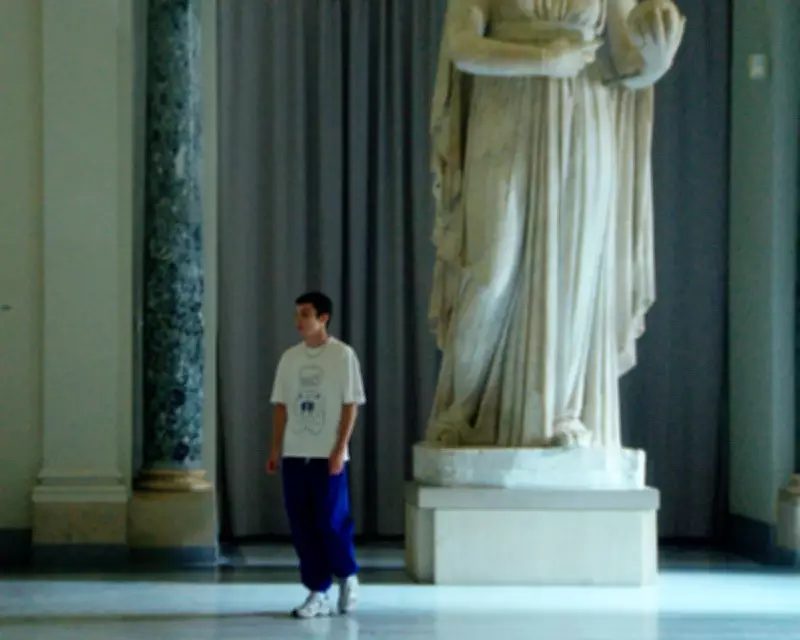
Atlan’s title is a reference to Wilhelm Jensen’s 1902 novella Gradiva, much admired by Sigmund Freud, in which an archaeologist is transfixed by the image of a woman he names “Gradiva” in a Roman museum and imagines she existed in Pompeii during the great Vesuvius eruption. This concept of transplanting an image to a time of catastrophe brings understanding of lost love. Atlan and her co-writer, Anne Brouillet, imagine a lively class of talented French teenagers led on a stressful but exciting school trip to Pompeii and Naples by their teacher, Mercier, played with superb intelligence and sympathy by Antonia Buresi. Mercier has been brought to the verge of quiet breakdown by emotional frustration and the thankless task of keeping the kids in line. There is a funny and heartbreaking moment when the Italian coach driver asks if she is “on her own”, and she embarks on a thoughtful monologue about being without a partner or children before realizing he meant if she was leading the class alone.
Main Characters
One particular pupil winding up Mercier is Toni (Colas Quignard), who plays music annoyingly loudly on the train and fails to submit homework despite extensions. Atlan places Toni at the centre of the film’s opening tableau in a mysterious nexus of sexual tension. Toni secretely stares into a couchette at his friend James (Mitia Capellier-Audat) and Angela (Hadya Fofana) who have just had sex; later, James reveals it meant nothing. Watching Toni from the corridor is Suzanne (Suzanne Gerin), a smart, disaffected girl fascinated by Toni and James, feeling least attractive in the class. She morosely reads Agatha Christie’s The Body in the Library. In the girls’ dorm, Suzanne listens angrily to Angela’s complaints about James ignoring her texts, saying, “Some women have to be unfuckable for others to be fuckable.” Atlan creates a dream sequence for Suzanne where she appears as Gradiva in Pompeii and has sex with Angela.

Toni considers his problems paramount and is electrified by the trip’s personal significance. His mother told him his grandmother was a maid in a grand Pompeii castle having a tragic love affair with an aristocratic master, forced to leave after the 1980 earthquake. Toni believes this forbidden love caused his grandmother’s pregnancy and departure to France. He likes to get high in Pompeii and hook up with guys online, but his main mission is to discover the truth about his noble lineage.
Teaching Scenes and Themes
Teaching scenes in films always fascinate, and these are tremendous. Mercier patiently, sometimes angrily, tries to get students to appreciate complexity, nuance, eroticism, and social commentary in frescoes and artwork. A nerdy student, Jean-Eudes (Mathéo De Carlo), thrills Mercier and irritates the class with his brilliant exegesis. Mercier brings commitment to an alfresco geological class on volcano origins. The pupils’ evening discussions on politics, racism, and sexism also show sinew and interest, with Mercier often listening tolerantly.
Atlan shows Suzanne’s self-worth restored not by love but by events showing her in a not-so-flattering light. She successfully humiliates James with a nasty prank, does well in college admissions, and is intimate witness to Toni’s disillusion. Suzanne has a vivid sense that she is one of life’s winners after all. This shifting sense of status is part of the mysterious darkness engulfing the story, overwhelmingly sad and sombre. La Gradiva screened at the Cannes film festival.