In November 2022, Iranians gathered around a bonfire on the streets of Tehran, chanting, 'You're the pervert. You're the whore. I'm a free woman,' in defiance of the state's strict dress codes. The video, sourced from Vahid Online and photographed by Parisa Azadi, captures a moment of rebellion during anti-government protests.
Women Behind the Lens: A Story of Mourning and Resistance
Iranian visual journalist Parisa Azadi set her images alight in response to January's violent repression by the regime. She explains that this act was not to erase them, but to convey 'rage, grief and refusal.' In September 2022, as revolution spread across Iran, Azadi witnessed it from Dubai through the unstable glow of phone screens. Raw videos surfaced daily before disappearing into internet blackouts: women burning their hijabs, young men wounded by metal pellets, and teenagers dragged into unmarked vans.
Unable to return safely to Iran, where she had spent six years documenting life under repression, Azadi felt helpless. This work emerged from that pain and is both testimony and absence: the public violence of the state and her private, long-distance bearing witness.

The Process: From Digital to Physical
Using open-source protest footage, Azadi began isolating frames from videos circulating on social media and photographing them directly from her computer with a Fujifilm instax camera, which can produce prints immediately. She wanted to interrupt the relentless flow of digital images – to arrest their movement, turning ephemeral pixels into solid physical objects. The process grew from her earlier work in Iran, where she carried an instax camera and gave portraits to strangers as yadegari – 'something to remember me by.' These small keepsakes were gifts as well as records, shaped by intimacy and precaution. During the uprising, that same ethic took on new urgency, transforming the medium into a response to rebellion and censorship.
The Image: Defiance in the Streets
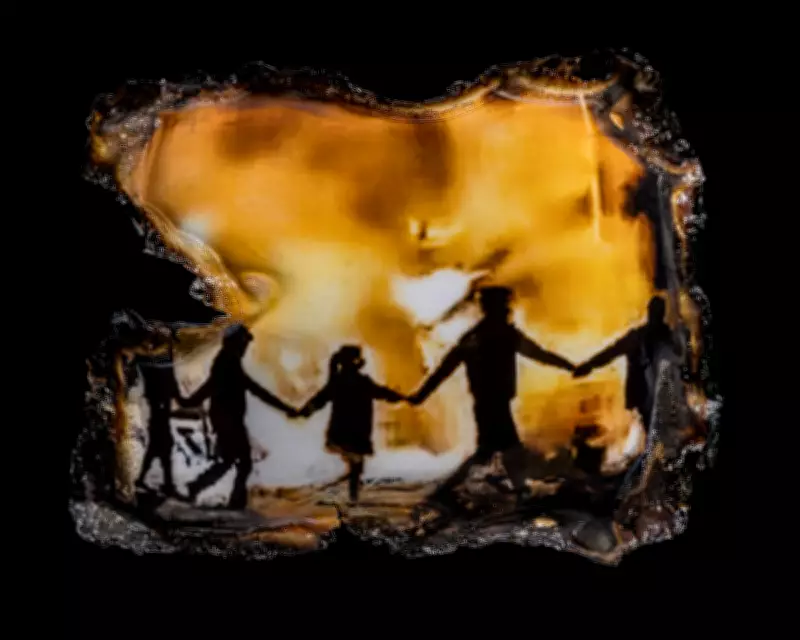
This particular image comes from a protest video in Tehran: crowds circle a fire burning in the street, holding hands and chanting, transforming misogynistic insults into defiance against the state. In the face of terror and repression, the body becomes the primary battlefield, refusing to return to the old way of life. Azadi photographed the silhouette of a young woman, perhaps an adolescent, with a high ponytail moving against smoke and fluorescent light. Its grainy, pixelated surface carries the urgency of testimony over perfection. It departs from her carefully composed, higher-resolution documentary style to embrace what German artist Hito Steyerl calls the 'poor image' as a politically potent form of testimony.
Burning Prints: An Act of Mourning
The photograph is part of a wider body of work drawn from protest fragments. In January 2026, after state massacres and executions, Azadi began burning the instax prints as an act of mourning. Fire scarred their surfaces, echoing the violence they depict. This was not erasure, but a way to push against the stillness of the image, allowing it to convey rage, grief, and refusal. For Azadi, this photograph holds revolt and transformation. It continues a practice shaped by care and witness, while embracing precarious, low-tech forms to respond to a movement insisting on bodily freedom. It speaks to rebellions public and private – on the street, in the home, across generations – and belongs to an unfinished, unfolding story of resistance.