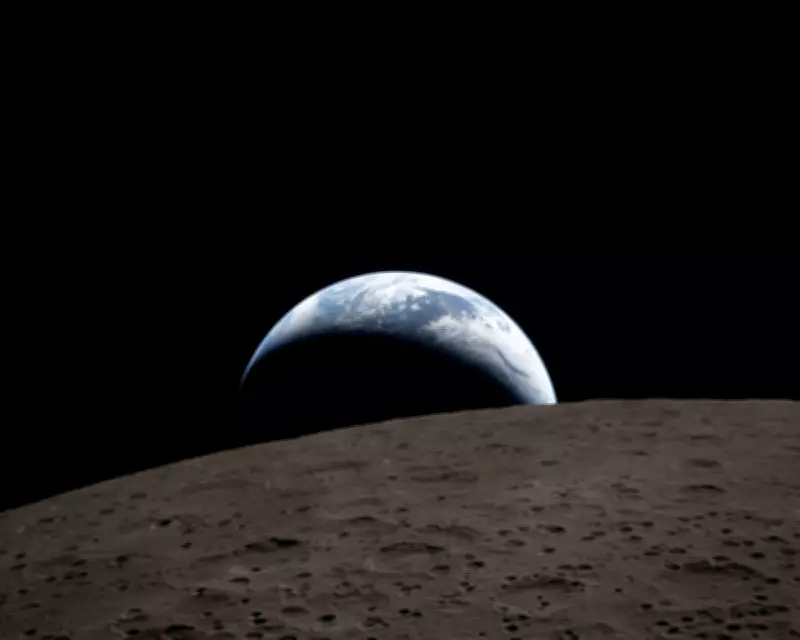
NASA's Sonifications Transform Moon's Dark Side into Audible Cosmic Music
While the Artemis II mission captivates with its lunar exploration, NASA's innovative sonification projects are turning the silent void of space into a symphony of cosmic vibrations. The process converts electromagnetic energy from celestial bodies into audible sound, offering a new way to experience the universe.
From Apollo Mysteries to Artemis Revelations
The Apollo 10 mission in 1969 reported strange whistling sounds during its dark side passage, later explained as radio interference between spacecraft transmitters. Today, Artemis II astronauts experience their own auditory environment, complete with wake-up music ranging from Chappell Roan to CeeLo Green, creating a human connection across 240,000 miles of space.
Space itself may be silent to human ears, lacking atmosphere to carry sound waves, but it teems with electromagnetic energy that NASA's sonification technology makes perceptible. By slowing hyperactive electromagnetic frequencies to audible ranges, scientists create sonic representations of Jupiter's orbits, Saturn's rings, and solar activities.

The Science Behind Cosmic Harmonies
These sonifications reflect ancient concepts of "music of the spheres" updated through modern physics. Theoretical physicist Michio Kaku suggests cosmic vibrations resonate through multiple dimensions, while every element of the universe—from dark matter to supernovae—consists of vibrating energy frequencies similar to musical tones.
The 2005 Huygens probe recording of Titan's atmosphere descent remains particularly remarkable, requiring no sonification due to the moon's dense atmosphere and providing direct auditory connection between worlds.
Artistic Interpretations of Cosmic Sound
Author Samantha Harvey's Booker-winning novel Orbital poetically describes planetary sounds as "liquid and rushing" or "metallic pulsing hum," capturing both the artistic and scientific essence of space sonification. Her metaphors align with NASA's actual audio transformations, bridging artistic imagination and scientific discovery.
Meanwhile, classical music continues exploring cosmic themes, with Karl Jenkins' The Armed Man: A Mass for Peace recently topping Classic FM's Hall of Fame. The work's anti-war sentiment resonates particularly in our current global climate, though Benjamin Britten's powerful War Requiem remains conspicuously absent from the rankings.
The Universal Language of Vibration
NASA's sonification projects demonstrate that while space may be silent to direct human hearing, the entire cosmos vibrates with energy that can be translated into musical experiences. From the electromagnetic maelstrom surrounding Artemis II to the gravitational waves stretching across galaxies, everything in existence participates in this cosmic symphony of frequencies.
As Artemis II continues its journey, these sonic transformations remind us that music exists not just in concert halls but throughout the universe—in the very fabric of space-time itself, waiting to be heard through the right technological interpretation.