Tech-Heavy Dance Double Bill at Sadler's Wells East
In a provocative exploration of modern tensions, Alexander Whitley Dance Company presents a double bill at Sadler's Wells East in London, featuring Mirror and a reinterpretation of The Rite of Spring. This performance delves into the complex relationship between human expression and advancing technology, raising questions about artistic balance in an increasingly digital world.
Mirror: Digital Doppelgangers Overshadow Live Dancers
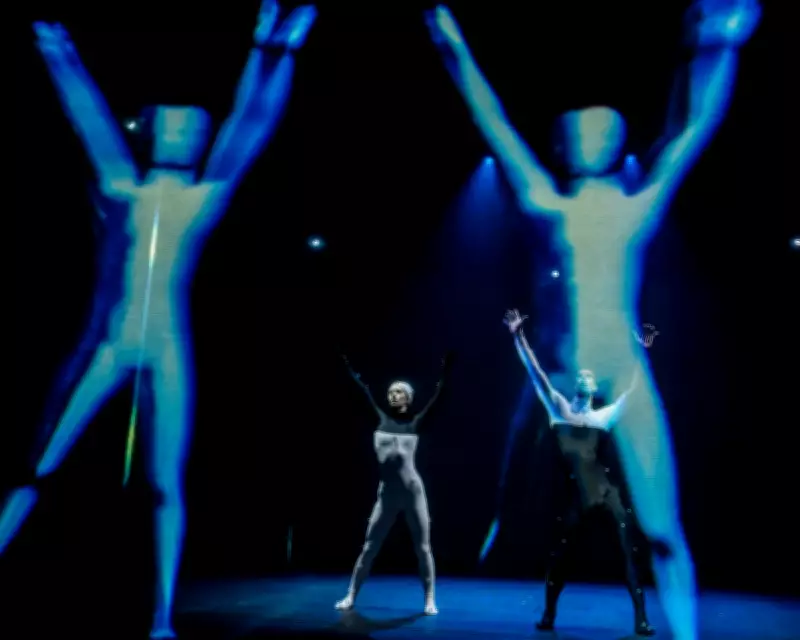
Mirror, a new duet choreographed by Alexander Whitley, showcases dancers Gabriel Ciulli and Daisy Dancer in black and white leotards adorned with motion-capture markers. Their movements spiral into intricate symmetries, shifting between intimate closeness and forceful counter-pull. However, this human interplay is disrupted by an impersonal beam of light that scans the stage, triggering flickering rectangles on a front cloth. These digital frames serve as portals for luminous doppelgangers, which initially echo the dancers but quickly upstage them, redirecting the performers' focus toward their ghostly avatars.
While the piece maintains a thread of human drama—featuring moments of departure, angst, and reconnection—the narrative becomes almost incidental. A series of scenes unfolds within spacey soundscapes, dominated by special effects such as multiplied bodies, dendritic flickers, and cosmic dust. Critics note that technology ultimately triumphs without clear justification, sidelining the emotional depth of the live performers.

The Rite of Spring: Techno-Primitivist Sequel with Glitched Score
In Whitley's version of The Rite of Spring, human elements take a slightly more prominent role, yet digital influences persist. Set on the same stage with projection cloths and a central circle of light, this piece features five dancers responding to a glitched and layered rendition of Stravinsky's iconic score. The choreography, described as uncharacteristically rudimentary, includes blunt-edged torques and lunges that align with the distorted music.
Gabriel Ciulli delivers another tortuous solo, while Elaini Lalousis performs a somewhat anticlimactic sacrificial dance. A brief, intriguing moment connects a tight circle of dancers to an iridescent ring reminiscent of Meta's AI icon, but this visual metaphor passes quickly. Overall, the piece's energies feel dissipated, leaving audiences with a sense of unfulfilled potential.
Audience and Critical Reception
The double bill has sparked discussions about the role of technology in contemporary dance. While the visual spectacle is undeniable, with motion-capture and generative effects creating immersive environments, some argue that the human drama is overwhelmed. Performances continue at Sadler's Wells East until March 21, offering viewers a chance to experience this tech-heavy exploration firsthand.
Alexander Whitley, known for his innovative use of digital, generative, and VR technologies, pushes boundaries but risks alienating traditional dance enthusiasts. As artificial intelligence and computing tools become more integrated into the arts, this production serves as a timely reflection on the balance between innovation and emotional resonance in performance.