The Punk Rock Flea Market: Seattle's Unlikely Cultural Lifeline
On a recent Friday afternoon in Seattle's Capitol Hill neighborhood, the unlikely sound of "Caravan of Love" echoes through the commercial corridor, emanating from the open doors of the Punk Rock Flea Market. This itinerant bazaar has become a quarterly institution since 2024, occupying a 20,000-square-foot former supermarket space left vacant when a Kroger-owned QFC abruptly departed.
A Two-Decade Journey Through Seattle's Changing Landscape
The market's $1 entry fee remains unchanged since its 2006 inception in an abandoned basement bar. Over two decades, it has occupied 13 different locations across Seattle—including former post offices, drugstores, and even a strip club—before settling in its current home within the city's historically queer arts epicenter. According to organizers, more than 8,000 people typically attend each weekend event, with December installments regularly reaching five figures.
The market represents a stark contrast to Seattle's dramatic transformation over the past 20 years. The city has evolved from what was once considered a low-stakes, overachieving cultural incubator into what many describe as the United States' hub of neoliberal corporate capitalism. Bureau of Labor Statistics data reveals the cost of living has skyrocketed by 78%, positioning Seattle as the world's 12th most expensive city—a reality that leaves little room for the artists and cultural innovators who originally made the city famous.
Inside the Parallel Economy
Stepping inside reveals a parking lot transformed into dozens of vendor booths, tables, and a food-truck court, while inside the building, DJ Port-a-Party transitions from the Housemartins to Kermit the Frog's "Rainbow Connection." The space hosts 204 vendors and hundreds of shoppers engaged in what founder Josh Okrent describes as "trading among ourselves in a way that refuses to recognize any other order."
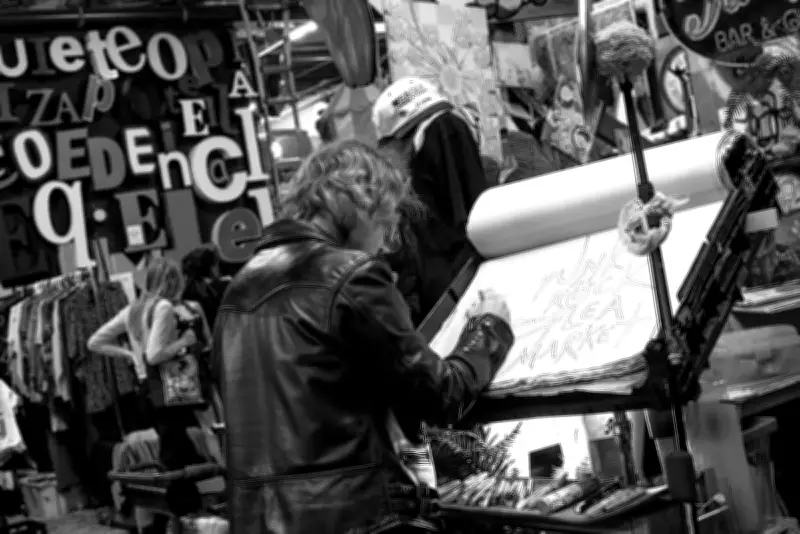
The market defies simple categorization: part renegade art gallery, part unfathomable yard sale, and part curated vintage mall. Where produce sections once stood, vendors now display artwork made from dried seaweed alongside anarchist booksellers and wooden dagger carvers. In former storerooms, hundreds of Hot Wheels and action figures hang in displays reminiscent of 1980s toy stores. Every surface—walls, floors, even ceilings—bears the evolving artwork of hundreds of local artists, some commissioned, others spontaneous.
"I'm an ageing punk. I'm a weirdo," says regular vendor Ray Myzelle Bones, who sells lavender products from her farm outside the city. "This is a place that's safe for neuro-spicy people. It's also this current of community that people say we've lost, but we haven't. It just lives somewhere else."
From Anti-Establishment to Community Establishment
What began as an anti-establishment endeavor has itself become an establishment, though one that has deepened its community-minded values. The Punk Rock Flea Market operates as a non-profit organization, donating proceeds to Seattle's Low Income Housing Institute and employing formerly unhoused individuals. It maintains intentionally low barriers to entry to maximize accessibility.
Founder Josh Okrent, a 57-year-old father of two and longtime professional non-profit fund developer, explains: "Punk stems from a musical style, but there's an entire worldview that transcends the music. We are punk in that we are defining our own identity. We're not political in terms of actively resisting anything, but we are organizing to trade among ourselves in a way that refuses to recognize any other order and makes no concession."
Okrent views trading as a fundamental human activity that predates and will outlast capitalism. "All the money is being kept in the community, and that's the objective," he states, describing the market as an example of what Czech philosopher Václav Benda termed a "parallel polis"—a self-contained society existing as a mirror to the status quo.
Survival Through Adaptation and Partnership
The market's journey hasn't been without challenges. After outgrowing its original location, Okrent spent years moving between spaces left vacant before new development transformed them into condos or expensive commercial real estate. During the pandemic, the market occupied an abandoned Bartell Drugs location through Seattle's Storefronts program, which covered the rent. This downtown location became ground zero for the collision of Seattle's homelessness and fentanyl crises.
"We had these people not only living on our doorstep, but dying on our doorstep," Okrent recalls. Staff member Ruby Tuesday Romero, who attended the inaugural market as a teenager, administered Narcan to overdose victims and responded to electrical fires started by squatters. "As someone who'd recently exited homelessness, it was a really big deal for me to be a part of that community and try to help others in that situation," she says.
Lessons learned downtown eventually led to the market's current Capitol Hill location through a partnership with real estate development firm Hunters Capital. Jill Cronauer, Hunters Capital's chief operating officer, recalls initial skepticism: "The building was broken into several times and was in really rough shape. So one of our biggest questions was, how is anyone going to take this space and make it work?" Okrent's proposal included upgrading the property and improving public safety by bringing cultural life to the neighborhood.
"These guys are just so talented and creative and have such an amazing volunteer team behind them that they made the space what it is today," Cronauer acknowledges. Okrent, who rarely praises landlords, calls Hunters "fantastic" and notes their genuine alignment with community needs in a city plagued by chronic vacancies and exorbitant rents.
A Growing Movement with Anarchistic Governance
While Okrent owns the Punk Rock Flea Market name as a Washington state business license, he takes no ownership of the concept itself. Unaffiliated versions have emerged in Philadelphia, London, Berlin, Toronto, Winnipeg, New Jersey, Phoenix, Salt Lake City, and elsewhere through exchanges with organizers from cities like Reno.
The Seattle market's paid staff of 11 meets weekly to plan year-round events including all-ages concerts, fashion shows, and raves. Governance follows an anarchistic model where consensus emerges through argument and compromise, with decisions made collectively among staff, volunteers, and vendors. They currently lease from Hunters Capital on a six-month basis, with plans to remain until construction begins on a six-story mixed-use development planned for the site.
"There's no amount of money that could replace the culture that we've created for ourselves," Okrent reflects. "At the end of the day, it's about the people who make it happen. We like each other and we like working together, and there's something wonderful about coming together in the challenge of this abandoned building and turning it into something beautiful—beautiful by our standards."
As Seattle continues its corporate transformation, the Punk Rock Flea Market stands as both a relic of the city's creative past and a living testament to alternative economic possibilities—a parallel polis thriving in the shadow of neoliberal capitalism, sustained by community, creativity, and a dollar at the door.