When Shahidul Partha was growing up in Kulkandi, Bangladesh in the early 2000s, many villagers watched World Cup matches on his family's property. Upwards of 80 people piled into his front yard to watch the action on a 14-inch black-and-white TV, run by battery. They sipped milk tea and ate biscuits, cheering whenever Brazil or Argentina scored.
A passion rooted in history
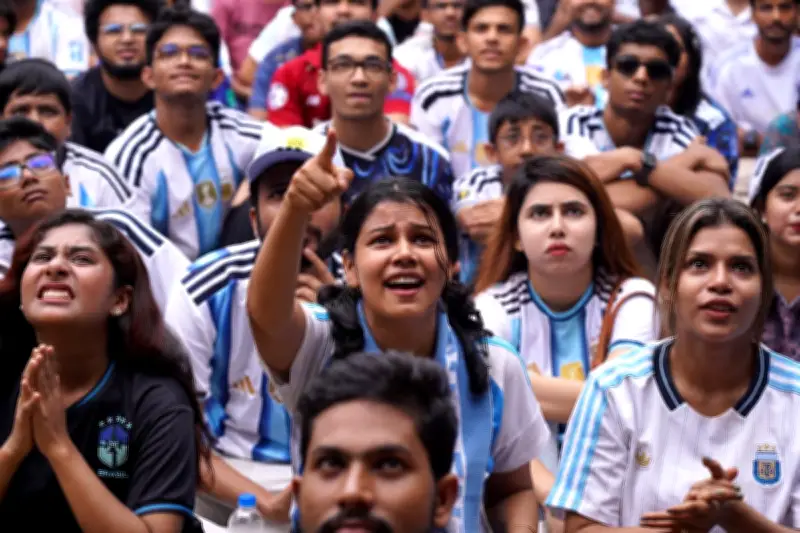
Bangladesh's national soccer team has never qualified for the World Cup, but the nation of more than 170 million people and its diaspora have long supported Argentina and Brazil. Nearly 20% of the traffic to the Guardian's live blog for Argentina's opening match with Algeria on 16 June came from Bangladesh. In Brahmanbaria, a Brazil superfan painted his house green and yellow to commemorate the nation's flag.
After Bangladesh's independence from West Pakistan in 1971, support for Brazil originated in the 1970s when Pelé was at his peak. Citizens of a newly formed nation related to the formerly colonized Brazilians and Pelé's transcendence from poverty. Mehedi Farhana, 48, an associate pharmacist born in Bangladesh now living in Hatfield, Pennsylvania, recalls her third-grade history textbook detailing Pelé's early struggles. "We are in that time, a third-world country. We are trading minimum resources, but we want to prove to the world that we can do it," she says.
The 1986 World Cup: A turning point
By the 1980s, color TV ownership surged in Bangladesh. Most Bangladeshis watched the World Cup for the first time in 1986, when state-owned BTV broadcast the tournament live. They were enthralled with Argentina and Brazil. In the quarter-finals, Argentina defeated England, which colonized the region for nearly 200 years. Diego Maradona's "hand of god" goal remains a source of pride. "These big stars are coming up, and they're defeating the nations who occupied before," said Onyx Chowdhury, 40, a Bangladeshi American from Long Island, New York. "In a match of soccer, that played a role in people's hearts."
The 1986 World Cup also occurred during political tension in Bangladesh, under martial law. Ibrahim Chowdhury, 65, a journalist and former activist, recalls hiding from police while watching matches. "We were fighting against the autocracy of military government. At that time that was the only entertainment that came in," he says. Now living in North Brunswick, New Jersey, he secured a volunteer position at the 2026 World Cup to greet fans, fulfilling a lifelong dream.
Generational fandom and community
Onyx Chowdhury sees a generational divide: older fans root for Brazil (Pelé's era), while his generation supports Argentina (Messi's era). In Paterson, New Jersey, the Bangladeshi American Sports League, founded in 2018, has hundreds of members who mostly support Argentina. "It's like an emotion to Bangladeshi people," says league secretary Monsur Latif, 34. "They don't see Brazil or Argentina as a different team. It's more like it's 'us'."
Throughout the month, community members host watch parties. Latif rooted for Brazil as they defeated Haiti on 19 June at a friend's house. Onyx Chowdhury is instilling fandom in his one-year-old son, dressing him in an Argentina jersey. "Through fandom, there's some sort of connection to where you're originally from," he says.