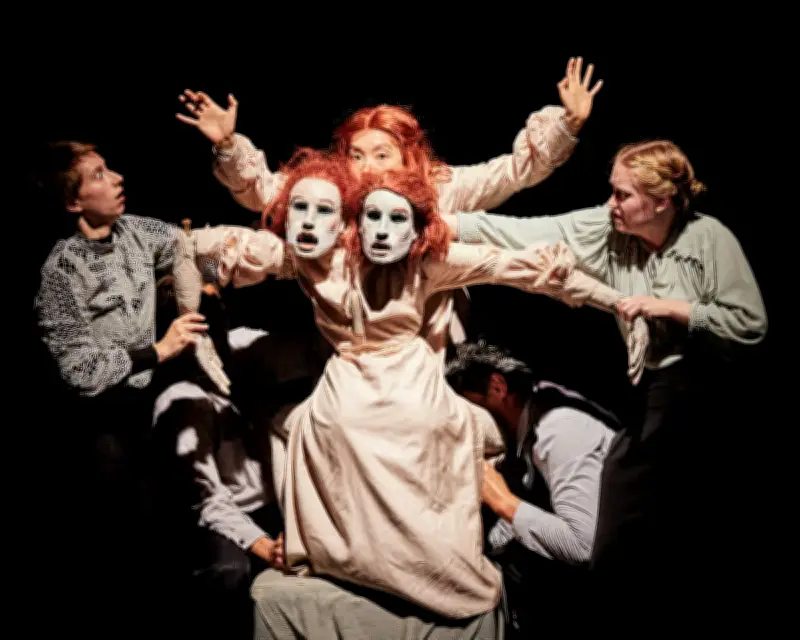
The Edinburgh fringe this summer will host a deeply creepy puppet version of Dracula, a show that director Yngvild Aspeli warns is definitely not for small children. The production, titled Dracula: Lucy's Dream, features a lifesized waxen puppet that one critic found as indelible as classic portrayals by Gary Oldman or Christopher Lee.
An Eerily Lifelike Puppet
Aspeli, director of the French-Norwegian company Plexus Polaire, describes Dracula as 'a good character for a puppet' because the inanimate object 'needs the blood-and-flesh actors to make him come alive.' The show uses sophisticated technical effects, including Emilie Nguyen's spectral lighting, to create stunning transformations where actors and puppets become indistinguishable. After seeing the show in Paris, one journalist reported it still haunts them, noting that the puppet seemed to disintegrate and reappear before their eyes.
A Feminist Twist on the Classic Tale
Aspeli's adaptation draws on a 1901 Icelandic translation, Powers of Darkness, in which Valdimar Ásmundsson 'took many liberties, adding and changing characters' to Bram Stoker's original. Unlike recent feminist revamps that gave Mina Harker control, this version places Lucy at the heart of the story. Aspeli says her productions often 'take the female character out of the victim position,' not to change the story but the perspective. On stage, this creates a sisterly counterforce to the patriarchal men of science who take charge of the case and the women.

Exploring Trauma and Manipulation
Aspeli, who founded Plexus Polaire in 2008, explains that the company's name reflects her interest in the solar plexus, where emotion sits in the body, and polarity, balancing sanity and madness, reality and illusion. Her retelling of Dracula explores trauma and how psychological abuse can 'control you even after it's no longer happening – what does this action do to your body and mind afterwards?' This theme also informed her feverish version of A Doll's House, where Nora's tarantella introduces an enormous spider.
Minimal Props, Maximum Illusion
Despite the atmospheric, fully realised world of Dracula: Lucy's Dream, only five people appear at the curtain call, visibly tired from their industrious work in and out of the shadows. The props are minimal, resembling a conjuring act. Aspeli says she likes 'the kind of old-school handcraft of puppetry and how to create something almost out of nothing.' Her lifesize puppets, inspired by the bunraku tradition, are made to be as light and anatomically correct as possible for realistic movements.
Sound and Personal Inspiration
Sound plays a key role, with piercing howls and an eerie song composed by Ane Marthe Sørlien Holen, titled The Children of the Night – a description Stoker's Dracula uses when Jonathan hears wolves howling. Aspeli, who feared wolves as a child, blames the vicious beast Gmork in The Neverending Story as her nightmare wolf.
Puppetry's Growing Reputation
Since Plexus Polaire's founding, Aspeli has seen puppetry's growing reputation as an art form for adults. At the fringe, where she previously performed with the UK clowning outfit Jammy Voo, the company will perform in a 1,200-capacity venue at the Edinburgh International Conference Centre. 'This is something that has taken a long time, but the art form can exist equally, and in the same spaces, as other theatrical expressions,' she says. While the idea that puppetry is not just kids' entertainment may be established, she adds: 'But it's still something that has to be said, “Do not send your small children to Dracula!”' She cackles. 'I will not take the responsibility!'
Dracula: Lucy's Dream is at Lennox theatre at Pleasance at EICC, Edinburgh, 6-29 August.