Arab football commentators at the 2026 World Cup have become viral sensations, captivating audiences with their poetic and passionate play-by-play that transforms ordinary goals into monumental events. With a record number of Middle Eastern teams participating, fans across the region are tuning in not just for the action but for the dramatic commentary that accompanies it.
Commentary as poetry: a love letter to football
When Cristiano Ronaldo scored his first goal of the tournament against Uzbekistan on Tuesday, Omani commentator Amer al-Khudhiri erupted with a prolonged “Allah!” before launching into a soliloquy that lasted over a minute and a half. “I knew you were coming for revenge. I knew you would answer everyone, the world, the World Cup, the doubters, those who have lost their memory,” he exclaimed. “Oh history, put Ronaldo here as Portugal’s all-time top scorer, through all its history. Allah, Allah, Allah!” His voice grew hoarse as he continued, “I knew my night would be long and I knew my words might fail me, and I knew my vocal cords might break, and yet I am ready for that, happy, embracing heaven, O Ronaldo.”
Similarly, after Lionel Messi’s record 17th World Cup goal against Austria, Yemeni commentator Hassan al-Aidarous delivered a rhetorical masterpiece: “Let history open its arms. Let the world bear witness to this moment. Let glory be etched for ever into eternity. I do not call you Leo, I call you history itself! For if glory has a king, then you are the king of glory. If records have a king, then you are the king of records. And if legends have a leader, then you are the leader of legends throughout all the ages.”
Arabic language and oral tradition fuel commentary style
The commentary style draws deeply from Arabic’s rich history of poetry and oral tradition. The Middle East has a long-standing culture of improvised poetry competitions, where participants showcase their command of a language said to have as many as 500 words for “lion.” This linguistic richness allows commentators to stretch time, turning a two-second sequence into a full paragraph. “The anticipation becomes the thing you are consuming, not only the goal,” said Hazar al-Kilani, a 27-year-old public relations manager in Doha.
Issam Chaouali, one of the Arab world’s most famous commentators, studied philology before becoming a broadcaster. His voice, along with that of Algeria’s Hafid Derradji, evokes nostalgia for many fans. “Chaouali’s voice represents the sound of World Cup summers to many of us,” al-Kilani added. “It belongs to the heat, to the whole family gathered in one room, to a match playing while that voice does what it has always done, which is to lift an ordinary goal into something monumental.”
Fans prefer Arabic commentary for its emotional impact
Cherly Abou Chabke, a 25-year-old reporter for a Lebanese TV station, said, “If I have the option of watching the game in French, Arabic or English, I won’t think twice about it. I automatically choose the Arabic one. Arab literature is a cornerstone of our identity and the commentators know how to build on that very well.” She added, “We know how to put on a show, and I feel like even if you don’t understand football and you’re watching the game, hearing this beautiful commentary that basically sounds like a love letter to football, you’re bound to get excited.”
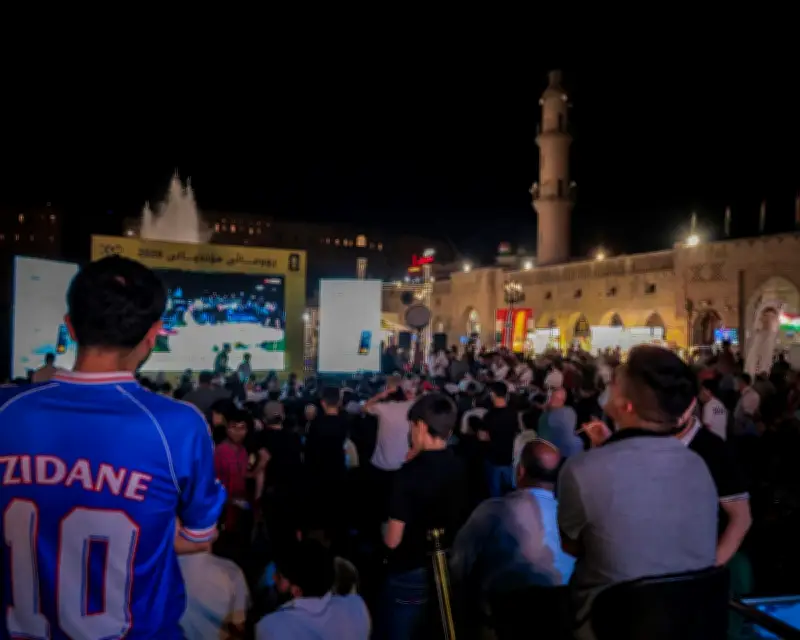
From crowded seaside cafes in Lebanon to air-conditioned restaurants in the Gulf, the booming voices of commentators like al-Khudhiri and Chaouali provide a soundtrack that heightens the drama. Clips of matches often go viral not just for the play but for the commentary, motivating even non-fans to watch. “Arabic has a classical science of eloquence, balagha, and a literary culture that has placed the poet at its centre since the pre-Islamic odes,” al-Kilani explained. “Commentary stepped into a seat that has already existed.”