Tabitha Arnold: The Socialist Textile Artist Weaving Labor Movement Narratives
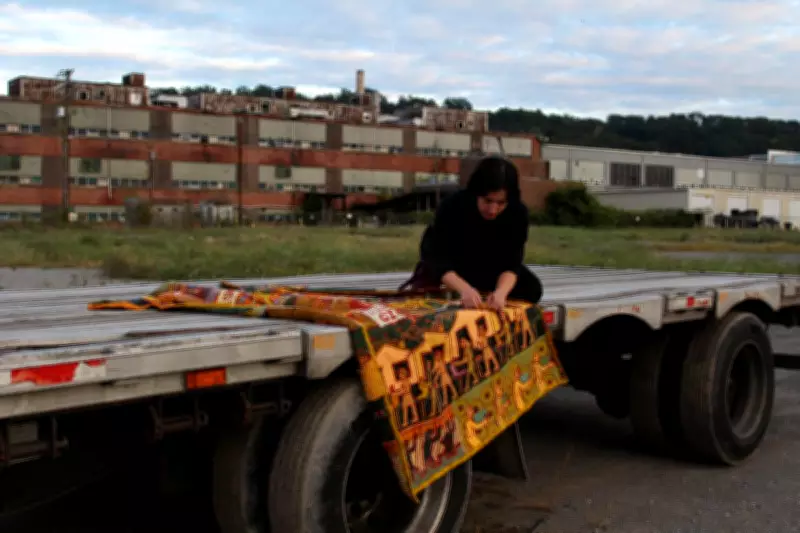
When Tabitha Arnold's exhibition Gospel of the Working Class opened in New York City's Chelsea gallery district last fall, the crowd defied typical art world expectations. Instead of older, affluent patrons, the space brimmed with twenty- and thirtysomethings adorned with Zohran Mamdani pins, Democratic Socialists of America hats, and SEIU T-shirts. This audience felt perfectly at home alongside Arnold's monumental handmade tapestries, which vividly portray working-class struggles from both recent and historical contexts.
Art as Organizing Tool
Arnold, a socialist and labor organizer based in Chattanooga, Tennessee, creates art specifically designed to reflect and inspire organizers and workers. In a cultural landscape saturated with narratives about extreme wealth, her pieces deliberately focus on the working people who constitute the 99%. Her dedication has earned significant recognition, including the 2025 Southern Prize for visual art, a prestigious MacDowell fellowship in 2023, and international exhibitions.
"I think of my work as being for labor organizers," Arnold explained. "I see it as being a source of encouragement for organizers, reflecting and validating what they're doing back to them." Her tapestries depict powerful scenes: textile workers carrying fabric bolts and wielding scissors while dodging bullets from strike-breakers, and angels walking behind autoworkers holding picket signs above hands grasping drills and tools.
From Barista to Artist-Organizer
Arnold's journey into labor politics began during her art studies in Philadelphia in the late 2010s. Working as a barista between classes, she discovered through a wage-transparency spreadsheet that her $8.50 hourly pay lagged behind colleagues' earnings elsewhere. A regular customer, the president of the local Teamsters unit, gave her his card, leading Arnold to participate in a union drive at her coffee shop. Although pandemic layoffs halted the effort, the experience proved transformative.
"I had these really transformative experiences going to picket lines, which is such a high-energy, ecstatic kind of experience," Arnold recalled. "But doing the union drive actually taught me about how much of the process is very boring, thankless, slow, difficult work. And so I had a lot of respect for what the process looks like, and I was interested in capturing it in my artwork."
Historical Context of Art in Social Movements
Julia Bryan-Wilson, a professor of art history and archaeology at Columbia University, emphasizes art's "vital role" in social movements throughout history. She cites Russian constructivism, where artists used abstract forms to communicate with illiterate peasants, and Chilean artists like Lotty Rosenfeld, who employed guerrilla graffiti against the Pinochet dictatorship. Arnold draws inspiration from muralist Diego Rivera's depictions of Mexican working-class society and the Palestinian poster movement's anti-imperialist messages celebrating farmers, workers, and teachers.
"Art not only provides crucial information, but sometimes it also can point to alternative futures," Bryan-Wilson noted. "I think that's one role that artists have, the critical role of imagining otherwise." She connects Arnold's work to 20th-century textile artists like Faith Ringgold, whose narrative quilts depict Black American experiences, and Hannah Ryggen, an anti-fascist tapestry maker in Europe.
Bryan-Wilson highlights textiles' unique suitability for labor commentary: "Textiles were at the heart of the Industrial Revolution and all of the many issues that arose with exploited bodies in systems of mass manufacturing." The connection between textile work and radical politics runs deep, she adds, noting that Friedrich Engels was politicized partly by witnessing conditions in Manchester's textile mills.
These Hands: A Tapestry for Workers
Despite historical overlaps between art and pro-worker movements, Arnold recognizes tension when her working-class tapestries appear in museums or elite spaces. This made her especially excited to unveil These Hands at a local union hall. The piece commemorates Tennessee Volkswagen organizing efforts with the United Auto Workers, featuring swirling images of autoworkers on assembly lines, literally holding up bridges that cars drive down, and carrying UAW picket signs, intertwined with religious imagery reflecting Arnold's Bible belt roots.
Arnold spent 224 hours creating the tapestry as a "meditation" on organizing, but felt nervous before revealing it to 200 Volkswagen workers and family members before a crucial union vote. "I didn't know what the workers would think about it, and I was kind of scared that they might think I was hijacking their really important moment," she admitted.
The moment was critical because two previous unionization attempts at the Tennessee plant had failed. Caleb Michalski, a plant employee, described harsh working conditions: "I've seen people cut and bleed and get yelled at by the supervisor for stopping their line. I've heard of people collapsing on the line, and the supervisor pushing their body out of the way so the line could keep running. That's our reality."
Artistic Impact and Labor Victories
Despite Arnold's fears, These Hands resonated powerfully at the IBEW Local 175 union hall in spring 2024. "All these people just kept grabbing me and wanting to tell me how much they loved it and how meaningful it was to them," she said. Michalski appreciated how the artwork "artistically demonstrates how working people are the drivers of the economy. Things exist because we make them. [Elites] make billions of dollars because of our blood, our sweat, our tears."
Less than a month after the tapestry unveiling, Volkswagen Tennessee workers made history by voting to join the UAW, becoming the first southern autoworkers outside of General Motors, Ford, and Stellantis to unionize—a significant achievement in a region historically resistant to unionization. Arnold felt "lucky" to play a small part in supporting workers with community solidarity.
Two years later, in February 2026, these workers secured another victory: a tentative agreement with Volkswagen guaranteeing 20% across-the-board wage increases, affordable healthcare, and real job security, later ratified by workers. Michalski, now a UAW-Volkswagen bargaining committee member, envisions a future union hall where Arnold's tapestry will hang centrally, providing ongoing inspiration.
"People feel seen and understood when they see themselves in an art piece. Otherwise, what they see subconsciously is that they're invisible and no one gives a damn about them," Michalski reflected. "I will always say: make more art, make more music, because our stories need to be told."