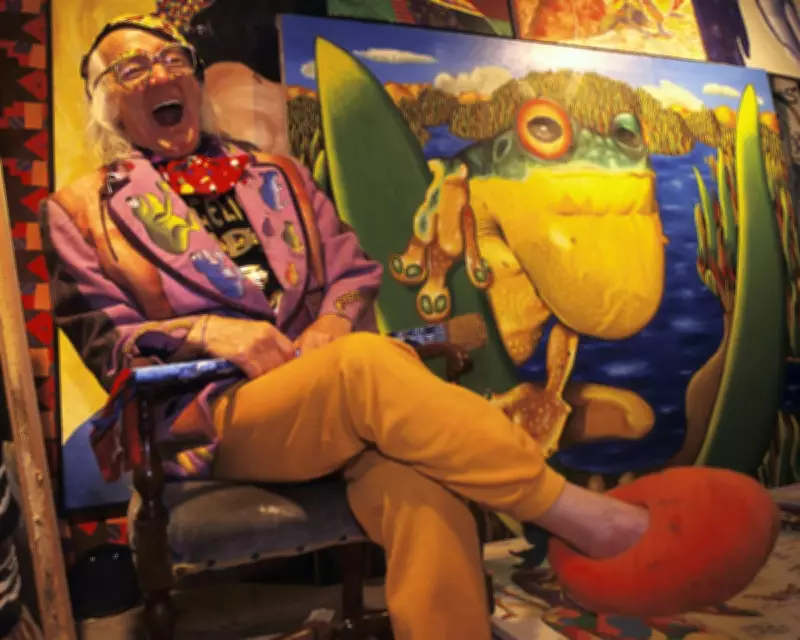
The Unforgettable Legacy of Harold 'the Kangaroo' Thornton
In 1983, visitors to the Archibald prize exhibition were captivated by a seven-foot painting titled Dr Brown and Green Old Time Waltz, a vibrant, psychedelic portrait of Greens leader Bob Brown. But the artwork was only half the spectacle; standing beside it was the artist himself, Harold "the Kangaroo" Thornton, clad in hand-painted attire, with painted false teeth and a walking stick he didn't need. Thornton, who proclaimed himself the "greatest genius that ever lived," was a relentless self-promoter, yet recognition eluded him throughout his life and continues to do so today.
A Life of Art and Myth-Making
Born in Enfield, Sydney, in 1915, Thornton's childhood was marked by hardship and bullying, which fueled his lifelong insecurities. Despite this, he found solace in painting, producing a prolific body of work that included murals, comic strips, and poems. His art, characterized by a mischievous sense of humor and surreal elements, never gained mainstream success, even as surrealism rose in popularity in Australia. Thornton's friend, artist Ken Done, once remarked, "Maybe he was ahead of his time, maybe he was behind his time. Maybe he was just on Harold Thornton's time."
Thornton's life was as extraordinary as his art. He was a professional wrestler, used a painted hearse for transportation, and starred in an early Peter Weir film. He owned a restaurant in Papua New Guinea, spent time in Moscow, and even painted a portrait of his father's corpse, locking himself in a room to complete it. Thornton loved tall tales, claiming that Paul McCartney and Jimi Hendrix stole his music and that he had died on an operating table and traveled as a ghost.
The Archibald Prize and Political Connections
Thornton was a three-time finalist in the Archibald prize, with his portrait of Bob Brown becoming his most notable work. The painting, now housed in the National Portrait Gallery in Canberra, was born from Thornton's involvement in the Franklin Dam blockade in Tasmania. There, he met Christine Milne, a future Greens leader, and Brown, who initially felt embarrassed by the halo in the portrait but now sees it as a historical record of Australia's environmental movement. Brown describes the work as having elements of Hieronymus Bosch, telling a whole story beyond a mere portrait.
Despite his efforts, Thornton struggled financially, often living in poverty and refusing to sell his art, believing it should remain accessible to the public. His stubbornness led to conflicts, such as when he exaggerated a mayor's red nose in a portrait, sparking a fight, or when he protested on the steps of an art gallery with a papier-mache head after a rejection.
Legacy and Remembering Thornton
Today, Thornton is better known in Amsterdam, where he lived for years, painting on the streets with a sign that read, "If you like Harold's art, Harold likes beer." A mural on The Bulldog cafe remains a tourist attraction. His nephew, Philip Thornton, and great-nephew, Chris Osborne, work to preserve his legacy, hoping for a dedicated gallery. Friends like Dale Trueman and Ken Done remember him fondly, with Done noting, "He was Harold, and he didn't give a fuck."
Thornton's prophecy that he would not be erased by death holds true; his vibrant, spellbinding paintings and unforgettable persona continue to inspire those who discover his story. As he once wrote, "I am told everybody dies. But not me."